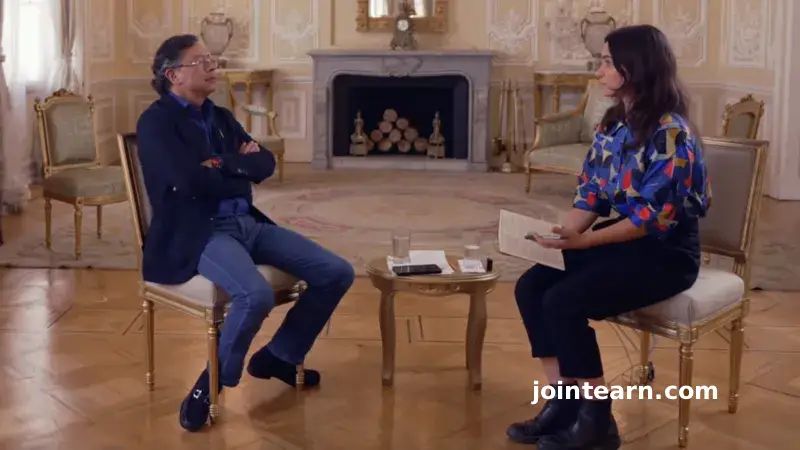
Colombian President Gustavo Petro has told the BBC that he believes there is a “real threat” of US military intervention in Colombia, following remarks by US President Donald Trump about potential action in the region. The warning comes amid heightened tensions over drug trafficking, immigration enforcement, and geopolitical influence in Latin America.
Petro accused the United States of treating other countries as part of a global empire and criticized the actions of US Immigration and Customs Enforcement (ICE) agents, saying they now act like “Nazi brigades.”
Background: US Threats Against Colombia
The tension escalated after Trump, following US operations in Venezuela and the capture of Nicolás Maduro, suggested a military operation targeting Colombia “sounds good.” He has repeatedly threatened Petro, prompting nationwide demonstrations in Colombia in support of sovereignty and democracy.
Petro described Trump’s remarks as a “real threat” and warned that continued US pressure risks isolating the United States from the world. He contrasted what he called the US “imperial dream” with the country’s current trajectory of aggressive enforcement and intervention.
“Instead of a United States dominating the world – an imperial dream – it is a United States isolated from the world. An empire was not built by being isolated from the world,” Petro said.
US Immigration Enforcement Criticized
President Petro strongly condemned ICE operations in the US, highlighting both their domestic and international impact:
- ICE has deported 605,000 people between January and December 2025.
- Approximately 1.9 million immigrants voluntarily left the US due to ICE campaigns.
- Around 65,000 people were in ICE detention as of November 2025.
Petro cited a recent fatal shooting by an ICE agent in Minneapolis, calling it an example of how the agency now targets not only Latin Americans but also US citizens.
“ICE has reached the point where it no longer only persecutes Latin Americans… it also kills United States citizens,” he said.
Colombia’s Response Strategy
Petro emphasized that Colombia prefers dialogue and diplomacy over military confrontation, though he pointed to the country’s history of resistance:
“It’s not about confronting a large army with weapons we don’t have. We rely on the masses, our mountains, and our jungles, as we always have.”
He also confirmed discussions with Venezuela’s acting president, Delcy Rodríguez, and reiterated that Colombia opposes covert operations targeting its sovereignty under the guise of anti-drug campaigns.
Drug Trafficking and Economic Context
Colombia, the world’s largest producer of cocaine, remains a critical hub for the global drug trade. It also has significant natural resources, including oil, gold, silver, emeralds, platinum, and coal.
Trump has accused Petro of tolerating cocaine production, claims the Colombian president strongly denied:
“For 20 years I have been fighting against the drug cartels, at the cost of my family having to go into exile… It has always been proven that I’m not involved.”
Petro’s administration has implemented a dual approach: pursuing peace negotiations with armed groups while conducting targeted military offensives against non-compliant organizations. He said this strategy has led to reductions in coca cultivation and homicide rates in southern Colombia.
Recent Diplomatic Developments
- Petro and Trump spoke by phone on Wednesday evening. Trump described the call as a “Great Honour” on his Truth Social platform, but Petro’s subsequent remarks suggest relations remain strained.
- Trump has also threatened US military action if further unrest occurs, prompting protests and public statements emphasizing Colombia’s sovereignty.
- The US continues to enforce sanctions and control Venezuelan oil sales while preparing for potential interventions in Latin America.
Regional and Global Implications
Petro warned that US interference in Colombia, Venezuela, and other Latin American nations risks escalating violence and undermining regional stability. He contrasted diplomatic dialogue and cooperation with the US’s history of unilateral actions, arguing for a more peaceful, law-based approach to international relations.
“The Venezuelan issue is about oil and coal, and if the US had remained committed to global agreements like the Paris Accord, there would be fewer wars and a more democratic relationship with South America,” he said.
The situation highlights the ongoing geopolitical tension in Latin America, where US military influence, drug trafficking, and domestic enforcement policies intersect with national sovereignty concerns.


Leave a Reply