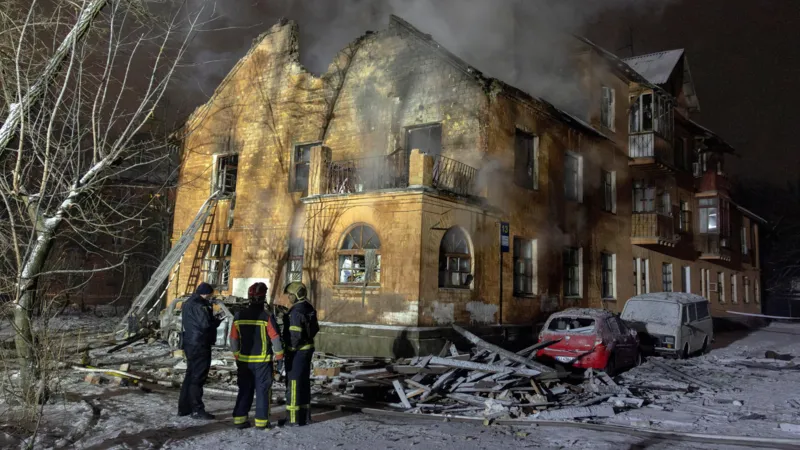
In a dramatic escalation of the ongoing conflict, Russia launched a large-scale missile and drone attack on Ukraine overnight, deploying the rarely-used Oreshnik ballistic missile. The strike resulted in multiple civilian casualties and significant damage to infrastructure in Kyiv and western Ukraine, including the city of Lviv near the Polish border.
Civilian Casualties and Damage in Kyiv
Kyiv bore the brunt of the assault, with four people killed and 25 others injured, according to local authorities. Among the dead was a paramedic responding to emergency calls, highlighting the deadly nature of what Ukrainian officials described as a “double-tap” strike.
Explosions were reported across several neighborhoods, including high-rise apartment buildings and residential blocks along the Dnipro River. The attack also caused power outages in multiple districts during an ongoing cold spell, with temperatures forecast to drop to -15°C (5°F) over the weekend.
Kyiv’s mayor, Vitali Klitschko, confirmed the severity of the attack, emphasizing the deliberate targeting of ordinary civilians. Ukrainian President Volodymyr Zelensky added that 13 ballistic missiles, 22 cruise missiles, and 242 drones were used in the strikes, some hitting energy facilities and even damaging a building at the Qatari embassy.
The Oreshnik Missile: Russia’s Rarely Used Weapon
The Oreshnik missile, used for only the second time since November 2024, represents a significant escalation in Russia’s arsenal. The first deployment targeted Dnipro last year.
- Type: Intermediate-range, hypersonic ballistic missile
- Range: Up to 5,500 km (3,417 miles)
- Warhead: Multiple independently targeted submunitions (MIRV) designed to fragment on descent, creating successive explosions
Videos circulated on social media showing bright flashes and explosions around Lviv, roughly 60 km (40 miles) from the Polish border. Ukrainian authorities confirmed that infrastructure in Lviv had been struck.
Ukrainian Foreign Minister Andrii Sybiha described the strike as a “grave threat to European security”, stressing that it was a direct challenge to the transatlantic community. He added that Russia’s missile attack was a retaliation for an alleged drone attack on Vladimir Putin’s residence in December 2025, which Ukraine denies carrying out.
Escalation of Energy Infrastructure Attacks
The targeting of energy facilities has become a recurring feature of the war. On Thursday night, multiple power plants and civilian infrastructure sites were hit, leaving thousands without heat or electricity amid winter conditions.
Ukraine has responded with strikes on Russian infrastructure, including the Belgorod region, where half a million people were left without power, and the city of Oryol, where Ukrainian attacks disrupted water and heating systems.
President Zelensky condemned the attacks as deliberately targeting civilians’ daily lives and called for accelerated restoration of electricity and heating across affected regions.
International Reactions
The EU has expressed skepticism over some of the reported attacks, while political figures like Donald Trump have questioned the veracity of the alleged strikes on Russian territory. Meanwhile, Ukrainian authorities and media have provided extensive documentation of the attacks, including videos of the explosions and damage.
How the Oreshnik Missile Works
The Oreshnik missile operates as follows:
- Rocket engines launch the missile into the upper atmosphere.
- The first stage is discarded.
- A MIRV bus carrying six warheads is released from the second stage.
- Thrusters position and direct each warhead toward separate targets.
- Warheads release, impacting multiple targets, while the main bus descends.
This technological capability allows Russia to strike multiple strategic points simultaneously, increasing the potential for both military and civilian damage.


Leave a Reply