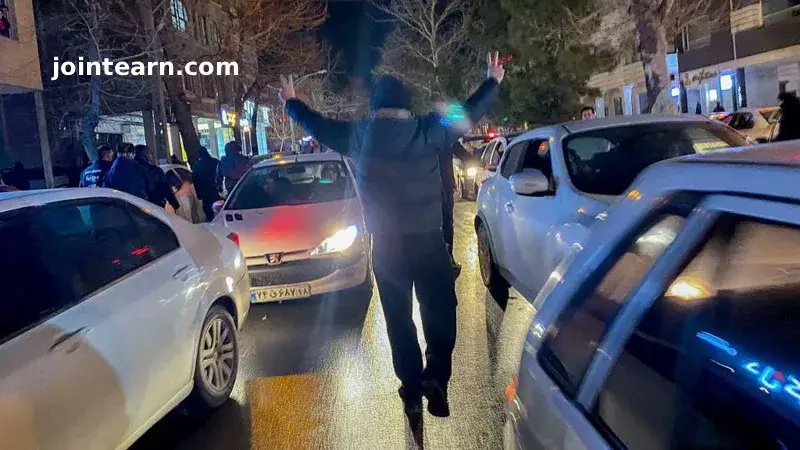
Iran is experiencing its largest anti-government protests in decades, with tens of thousands of demonstrators taking to the streets of Tehran and other cities. While security forces in the capital have shown uncharacteristic restraint, reports from smaller cities suggest a far more violent crackdown, highlighting a strategic, selective approach by the regime.
Protests Sweep Across Tehran and Provinces
Protests have engulfed dozens of districts in Tehran’s metropolitan area, home to nearly 16 million people. Observers noted that, for several hours, security units largely avoided direct confrontation in areas with particularly large crowds, prompting speculation that authorities may be deliberately holding back in symbolic locations to limit international backlash.
Outside Tehran, however, repression has been swift and deadly. Human rights organizations, including Hengaw and HRANA, report that over 40 people have been killed since the protests began nearly two weeks ago. BBC verification has confirmed at least 21 victims in provinces such as Lorestan, Illam, and Kermanshah, many from Kurdish-majority regions. Video evidence shows security forces firing directly at protesters, while at least four security personnel have also been killed.
Supreme Leader Khamenei Frames Protests as Foreign Sabotage
Iran’s Supreme Leader Ayatollah Ali Khamenei has issued stern warnings, declaring that the Islamic Republic “will not back down in the face of vandals.” He portrayed the demonstrations as foreign-inspired sabotage, suggesting that protesters were destroying property “just to please the president of the United States.”
The government’s framing underscores a long-standing narrative that Western powers, particularly the US, are behind unrest in Iran, and that domestic dissent is being manipulated to weaken the regime.
Trump’s Role in Tehran’s Calculations
US President Donald Trump has emerged as a key factor in the regime’s strategic calculations. Since the protests began, Trump has repeatedly warned Tehran of potential US retaliation if protesters are killed. In a recent interview, he stated that Iran would “get hit very hard” if mass killings similar to those in previous uprisings were repeated.
While Trump acknowledged that some deaths may be due to stampedes, he emphasized that Iranian authorities had been “told very strongly” where red lines lie. Analysts suggest that these warnings may be influencing Tehran’s decision to exercise restraint in Tehran proper, where international visibility is highest, while allowing more lethal enforcement in smaller cities.
Historical Context of Protest Suppression
Iran has a history of violent repression of large-scale protests. During the 2022 Mahsa Amini protests, human rights groups report that over 500 demonstrators were killed, with the Islamic Revolutionary Guard Corps (IRGC) and affiliated militias playing central roles in suppression.
The regime typically uses a layered security apparatus:
- Riot police handle initial crowd control.
- The Basij militia, a volunteer paramilitary force under IRGC control, often operates in plain clothes.
- In extreme unrest, command shifts from police to IRGC commanders, signaling that the situation is treated as a national security threat, not merely a civil disturbance.
This escalation often precedes mass arrests, lethal force, and harsh crackdowns.
Current Strategy: Restraint and Buy Time
The current protests suggest that the regime is deliberately buying time, aiming to exhaust demonstrators and limit visible casualties in Tehran to avoid provoking foreign intervention, particularly from the US. Iranian President Masoud Pezeshkian has called for tolerance of “legitimate protests,” but ultimate authority over security policy rests with Supreme Leader Khamenei.
Experts say the regime is attempting to balance repression with strategic restraint, ensuring that while dissent is controlled, the government does not cross thresholds that could trigger direct US military retaliation.


Leave a Reply