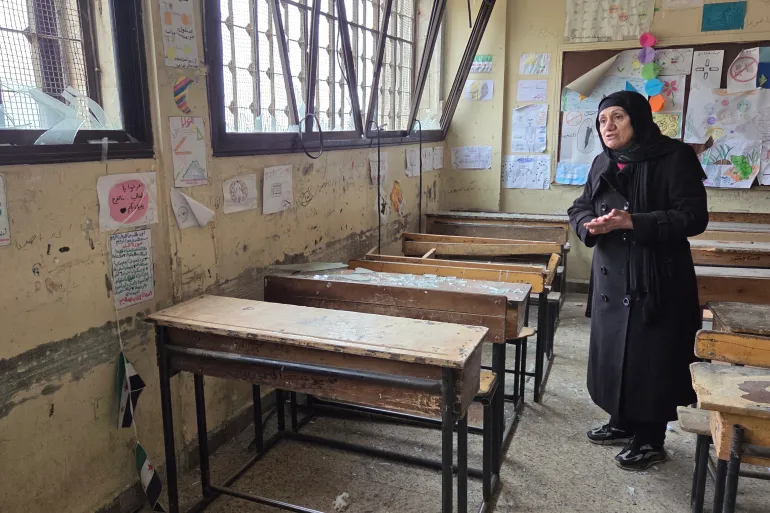
Aleppo, Syria – The classrooms of Qassem Amin School in Aleppo’s Ashrafieh neighborhood bear the scars of recent conflict: spent bullet casings scattered across floors, broken glass crunching underfoot, and desks used as makeshift barricades. Once a place of learning, the school’s playground became a frontline last week, caught in the crossfire between Kurdish-led Syrian Democratic Forces (SDF) and Syrian government troops.
SDF Occupation of School and Its Impact on Students
Ouafa Zein al-Dein, head teacher of Qassem Amin School, described how SDF fighters had taken control of part of the building months before the clashes. “It was very wrong, especially for the children,” Zein al-Dein said. She emphasized that the staff never interacted with the fighters and made sure students stayed away from the occupied areas.
On January 6, 2026, students were sitting for exams when the fighting erupted. Zein al-Dein immediately sent the children home, leaving classrooms empty and echoing with the aftermath of battle.
The Human Toll: Civilians Displaced
The neighborhoods of Ashrafieh and Sheikh Maqsoud, home to predominantly Kurdish populations, were the epicenters of the fighting. Over 155,000 residents fled these areas during the clashes. These neighborhoods had been under SDF control for a decade, creating a tense and delicate balance with the Syrian government.
Last year, the SDF agreed to merge with Syrian government forces following discussions between SDF leader Mazloum Abdi (also known as Mazloum Kobani) and Syrian President Ahmed al-Sharaa. The agreement aimed to integrate SDF-held areas under government control after the fall of Bashar al-Assad’s regime in December 2024. However, the integration process never materialized, leading to the intense fighting that occurred last week.
Syrian Army Secures Neighborhoods
The fighting ended only when SDF units agreed to withdraw to prevent further civilian casualties—a claim contested by both sides. Following their departure, Syrian government forces conducted security sweeps, searching for explosives, weapons, and prisoners previously detained during the SDF’s alliance with the former regime.
Residents have cautiously begun returning to Ashrafieh and Sheikh Maqsoud. Streets lined with concrete and breeze-block buildings are slowly coming back to life, though signs of damage remain. Abu Walid, a local shop owner, recounted an encounter with an SDF fighter who attempted to use his home for military purposes. “I asked him, ‘What about the lives of civilians?’ He told me it didn’t matter; what mattered is control,” Abu Walid said.
Long-Term Implications for Aleppo and Syria
While the Syrian army has regained control of key neighborhoods in Aleppo, the SDF continues to maintain a presence in northeastern Syria, regrouping units in rural areas east of the city. Analysts suggest that future clashes could occur as the SDF recalibrates its strategy and seeks to retain influence in northern Syria.
For Aleppo residents, the priority is rebuilding their communities, restoring schools, and ensuring children can return to education safely. Qassem Amin School stands as a symbol of resilience, a place scarred by conflict but ready to welcome students once more.
Conclusion
The recent clashes in Aleppo highlight the fragility of peace in Syria’s contested regions. With civilians returning and schools attempting to resume normal operations, the city faces the dual challenge of rebuilding infrastructure while navigating political and security complexities. The story of Qassem Amin School serves as a microcosm of Aleppo itself—a city striving to heal after years of conflict.
Keywords for SEO: Aleppo conflict 2026, SDF Syria, Syrian government forces, Aleppo schools, Ashrafieh neighborhood, Sheikh Maqsoud, Syrian army security, civilian return Aleppo, Qassem Amin school, post-conflict Aleppo.


Leave a Reply