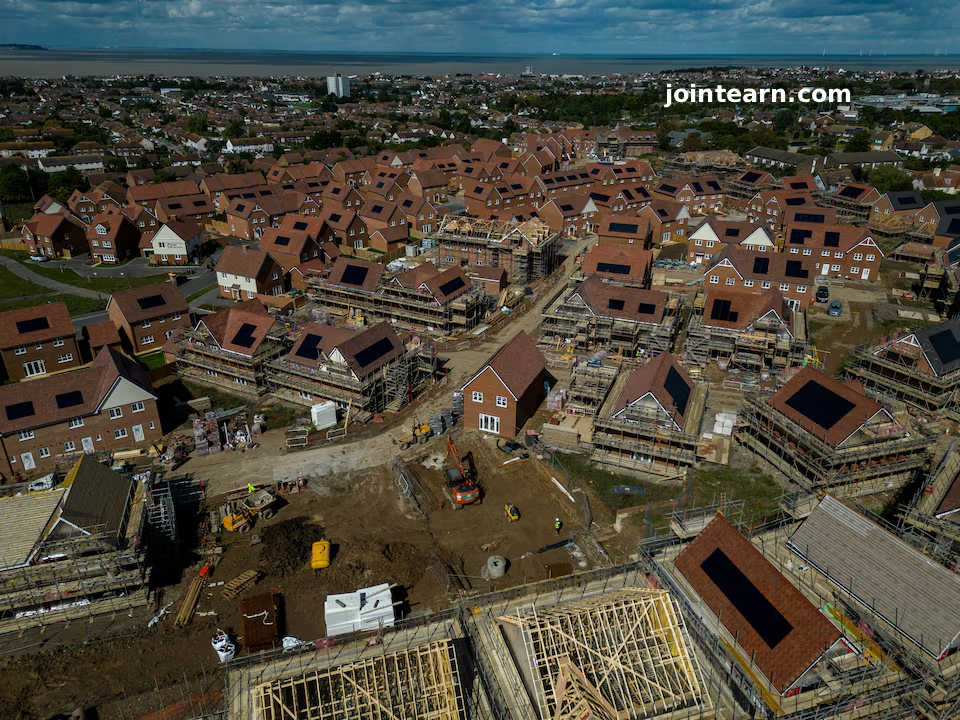
British homebuilder Vistry Group (VTYV.L) reported on Wednesday that its 2025 profit forecast fell below market expectations, driven by declining home sales and ongoing market uncertainties affecting private buyers and social housing contracts. The announcement sent Vistry shares down over 8% in early trade, leading losses on the FTSE Midcap index and adding pressure to London’s broader housing sector.
Vistry’s 2025 Performance and Forward Sales
The Kent-based construction firm revealed that home sales declined 9% in 2025, with the company selling approximately 15,700 homes, compared to 17,225 homes in 2024. Revenue remained broadly stable at £4.2 billion ($5.37 billion).
Vistry’s forward sales pipeline fell to £4 billion at the start of 2026, down from £4.4 billion a year earlier, reflecting ongoing softness in the private housing market. CEO Greg Fitzgerald highlighted that uncertainty around the UK government’s November budget delayed some partner-funded deals, adding pressure to near-term growth.
“The continued weakness in the private housing market, alongside budget uncertainty, has affected timing for some of our partner-funded contracts,” Fitzgerald stated.
Government Support and Social Housing Opportunities
Despite challenges, Vistry expects to benefit from government-backed housing programs, including the 10-year Social and Affordable Homes Programme, which provides grant funding to accelerate the construction of new social and affordable homes.
The company anticipates bidding under the programme in the first half of 2026, with early allocations expected by mid-year or early in Q3. Vistry also noted that ongoing support from local authorities, housing associations, and government partners helped sustain its sales despite private market weakness.
Profit Outlook and Analyst Expectations
Vistry now expects an adjusted profit before tax of around £270 million, slightly below analysts’ consensus of £272.6 million, according to LSEG data.
The firm remains cautiously optimistic, citing the potential positive impact of lower interest rates on private buyers. However, the company expects 2026 to remain weighted toward the second half of the year, albeit less dramatically than in 2025.
Analysts at Jefferies noted that while Vistry has solid long-term prospects, investors may require greater clarity on near-term forecasts and balance sheet strength before committing to the stock.
Market Context
The broader UK housing market has faced persistent challenges in 2025, including affordability pressures, higher borrowing costs, and economic uncertainties. Government initiatives such as multi-billion-pound affordable housing investments have helped support construction firms like Vistry, but private buyer demand remains subdued.
The recent decline in Vistry shares underscores market sensitivity to profit guidance, policy uncertainty, and forward-looking growth prospects, highlighting the challenges for mid-sized UK homebuilders navigating a complex housing landscape.


Leave a Reply