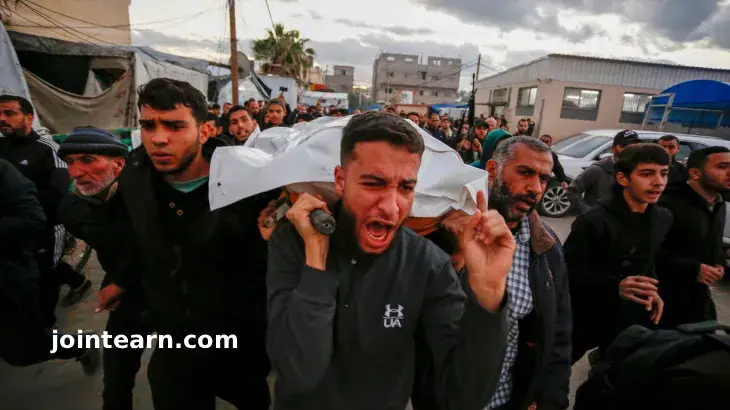
Gaza, January 15, 2026 – At least 10 Palestinians were killed across Gaza on Thursday, as the United States officially declared the launch of phase two of a 20-point ceasefire plan designed to end the ongoing conflict between Israel and Hamas. The deadly attacks coincided with continued violence across the war-torn enclave, highlighting the fragile state of the truce.
According to Gaza health authorities and local media, the Israeli military bombed multiple residential homes, including those belonging to the al-Hawli and al-Jarou families in Deir el-Balah. Among the casualties was a 16-year-old minor, bringing attention to the human cost of the conflict.
Israeli Strikes and Targeted Attacks
The Israeli military confirmed that one of the individuals killed, Muhammad al-Hawli, was a commander in the Qassam Brigades, Hamas’ armed wing. Al Jazeera correspondent Ibrahim al-Khalili reported from Gaza City that the attack reinforced Israel’s intent to define phase two of the ceasefire “on its own terms”.
Additional attacks were reported across Gaza, including:
- One person shot dead near Al-Alam roundabout, west of Rafah city.
- One casualty in an Israeli strike on a police post near Al-Nablusi Junction, southwest of Gaza City.
- Two deaths from an Israeli airstrike on the Al-Khatib family home in the Nuseirat refugee camp.
Hamas condemned the attacks as a “despicable crime” and accused Israeli Prime Minister Benjamin Netanyahu of violating the October ceasefire agreement.
Since the ceasefire began in October 2025, at least 451 Palestinians, including over 100 children, have been reported killed, while Israel has lost three soldiers in the same period.
US Declares Phase Two of Ceasefire Plan
The second phase of the US-mediated ceasefire plan, announced by Special Envoy Steve Witkoff, transitions from a basic ceasefire to demilitarization, technocratic governance, and reconstruction of Gaza. Key elements of phase two include:
- Full demilitarization of Gaza, focusing on disarming unauthorized personnel, including Hamas fighters.
- Creation of a 15-member National Committee for the Administration of Gaza, responsible for day-to-day governance.
- Deployment of an International Stabilisation Force to secure Gaza and train vetted Palestinian police units.
- Oversight by a US-proposed “Board of Peace”, expected to be led by Bulgarian diplomat Nickolay Mladenov, ensuring international supervision.
Ali Shaath, former deputy minister in the Ramallah-based Palestinian Authority, has been appointed to lead the technocratic committee, which is currently preparing in Egypt before entering Gaza. Shaath emphasized a focus on “brains rather than weapons,” indicating the committee’s governance would not rely on armed groups.
Humanitarian Crisis and Reconstruction Challenges
Despite the ceasefire, Gaza remains in a humanitarian emergency. With more than 2 million residents displaced and winter conditions worsening, many Palestinians are forced to live in damaged buildings or makeshift shelters.
Jorge Moreira da Silva, head of the United Nations Office for Project Services (UNOPS), described the situation as “inhumane” and called for accelerated reconstruction, warning that delays could worsen the crisis. He emphasized that rebuilding Gaza would require $52 billion, according to assessments by the World Bank, UN, and European Commission.
Shaath outlined plans to remove rubble, estimating 60 million tonnes of debris scattered across Gaza, including unexploded ordnance, dangerous waste, and human remains. Bulldozers are set to push rubble into the sea to create new land, highlighting the massive logistical challenge of reconstruction.
Hamas Response and Ceasefire Prospects
Hamas officials, including senior figure Bassem Naim, cautiously welcomed the establishment of the technocratic committee, describing it as “a step in the right direction.” The group signaled a willingness to transfer administrative control of Gaza, while emphasizing the need for international support to consolidate the ceasefire and rebuild infrastructure.
“This is crucial for consolidating the ceasefire, preventing a return to war, addressing the catastrophic humanitarian crisis and preparing for comprehensive reconstruction,” Naim said.
The Board of Peace, backed by the US, will work alongside the committee to ensure compliance with ceasefire obligations, monitor disarmament, and oversee reconstruction efforts, though key political and security questions, including Israel’s withdrawal from Gaza, remain unresolved.
The Toll of Conflict
Since October 7, 2023, when Israel launched a full-scale offensive, over 71,441 Palestinians have been killed, with widespread destruction across Gaza’s urban centers. The continuing violence underscores the fragility of ceasefire agreements and the urgency of international intervention to protect civilians and restore stability.
Al Jazeera correspondent al-Khalili noted that while the announcement of phase two provides hope on paper, the implementation on the ground remains limited, leaving hundreds of thousands of displaced Palestinians struggling to survive in unsafe and overcrowded conditions.
Moving Forward: International Oversight and Reconstruction
Phase two represents a critical opportunity to rebuild Gaza, provide humanitarian aid, and establish a functioning governance system independent of armed groups. Experts emphasize that effective international monitoring, funding, and enforcement are essential to prevent renewed violence and ensure the long-term viability of Gaza’s reconstruction.
The world is watching whether phase two can transform Gaza from a conflict zone into a stabilized region, or whether the underlying political disputes will perpetuate instability and suffering for its residents.


Leave a Reply