Minneapolis, Minnesota – January 15, 2026 – United States President Donald Trump has threatened to invoke the Insurrection Act, a rarely used federal law, to deploy U.S. military forces in Minneapolis, where protests have erupted following two shootings by federal Immigration and Customs Enforcement (ICE) agents within a single week. The president framed the measure as necessary to restore order, blaming “corrupt politicians” and protesters whom he described as “professional agitators and insurrectionists.”
“If the corrupt politicians of Minnesota don’t obey the law and stop the professional agitators and insurrectionists from attacking the Patriots of I.C.E., who are only trying to do their job, I will institute the INSURRECTION ACT… and quickly put an end to the travesty that is taking place in that once great State,” Trump wrote on social media Thursday.
Federal Shooting Incidents Spark Protests
The president’s warning comes a day after a federal agent shot and wounded a Venezuelan man in Minneapolis. According to the Trump administration, the agent was attacked with a shovel and broom handle while attempting to apprehend the man, who was allegedly in the U.S. illegally.
This incident inflamed tensions just a week after ICE agents fatally shot 37-year-old Renee Good, a U.S. citizen, in her car. Good, a mother of three, was controversially labelled a “domestic terrorist” by the administration, a characterization that sparked widespread outrage and prompted protests across Minneapolis and beyond.
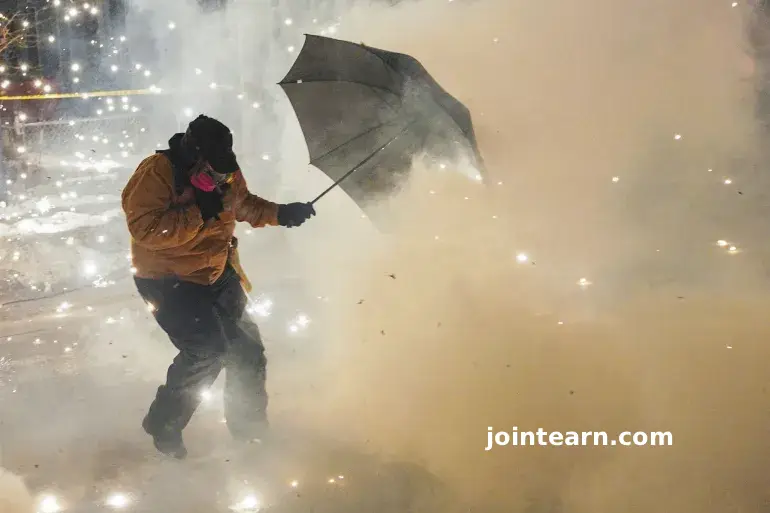
Smoke and tear gas filled the streets of Minneapolis on Wednesday night, as federal officers in gas masks confronted protesters who responded by throwing rocks and setting off fireworks.
Minneapolis Officials Respond
Mayor Jacob Frey described the situation as “unsustainable”, noting that the city faces the challenge of balancing public safety while managing federal forces.
“This is an impossible situation that our city is presently being put in, and at the same time, we are trying to find a way forward to keep people safe, to protect our neighbours, to maintain order,” Frey said.
Frey criticized the federal presence, describing it as a force five times larger than the city’s 600-officer police force, saying it has “invaded” Minneapolis and alarmed residents. Many locals reportedly urged the Minneapolis Police Department to take stronger action against ICE agents.
Police Chief Brian O’Hara also addressed the protests, urging crowds engaged in “unlawful acts” near the shooting scenes to disperse peacefully.
“We do not need this to escalate any further,” O’Hara said at a press briefing alongside Mayor Frey.
DHS Defends Federal Response
The Department of Homeland Security (DHS) stated that over 2,000 arrests have been made in Minnesota since early December as part of immigration enforcement operations. DHS officials defended the actions of ICE agents, claiming that both local leaders and protesters have encouraged resistance to federal law enforcement through “hateful rhetoric.”
The department also argued that agents have faced increasing assaults while carrying out detentions, framing the federal presence as necessary to ensure officer safety.
DHS continues to assert that it will not “back down” amid ongoing protests, signaling a potentially prolonged federal presence in Minneapolis.
Insurrection Act: Rare Federal Tool
The Insurrection Act allows the president to deploy U.S. military forces domestically to restore order during civil unrest or when local authorities are unable to maintain law and order. Trump has repeatedly threatened to use this law, raising concerns among legal experts and civil rights advocates about the use of military force on U.S. soil.
Historically, the law has been invoked sparingly, most notably during civil rights-era riots and in extreme cases of domestic insurgency. Critics argue that using the military in Minneapolis could escalate tensions and provoke further unrest.
Ongoing Tensions and Political Fallout
Minnesota Governor Tim Walz and Mayor Frey, both Democrats, rejected DHS accusations of encouraging resistance. The situation highlights federal-state conflicts over immigration enforcement and the broader debate about the use of federal power in domestic policing.
Protests in Minneapolis have drawn national attention, with activists, local residents, and legal experts warning that the combination of federal agents, ICE enforcement, and potential military deployment could lead to a serious escalation of violence.
Analysts note that the recent shootings, combined with Trump’s public threats, have made Minneapolis a focal point in the ongoing national debate over immigration enforcement, law enforcement accountability, and civil rights protections.


Leave a Reply