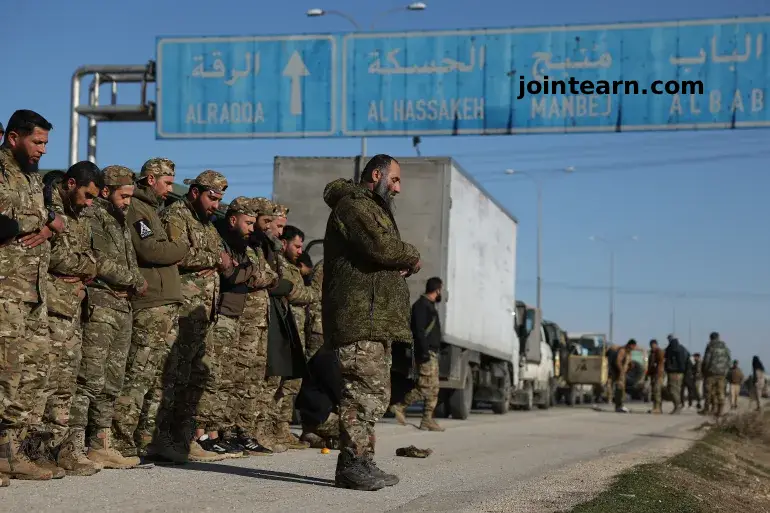
The Syrian army has ordered residents in parts of rural Aleppo governorate to evacuate as fears mount over a new front opening in the ongoing conflict between government forces and the Syrian Democratic Forces (SDF). The announcement comes after days of deadly clashes in Aleppo city, raising concerns of a widening conflict in northeastern Syria.
Humanitarian Corridor Opens for Civilians
Authorities declared a “humanitarian zone” in Deir Hafer and Maskana on Thursday, allowing civilians to leave safely between 9:00 a.m. and 5:00 p.m. local time (6:00–14:00 GMT). The Syrian army had previously classified the areas as closed military zones and reinforced its presence with additional troops, warning residents to evacuate immediately.
Al Jazeera correspondent Zein Basravi reported from Deir Hafer that heavily armed convoys and military vehicles were moving through the countryside, emphasizing the government’s commitment to retake areas under SDF control. “This represents more than a show of force,” Basravi said.
Escalating Conflict Between Syrian Army and SDF
Clashes between the Kurdish-led SDF, supported by the United States, and Syrian government forces have killed at least 23 people in Aleppo over the past week. The violence follows stalled negotiations over incorporating the SDF into Syrian state institutions, despite a March deal that promised integration.
A ceasefire announced on January 9 allowed some SDF fighters to leave Aleppo’s Ashrafieh and Sheikh Maqsoud neighborhoods and relocate to northeastern Syria, where the SDF operates a semi-autonomous zone.
The Syrian army is now demanding that SDF forces withdraw east of the Euphrates River, while limited skirmishes have erupted in Deir Hafer and Maskana. The government also accused the SDF of carrying out drone strikes in Aleppo city, including one that hit the governorate building on Saturday during a government press conference.
Meanwhile, the SDF claims the Syrian army has intensified attacks on civilian infrastructure and key facilities in Deir Hafer.
Turkish Response and Regional Implications
The conflict has drawn international attention, with Turkey closely monitoring developments due to the involvement of the Kurdistan Workers’ Party (PKK) and other Kurdish factions. Turkish Ambassador to Damascus Nuh Yilmaz visited Aleppo, urging all parties to uphold the March agreement and prevent further fighting.
“We are eagerly awaiting the implementation of the [March] agreement without the need for war,” Yilmaz said. Turkish Foreign Minister Hakan Fidan added that the SDF must demonstrate good faith and break the cycle of violence.
Civilian Perspectives
Civilians caught in the crossfire expressed frustration and fear. One Aleppo resident, Zuhair, told Al Jazeera, “We are desperate to flee, but there’s nowhere to go. Wherever you go, there is bombing. We want to be stable. We want to live. I swear, we’re tired.”
Syrian Government Releases SDF Fighters
In a separate move, the Syrian Interior Ministry released several dozen SDF fighters detained in the Sheikh Maqsoud neighborhood, stating they were not involved in criminal acts against civilians. Footage broadcast by Al Jazeera showed the fighters boarding buses after their release.
The government described the release as part of a broader policy “to open the doors of return for all those who have gone astray and have not committed crimes against civilians.”
President Al-Sharaa’s Statements on Kurdish Population
Syrian President Ahmed al-Sharaa praised the Kurdish people for their courage while criticizing the SDF for obstructing safe evacuation efforts and mediating ceasefires. An interview with Shams TV in Erbil was partially blocked due to the president’s hardline stance, though clips were aired on state television.
Al-Sharaa argued that the SDF’s refusal to facilitate civilian evacuations has complicated efforts by international mediators, including the United States and France, to stabilize the region.
Outlook for Eastern Aleppo
As the Syrian army consolidates its positions in Deir Hafer and Maskana, tensions remain high. Analysts warn that the renewed clashes could spark a broader confrontation between government forces and Kurdish-led factions, with significant humanitarian consequences for civilians in eastern Aleppo.
Authorities have emphasized that the humanitarian corridor will remain open for the safe evacuation of civilians, while the situation continues to evolve amid ongoing diplomatic and military pressures in the region.


Leave a Reply