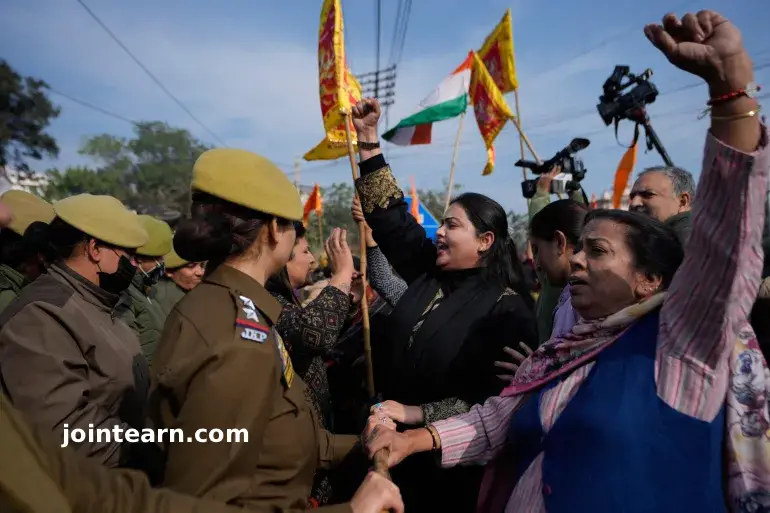
India has closed the Shri Mata Vaishno Devi Medical Institute (SMVDMI) in Reasi, Indian-administered Kashmir, following protests by right-wing Hindu groups over the admission of a majority of Muslim students into its inaugural MBBS batch. The decision has sparked widespread criticism and raised concerns about religion-based discrimination in Indian education.
Closure Following Protests
On January 6, 2026, the National Medical Commission (NMC), India’s federal regulatory body for medical education, revoked the recognition of SMVDMI. The closure followed weeks of demonstrations by Hindu groups who claimed that Muslim students had “no business” attending an institution founded by a Hindu religious trust and partly funded by the government.
The protests intensified after it was revealed that out of 50 students admitted in November 2025, 42 were Muslim, while seven were Hindu and one was Sikh. This marked the college’s first MBBS intake, launched under the supervision of the Mata Vaishno Devi Temple trust.
Students Caught in the Crossfire
Many students described the college as well-equipped and fully capable of offering high-quality medical education. Saniya Jan*, an 18-year-old from Baramulla, told Al Jazeera that gaining admission was a dream come true.
“My daughter has been a topper since childhood,” said her father, Gazanfar Ahmad*. “She really worked hard to get a medical seat, and everything seemed normal when we arrived at the college. The faculty was supportive, and it looked like no one cared about religion inside the campus.”
Other students echoed this sentiment, noting that SMVDMI offered better facilities than many government medical colleges, including multiple cadavers for hands-on anatomy study and modern labs.
Government and Political Responses
While the NMC cited deficiencies in teaching faculty, patient flow, and infrastructure as reasons for revoking the college’s recognition, analysts have questioned the timing and legitimacy of these claims. Zafar Choudhary, a political analyst in Jammu, said:
“Logic dictates that the infrastructure would have improved since classes started. The sudden declaration of deficiencies seems inconsistent, especially since admissions are based on merit through the National Entrance Examination Test (NEET), which is religion-neutral.”
The Bharatiya Janata Party (BJP), India’s ruling party, denied that the closure was about religion but supported the recognition of Hindu devotees’ “legitimate sentiments” regarding the temple trust. Altaf Thakur, a BJP spokesperson in Kashmir, told Al Jazeera:
“This college is named after Mata Vaishno Devi, and there are millions of devotees whose religious emotions are strongly attached to this shrine. The college recognition was withdrawn because NMC found several shortcomings. There’s no question of Hindus or Muslims being targeted.”
Meanwhile, Omar Abdullah, former chief minister of Kashmir, vowed that displaced students would not suffer academically. He announced plans to provide supernumerary seats in other medical colleges across the region to accommodate all 50 students affected by the closure.
“People generally fight to have a medical college in their midst,” Abdullah said. “Here, the fight was put up to have the medical college shut. You have played with the future of the students. If ruining their future brings you happiness, then celebrate it.”
Concerns About Communalizing Education
Educators and student leaders have expressed concern that the controversy could communalize the region’s education sector. Nasir Khuehami, head of the Jammu and Kashmir Students’ Association, warned that framing admissions along religious lines threatens meritocracy and social cohesion.
“Muslim-run universities across India enroll Hindus under minority quotas without controversy,” Khuehami said. “The narrative that students from a particular religion should be excluded from colleges run by another community is dangerous.”
Students like Saniya Jan are now left uncertain about their futures. “I appeared for a competitive exam, one of the hardest in India, and earned a seat at a medical college,” she said. “Now everything seems to have crashed. They turned our merit into religion.”
Broader Implications
The closure of SMVDMI raises questions about the intersection of religion, education, and politics in India, particularly in regions like Kashmir, which has a Muslim-majority population but is administered under federal oversight. Critics argue that the incident reflects ongoing pressures from right-wing Hindu groups and highlights the vulnerability of students whose academic opportunities may be compromised by identity politics.
With NEET-based admissions designed to be meritocratic and secular, the controversy exposes tensions between religious institutions, government regulators, and civil society over the governance and inclusivity of higher education in India.


Leave a Reply