London, January 16, 2026 — Five pro-Palestinian activists have pleaded not guilty to serious criminal charges relating to a break-in at a British military air base, in a case that has intensified debate in the United Kingdom over protest, national security, and the government’s stance on Israel’s war in Gaza.
The defendants are accused of illegally entering the Royal Air Force base at Brize Norton in central England in June and damaging two military aircraft as part of a protest against the UK’s military and political support for Israel.
Charges Linked to National Security Law
The activists face charges of damaging property for a purpose prejudicial to the interests or safety of the United Kingdom, a serious offence under UK law that carries potentially lengthy prison sentences.
The accused — Lewie Chiaramello, Jon Cink, Amy Gardiner-Gibson, Daniel Jeronymides-Norie, and Muhammad Umer Khalid — appeared at London’s Old Bailey court on Friday via video link from prison. All five entered not guilty pleas.
The court confirmed that the trial is scheduled to begin in January 2027, reflecting the complexity and sensitivity of the case.
Alleged RAF Brize Norton Incident
According to prosecutors, the group broke into RAF Brize Norton and spray-painted red paint over two Voyager aircraft, which are used by the British military for air-to-air refuelling and transport operations.
The act was presented by the prosecution as a deliberate attempt to disrupt military operations and draw attention to Britain’s involvement in Israel’s military campaign in Gaza.
The activist group Palestine Action, which has since been banned by the UK government, said it was responsible for organising the action.
Palestine Action and Government Proscription
Palestine Action, founded in 2020, describes itself as a direct-action movement opposing what it calls global complicity in Israel’s policies towards Palestinians. The group has frequently targeted defence companies and military infrastructure in the UK.
In July 2025, the UK parliament voted to proscribe Palestine Action as a terrorist organisation under the Terrorism Act 2000, making membership, support, or public endorsement of the group a criminal offence.
The ban came into effect shortly after the Brize Norton incident and has since become the subject of intense legal and political controversy.
Detention and Bail Decision
No applications for bail were made during Friday’s court hearing, despite bail being one of several demands raised by supporters of the activists.
In statements released through supporters, the defendants outlined a series of demands, including:
- Immediate release on bail
- Access to documents related to what they describe as a “targeted crackdown” on pro-Palestinian activism
- An end to restrictions on their communications
- The removal of Palestine Action from the UK’s list of proscribed organisations
- The closure of UK-based facilities operated by Israeli defence firm Elbit Systems
The court did not rule on any of these demands at the hearing.
Arrests and Legal Challenge
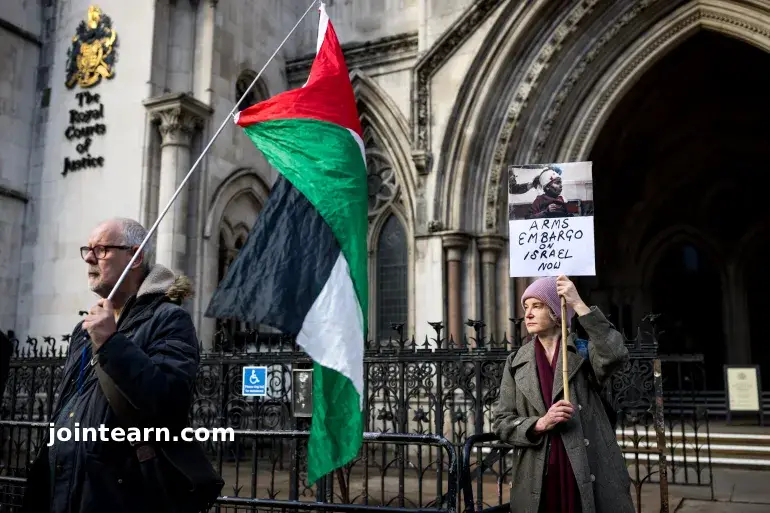
Since the proscription came into force, more than 1,600 arrests have reportedly been made in connection with alleged support for Palestine Action, according to campaigners. Many arrests involved individuals displaying placards or slogans opposing Israel’s military actions in Gaza.
Civil liberties groups, writers, artists, and human rights organisations have raised concerns about freedom of expression and protest, arguing that the ban risks criminalising political speech.
A legal challenge to the government’s decision to proscribe Palestine Action is currently working its way through the courts.
Broader Political Context
The case unfolds against the backdrop of growing public tension in the UK over the Gaza war, Britain’s arms exports to Israel, and the balance between national security and civil liberties.
Government officials have defended the proscription, arguing that direct action targeting military infrastructure poses unacceptable risks to public safety and national defence.
Supporters of the defendants, however, maintain that the actions were symbolic and aimed at preventing what they describe as UK complicity in violations of international law.
As the case heads toward trial, it is expected to become a landmark legal battle over protest rights, terrorism legislation, and the limits of dissent in modern Britain.


Leave a Reply