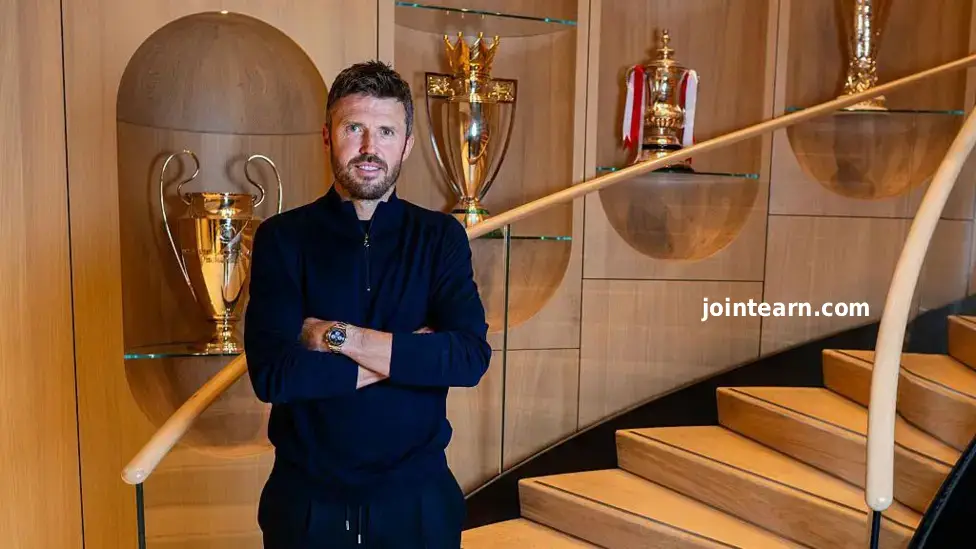
Manchester United has officially appointed Michael Carrick as head coach until the end of the season, presenting a unique challenge: how will the former United midfielder transform a team struggling for consistency into a Premier League contender?
Carrick’s coaching journey offers two distinct perspectives. On one hand, he briefly managed Manchester United as interim head coach, overseeing three games in 2021. On the other, he spent three years managing Middlesbrough in the Championship, where he implemented a structured, possession-based style. Now, with a five-month stint at Old Trafford, Carrick faces the delicate task of blending these approaches to achieve immediate results.
In this analysis, we examine the tactical principles, strategies, and player roles Carrick is likely to employ at Manchester United, drawing lessons from his past managerial experiences.
Carrick’s Adaptability: The Key to Early Success
Carrick’s first two fixtures as Manchester United’s head coach will be tough tests, facing the current Premier League leaders, Manchester City and Arsenal. These matches demand a tactical approach that is both pragmatic and flexible.
During his time at Middlesbrough, Carrick favored a possession-based 4-2-3-1 system, focusing on controlling the game rather than adapting radically to opponents. Conversely, in his 2021 stint as United interim boss, he demonstrated pragmatic adaptability, adjusting his system to counter specific threats. For instance:
- Against Chelsea, Carrick employed a 4-3-1-2 defensive shape to block central channels, limiting the influence of midfielders Jorginho and Ruben Loftus-Cheek.
- Scott McTominay and Fred played pivotal roles in tracking Chelsea’s wing-backs, while the remaining midfielders shifted to maintain balance.
- The result: a 1-1 draw, with Chelsea only scoring via penalty—a testament to Carrick’s effective in-game tactical tweaks.
This example highlights Carrick’s ability to adjust defensive structures, a skill likely to be crucial against Arsenal and Manchester City’s fluid attacking lines.
Potential Tactical Adjustments Against Top Teams
Against Manchester City
City’s wide threats, enhanced by Antoine Semenyo and the return of Jeremy Doku, may prompt Carrick to adopt a 4-5-1 defensive shape, focusing on space denial rather than high pressing. Quick transitions from defense to attack could exploit City’s occasional defensive vulnerabilities, particularly through fast breaks and wide play.
Against Arsenal
Liverpool’s recent success against Arsenal offers a potential blueprint: using a false nine to create midfield overloads and instructing wingers to man-mark roaming full-backs. Carrick could deploy similar tactics, with players like Bryan Mbeumo or Mason Mount exploiting space and disrupting Arsenal’s rhythm.
What ‘Carrick’s United’ Might Look Like
Carrick’s Middlesbrough sides demonstrated that formation flexibility is as important as player quality. While a 4-2-3-1 shape was standard on paper, his team often transitioned into a 3-2-5 attacking structure, depending on possession and phase of play.
Key characteristics included:
- Short build-ups from the goalkeeper, involving two central midfielders and four defenders for controlled possession.
- Fluid attacking rotations, where full-backs and wingers alternated positions to create width and overload central areas.
- Quick transitions from possession, exploiting defensive lapses with direct attacking play.
The main limitation in Middlesbrough’s setup was predictability and occasional defensive gaps. However, at Manchester United, superior player quality—including Lisandro Martinez, Bruno Fernandes, and Kobbie Mainoo—can enhance pace and efficiency, addressing these shortcomings.
Line-Up Illustrations: Potential Formations
Carrick’s tactical versatility can be visualized through multiple formations:
- 4-2-3-1 – Base formation, controlling midfield possession and maintaining defensive balance.
- 3-2-5 on the ball – Aggressive attacking structure, with wide and central players interchanging to overload opposition defense.
- 4-4-2 out of possession – Compact defensive shape, blocking central channels and limiting counterattacks.
These formations emphasize positional flexibility, allowing Carrick to leverage players’ strengths while keeping opponents guessing.
Building on Amorim’s Foundations
Rather than implementing radical change, Carrick may opt to build on Ruben Amorim’s system used before his departure. For example, goalkeeper Senne Lammens might continue to favor long passes, while full-backs could drop into the backline during attacks, forming a five-man defensive structure—similar to tactics seen at Middlesbrough.
Carrick’s ability to combine structured principles with player creativity will be vital in bridging the gap between Championship-level organization and Premier League demands.
Conclusion: A Solid Tactical Base for Manchester United
In essence, Carrick’s vision for Manchester United revolves around high-possession, flexible attacking play, coupled with compact defensive structures. His approach—if successfully communicated and drilled—offers a tactical foundation that can stabilize United during a period of uncertainty.
With adaptability, clear principles, and the right player utilization, Carrick has the potential to turn Manchester United into a team capable of challenging the top of the Premier League table.


Leave a Reply