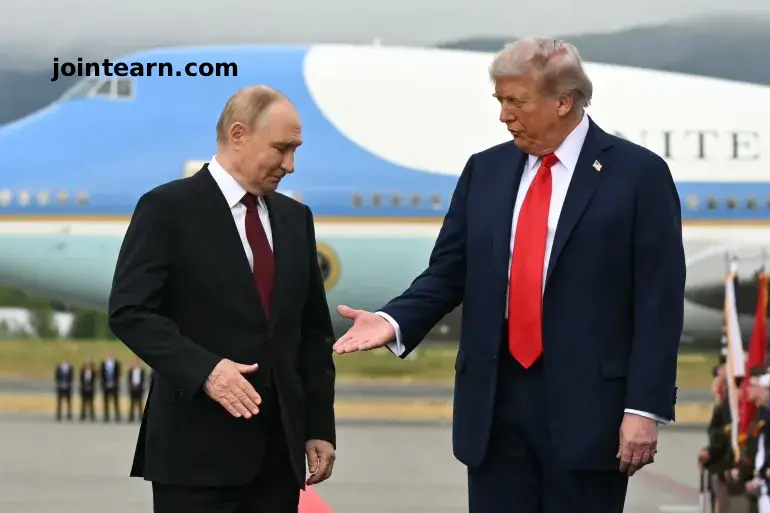
US President Donald Trump has invited Russian President Vladimir Putin to join a proposed international “board of peace”, an initiative the White House says is aimed at resolving major global conflicts and overseeing postwar governance and reconstruction in Gaza.
The invitation, revealed on Monday, comes at a time when Russia’s nearly four-year war in Ukraine continues with no comprehensive peace agreement in sight—raising questions among analysts about the credibility and geopolitical implications of Moscow’s potential inclusion in such a body.
Kremlin Confirms Invitation, Seeks Clarification
The Kremlin confirmed that Putin had received the invitation, though it stopped short of indicating whether Russia would accept.
“President Putin also received an invitation to join this board of peace,” Kremlin spokesman Dmitry Peskov told reporters.
He added that Moscow was seeking to “clarify all the nuances” of the proposal with Washington.
No timeline has been provided for a Russian decision, and US officials have yet to publicly explain how Russia’s role would align with the board’s stated objectives.
Gaza ‘Board of Peace’: A Broader Global Mandate
The “board of peace”, chaired by Trump himself, is expected to implement a 20-point plan aimed at ending Israel’s war on Gaza and managing post-conflict governance, security, and reconstruction.
While Gaza is the central focus, the initiative appears to carry a broader mandate, positioning itself as a forum for resolving entrenched international conflicts. Invitations have reportedly been extended to leaders and former leaders from Europe, the Middle East, and beyond.
Among those named in previous announcements are:
- Tony Blair, former UK prime minister
- Jared Kushner, Trump’s son-in-law and former Middle East envoy
- Leaders from Turkiye and Egypt, including President Recep Tayyip Erdogan and President Abdel Fattah el-Sisi
Belarusian President Alexander Lukashenko, a close ally of Putin, has also reportedly been invited.
Ukraine War Looms Over the Proposal
The invitation to Putin has drawn scrutiny given Russia’s continued military campaign in Ukraine, which began with its full-scale invasion in February 2022.
Trump had repeatedly claimed during his campaign that he could end the war within 24 hours of returning to office. However, while limited negotiations have taken place, the conflict has devolved into a war of attrition, with peace talks stalling again in recent months.
Analysts note that including Russia in a peace-governance body—while it remains engaged in an unresolved war—risks undermining the board’s legitimacy.
Russia’s Shifting Middle East Position
For years, Moscow sought to balance relationships across the Middle East, maintaining ties with Israel, Arab states, and Palestinian factions. That posture has shifted significantly since the start of Israel’s more than two-year war on Gaza.
Russia has increasingly distanced itself from Israel while strengthening relations with Iran and Gulf Arab states, a move analysts attribute to Moscow’s growing isolation from the West due to the Ukraine war.
The Kremlin has repeatedly criticised Israel’s actions in Gaza, framing the conflict in humanitarian terms.
“The Gaza Strip is experiencing a humanitarian catastrophe in the full sense of the word,” Putin said in May during a meeting with Palestinian Authority President Mahmoud Abbas, according to RIA Novosti.
“Russia, as a friend of the Palestinian people, is trying to provide regular assistance,” he added.
Putin Praises Trump’s Conflict-Resolution Efforts
Despite tensions between Russia and the United States, Putin has previously spoken positively about Trump’s diplomatic ambitions.
In October, the Russian leader praised Trump’s efforts to resolve long-running international crises:
“He’s really doing a lot to resolve these complex crises, which have lasted for years, even decades,” Putin said.
Referring specifically to the Middle East, he added:
“If we succeed in achieving everything Donald has strived for, it will be a historic event.”
Criticism of the ‘Board of Peace’ Structure
Despite the White House’s framing, the proposed three-tier governance model for Gaza has faced sharp criticism from experts and humanitarian groups.
Under the plan:
- Top decision-making authority would rest with Trump and senior international figures
- Regional and international actors would occupy the second tier
- Palestinians would be relegated to a third tier, responsible mainly for municipal administration
Critics argue the structure marginalises Palestinian political agency and risks imposing a commercialised, neocolonial governance model under foreign oversight.
A Controversial Diplomatic Gamble
Trump’s decision to invite Putin highlights his unconventional approach to diplomacy—one that prioritises personal relationships and high-profile deal-making over traditional multilateral frameworks.
Whether the “board of peace” can achieve tangible results remains unclear, particularly as it seeks to address the Gaza crisis while navigating unresolved wars, regional rivalries, and growing global scepticism.
As the Kremlin weighs its response, the proposal underscores the complex entanglement of the Gaza war, the Ukraine conflict, and shifting global power dynamics in 2026.


Leave a Reply