As the Syrian government regains control over energy hubs and strategic infrastructure in the country’s northeast, the battle for territory is giving way to a far more complex challenge: rebuilding trust, managing local power dynamics, and transforming military gains into lasting national unity.
Syria’s Northeast: Where Energy, Politics and History Converge
On the expansive plains of eastern Syria, where the Euphrates River winds through oil-rich soil and war-scarred towns, history has always been written through power—both political and literal. The oil fields of al-Omar, the gas facilities of Conoco, and the massive Tabqa Dam are not merely assets; they are symbols of sovereignty, survival, and the long struggle to reunify a fractured state.
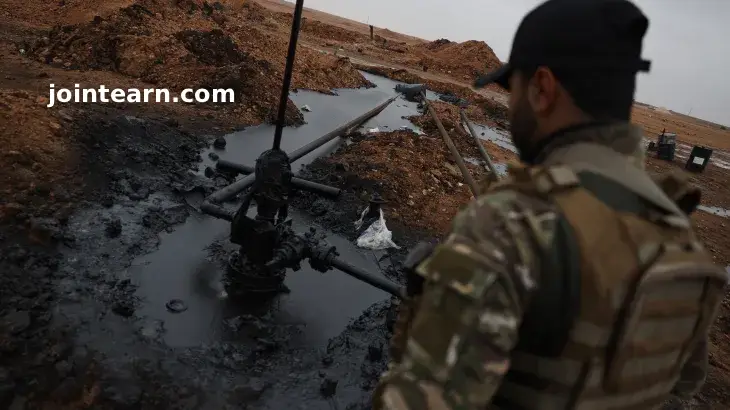
Over the weekend, Syrian government forces seized control of all three sites—al-Omar oilfield and Conoco gas complex in Deir Az Zor, and the Tabqa Dam in Raqqa governorate. While officials framed the operation as a decisive military achievement, its implications reach far beyond the battlefield.
This moment reshapes Syria’s political economy, alters the balance between the central state and former autonomous actors, and tests the fragile agreements meant to bring an end to more than a decade of fragmentation.
A Turning Point for the Syrian Democratic Forces
The Kurdish-led Syrian Democratic Forces (SDF), which had controlled much of northeastern Syria for years, quickly recognised the gravity of the shift. By Sunday evening, President Ahmed al-Sharaa announced a deal with the SDF that would allow Syrian state institutions to re-enter the eastern and northeastern governorates of Hasakah, Deir Az Zor and Raqqa.
For the first time since 2013, Syria now stands largely unified under a single central authority—a milestone that analysts describe as historic, even if fragile.
Energy as the Backbone of Syria’s Recovery
Before the war erupted in 2011, oil and gas accounted for nearly 20 percent of Syria’s GDP. As the conflict intensified, energy resources became the backbone of a fragmented war economy, exploited by armed factions, militias, and even ISIL.
Reclaiming these fields is therefore not symbolic—it is essential.
“Al-Omar, Tabqa and Tishreen are pivotal for economic recovery,” said Labib al-Nahhas, director of the Syrian Association for Citizens’ Dignity. “Not just because of oil and gas, but because they will have a huge impact on prices and living conditions.”
However, experts caution against expectations of immediate economic relief.
“These fields require massive international investment,” said Radwan Ziadeh of the Arab Center Washington DC. “On their own, they cannot deliver recovery. But politically, this is a crucial step toward national unification.”
The March 2025 Agreement: Promise and Breakdown
In March 2025, SDF commander Mazloum Abdi signed a framework agreement with al-Sharaa aimed at integrating the SDF into state institutions while preserving Kurdish rights and local governance.
At the time, Abdi described the deal as a “real opportunity to build a new Syria,” stressing there would be “no armies outside the state.” Al-Sharaa, meanwhile, emphasised state sovereignty first, a difference in interpretation that would later strain the agreement.
By late 2025, implementation stalled. Administrative disputes, territorial disagreements, and shifting alliances opened the door for Syrian army advances into SDF-controlled areas.
Tribal Politics: The Decisive Factor
While international diplomacy shaped the background, local tribal dynamics proved decisive on the ground.
Arab tribes in Deir Az Zor and Raqqa—long dissatisfied with Kurdish-led governance—had grown increasingly frustrated with delays in implementing the March agreement. Damascus capitalised on this discontent, courting tribal leaders and offering reintegration into state structures.
At a January 17 meeting of tribal elders, sheikhs warned that failure to honour agreements could destabilise the region. Soon after, tribes actively pushed the SDF out of their areas.
“Areas south of Hasakah are now free of SDF forces,” a source from the Syrian Tribal Forces told Al Jazeera.
In northeastern Syria, loyalty is often transactional. Control follows whoever can provide security, services, and economic stability—and for now, that appears to be Damascus.
Shifting Regional and International Winds
The unravelling of SDF control was accelerated by changing geopolitical realities.
The United States, once the SDF’s main military backer, narrowed its role to counter-ISIL operations, effectively removing enforcement power behind Kurdish autonomy. This opened space for Damascus to reassert authority east of the Euphrates.
Turkiye, long opposed to any form of SDF self-rule, openly supported al-Sharaa’s moves. President Recep Tayyip Erdogan welcomed the latest deal, reinforcing regional alignment behind Syrian territorial unity.
The result was not just a military defeat for the SDF, but a loss of financial independence and political leverage.
Energy and Water: Tools of State Authority
Control of the Tabqa Dam, Syria’s largest hydroelectric facility, may prove as consequential as the oilfields. The dam regulates electricity and irrigation across large swathes of northern and eastern Syria, directly affecting hospitals, agriculture, industry and daily life.
Yet infrastructure alone is not enough.
Years of war have left facilities damaged, undermaintained, and operating far below capacity. Turning reclaimed assets into functioning pillars of the state will require transparent governance, international financing, and technical expertise.
No Immediate Oil Windfall
Economist Mohamad Ahmad of Karam Shaar Advisory Limited warns that expectations of rapid economic gains are unrealistic.
“Production at al-Omar has collapsed to around 14,200 barrels per day,” he said, compared to nearly 90,000 barrels per day before the war. Reservoirs are stressed, infrastructure damage exceeds $800m, and rehabilitation will take years.
“What was once Syria’s flagship oilfield has become a symbol of the war’s devastation,” Ahmad said.
Social Transformation and Uncertain Futures
As the government advances eastward, communities are being reshaped. Thousands have been displaced from Aleppo, Raqqa and Tabqa. Kurdish civilians face the tension between promised citizenship rights—restored by presidential decree on January 16—and the erosion of political autonomy.
Arab tribes are recalibrating alliances. For groups such as al-Ukaidat, al-Bakara, Shammar, Bani Khalid and al-Jabour, survival depends on aligning with whoever governs effectively.
The social contract, long fractured, is being renegotiated in real time.
Unity Achieved, Stability Not Guaranteed
For the first time in more than a decade, Syria is largely unified under one government. Analysts say that the inclusion of Kurdish rights within the state framework elevates this moment beyond a military victory.
“This is the first time we are seeing a unifying government in Syria,” Ziadeh said. “That is the most important takeaway.”
Yet unification remains fragile.
Economic hardship, lingering distrust, and foreign influence continue to shape realities on the ground. Whether Syria’s leadership can convert reclaimed oil fields, gas plants and dams into inclusive governance, tangible improvements, and durable peace remains the defining question.
In Syria, the Euphrates has witnessed empires rise and fall. Today, it once again marks the line between fragmentation and unity—its waters flowing through a nation cautiously testing whether power, in all its forms, can finally bind the country back together.


Leave a Reply