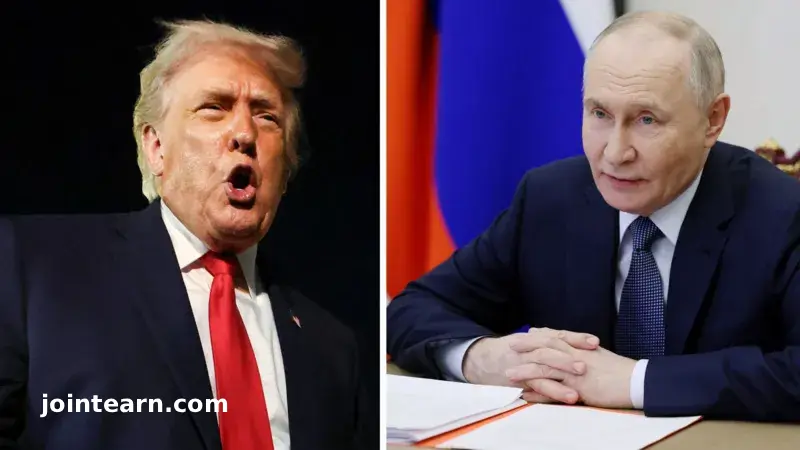
President Donald Trump has confirmed that he extended an invitation to Russian President Vladimir Putin to join a US-proposed Gaza “Board of Peace”, part of his controversial 20-point plan to end the Israel-Hamas war. The initiative is designed to temporarily oversee the administration of Gaza and coordinate its reconstruction and humanitarian aid efforts.
The Kremlin acknowledged on Monday that Putin had received the offer, but neither Moscow nor Washington has confirmed whether the Russian leader has accepted.
The Purpose of the Board of Peace
The Board of Peace is envisioned as a high-level international body made up of world leaders, with Trump serving as its chairman, according to the White House. The board’s mission is to ensure effective governance, investment, and reconstruction in Gaza, following a prolonged period of conflict between Israel and Hamas.
The board consists of two senior components:
- Gaza Executive Board – Responsible for on-ground operations, including infrastructure repair, aid distribution, and temporary governance.
- Founding Executive Board – Focused on investment, diplomacy, and strategic decision-making, with members including Tony Blair, US Secretary of State Marco Rubio, and Trump’s son-in-law Jared Kushner.
So far, no Palestinian representatives have been included on either board, a point that has drawn criticism from Israel and Palestinian advocates alike.
Global Responses to Invitations
Trump has invited several world leaders to participate in the board. Responses so far have been mixed:
- Hungarian Prime Minister Viktor Orban, a Trump ally, has accepted the invitation.
- Morocco’s King Mohammed VI has also agreed to join.
- French President Emmanuel Macron declined membership, prompting Trump to threaten 200% tariffs on French wine and champagne imports.
A source close to Macron called the tariff threats “unacceptable and ineffective”, while also confirming that Macron offered to organize a Group of Seven (G7) meeting including Russia, Ukraine, Denmark, and Syria.
Trump posted a screenshot of Macron’s message on Truth Social, in which the French president proposed:
“Let us have a dinner together in Paris on Thursday before you go back to the US.”
Putin’s Potential Role
The invitation to Putin comes at a delicate moment in international politics. Russia has yet to accept any US-backed peace deal aimed at ending its four-year military involvement in Ukraine. Kremlin spokesperson Dmitry Peskov said on Monday:
“Moscow is currently studying all details of this offer. We hope to be in touch with the US to clarify all aspects of it.”
Trump confirmed the invitation in Florida, stating:
“Yes […] these are world leaders. The answer is yes, I did.”
The inclusion of Putin would mark a major step in engaging Russia diplomatically in the Middle East, while also raising questions about the geopolitical implications of US-led reconstruction efforts in Gaza.
Controversy Surrounding the Board
Israel has expressed objections to Trump’s board, emphasizing that it was not consulted on the composition or responsibilities of the two senior boards. Critics argue that the absence of Palestinian representatives and direct Israeli involvement could undermine the board’s legitimacy and effectiveness.
Reports indicate that Trump aims to formally ratify the board during a special ceremony at the World Economic Forum in Davos, Switzerland, later this week.
Additionally, Bloomberg reported that Trump has requested countries to contribute $1 billion (£745 million) to join the board, although the White House has suggested participation could be flexible.
Broader Implications
The proposed Gaza Board of Peace highlights several ongoing global challenges:
- Balancing international involvement with local legitimacy, particularly given the lack of Palestinian representation.
- Integrating major world powers, including Russia, into conflict resolution efforts in the Middle East.
- Navigating economic diplomacy, as demonstrated by Trump’s tariff threats toward France.
- Addressing the humanitarian crisis in Gaza, where infrastructure destruction and civilian suffering remain severe following the Israel-Hamas conflict.
The initiative underscores the Trump administration’s approach to high-profile global diplomacy, combining incentives, pressure tactics, and direct engagement with world leaders.
Key Takeaways
- President Trump has invited Vladimir Putin to join the US-led Gaza Board of Peace.
- The board is designed to temporarily oversee Gaza’s administration and reconstruction.
- So far, Hungary and Morocco have accepted, while France has declined, prompting tariff threats.
- Israel has voiced objections, citing a lack of consultation.
- The board may be formally ratified at Davos, and membership could involve financial contributions from participating countries.
- The initiative remains controversial due to geopolitical tensions, absent Palestinian representation, and ongoing humanitarian concerns in Gaza.


Leave a Reply