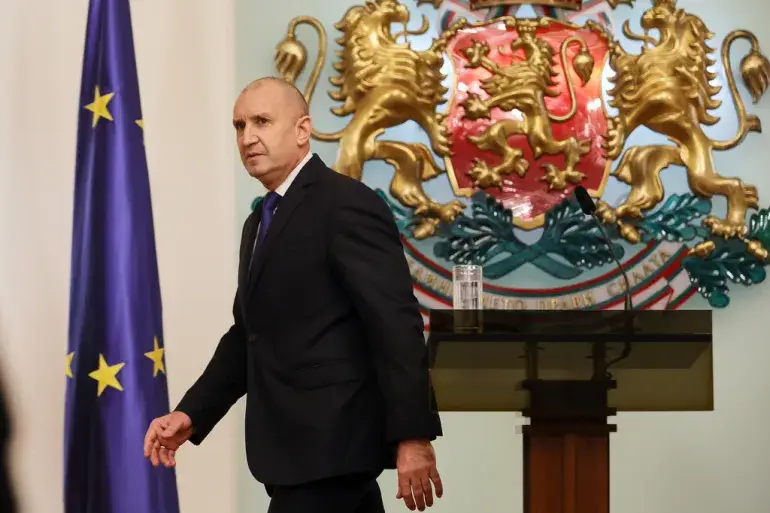
Sofia, Bulgaria – Bulgarian President Rumen Radev has announced that he will resign from office, a historic decision that has intensified speculation he plans to form his own political party and contest upcoming snap parliamentary elections expected later this year.
In a televised address on Monday, the 62-year-old head of state confirmed that he would formally submit his resignation to Bulgaria’s Constitutional Court on Tuesday. If the court approves the request, Vice President Iliana Iotova will assume the role of interim president in line with the country’s constitution.
“Today, I am addressing you for the last time as president of Bulgaria,” Radev said, adding that he was ready to take part in what he described as a decisive “battle for the future of the country.”
First Presidential Resignation in Post-Communist Bulgaria
Radev’s decision marks the first resignation by a Bulgarian president since the end of communist rule, underscoring the severity of the country’s ongoing political turmoil. Bulgaria, a member of both the European Union and NATO, has been mired in instability for years, with frequent elections and short-lived governments failing to produce lasting political consensus.
The president’s move comes amid a deepening crisis following the collapse of the most recent governing coalition in December, after weeks of large-scale anticorruption protests swept the country. Radev, a former Air Force general with a left-leaning political profile, was a vocal supporter of the demonstrators.
Bulgaria Headed for Eighth Election in Five Years
Efforts to form a new government within the current parliament have since failed, making another snap election all but inevitable. The upcoming vote will be Bulgaria’s eighth parliamentary election since 2021, a reflection of persistent deadlock between rival political forces.
The outgoing coalition was led by the centre-right GERB party, whose government collapsed under public pressure over allegations of corruption and governance failures. GERB leader Boyko Borissov, a former prime minister, has long been one of Radev’s fiercest political rivals.
Speculation Grows Over New Political Party
Although Radev did not explicitly confirm his future plans, political analysts widely expect him to launch a new political movement ahead of the elections. His second presidential mandate was due to expire in 2026, but his early resignation clears the way for him to enter electoral politics directly.
When asked recently about forming a party, Radev said Bulgaria needed a political force that could “unite all democrats – left and right,” including citizens who have become disillusioned with traditional parties.
“Because we all need fair elections and democratic, free development,” he said.
Opposition to Powerful Political Figures
Radev has positioned himself as a staunch opponent of entrenched political and business interests. He has repeatedly criticised Delyan Peevski, a powerful politician and media mogul who has been sanctioned by the United States and the United Kingdom over alleged corruption, bribery, and media influence.
Peevski’s MRF New Beginning party has consistently supported GERB-led governments, making him a central figure in Bulgaria’s political battles. Radev’s confrontations with both Peevski and Borissov have strengthened his image as an outsider challenging the political establishment.
Key Policy Positions and Controversies
During his presidency, Radev has taken several positions that set him apart from Bulgaria’s mainstream political leadership. He has expressed skepticism about Bulgaria’s adoption of the euro, warning about potential economic risks and public discontent.
Radev has also opposed sending military aid to Ukraine, arguing that European leaders should place greater emphasis on diplomatic efforts. He has publicly criticised the EU for failing to adequately support initiatives by US President Donald Trump aimed at negotiating an end to the war.
These positions have earned him both strong supporters and vocal critics, particularly among Bulgaria’s pro-EU and pro-NATO political factions.
Public Support and Political Prospects
Despite the controversy, Radev remains one of the country’s most popular political figures. A recent Market Links opinion poll found that he enjoys an approval rating of 44 percent, a significant figure in Bulgaria’s fragmented political landscape.
Parvan Simeonov, a political analyst from the Myara polling agency, told AFP that Radev’s potential electoral strategy appears focused on achieving near-majority support.
“His goal is to be close to the majority so that he doesn’t have to negotiate,” Simeonov said, adding that a strong showing by Radev could provide “a way out of the political crisis.”
A Turning Point for Bulgarian Politics
Radev’s resignation represents a major turning point in Bulgarian politics, signaling a shift from his role as head of state to that of a potential political challenger in an already volatile environment.
As Bulgaria prepares yet another election amid public frustration, economic uncertainty, and concerns about corruption, Radev’s next move could reshape the country’s political map — either by consolidating fragmented voter support or further intensifying the struggle for power.


Leave a Reply