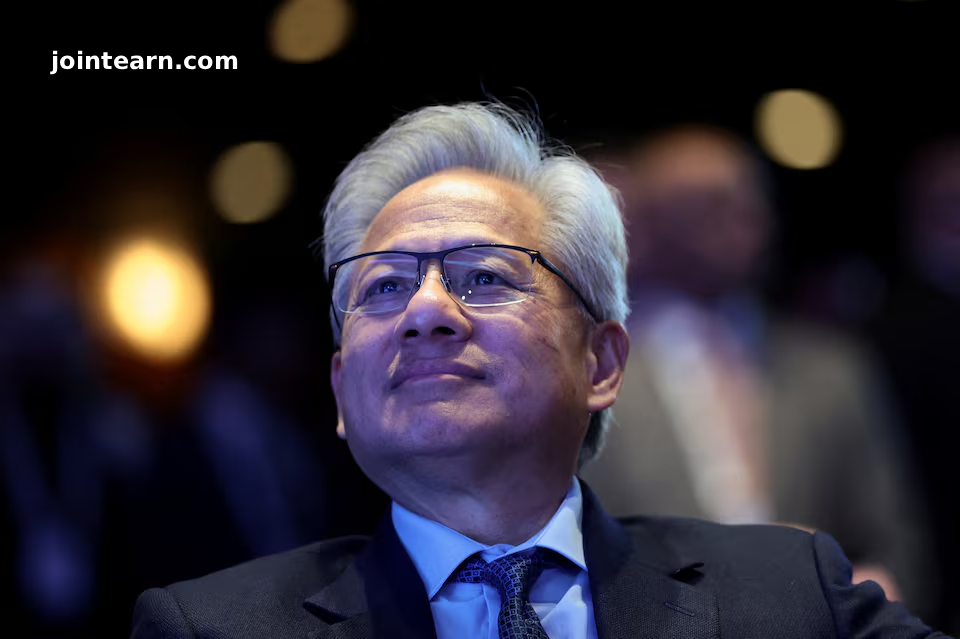
Nvidia Corporation (NASDAQ: NVDA) CEO Jensen Huang has dismissed market concerns of an artificial intelligence (AI) bubble, instead describing the current moment as a tipping point in AI technology adoption. Huang envisions a world where Nvidia’s high-powered chipsets underpin not only traditional computing but also new AI applications across software, robotics, and everyday devices.
However, market skeptics caution that Nvidia’s meteoric rise is intertwined with risks, including heavy reliance on a few key customers, complex financial arrangements, and infrastructure challenges that could impact long-term growth.
Nvidia’s Customer Concentration Raises Concerns
In a recent regulatory filing, Nvidia revealed that four major customers accounted for 61% of its $57 billion in third-quarter revenue, up from 56% in the previous quarter. Analysts speculate these customers may include industry giants such as Microsoft, Meta, and Oracle.
Additionally, Nvidia has doubled its spending to rent back its own chips from cloud clients, reaching $26 billion, with contracts extending through 2031. The company has also committed to investing up to $100 billion in OpenAI and $10 billion in Anthropic, two major AI partners.
This close financial entanglement has raised eyebrows among analysts. Chaim Siegel, an analyst at Elazar Advisors, noted:
“A lot of this growth is coming from loss-making startups or loss-making projects, so most likely the cycle ends badly unless all these companies agree to stop spending together and let profits shine through, which is a near impossibility.”
CEO Huang Outlines AI Vision
During Nvidia’s earnings call, Huang emphasized that the company sees a fundamentally different trajectory from the market talk of an AI bubble. He outlined three transformative shifts driving Nvidia’s long-term growth:
- Transition of non-AI software—including engineering simulations and data science—from traditional central processors to Nvidia’s GPUs.
- Emergence of new AI software categories, such as coding assistants and other intelligent applications.
- Expansion of AI into the physical world, powering robotics, autonomous vehicles, and real-world automation.
“These three fundamental dynamics each will contribute to infrastructure growth in the coming years. Nvidia is chosen because our singular architecture enables all three transitions,” Huang said.
Infrastructure Challenges and Market Risks
While Nvidia’s vision is ambitious, it faces tangible infrastructure challenges, including the need for massive amounts of land, power, and data center facilities. Ivana Delevska, CIO at Spear Invest, noted that these requirements remain a concern even for Nvidia bulls.
Huang assured investors that Nvidia is actively partnering with stakeholders in land, power, and financing to overcome these hurdles.
“None of these things are easy, but they’re all tractable, and they’re all solvable things,” he said.
Competition and Market Saturation
Despite Nvidia’s dominance, competition is intensifying. Alphabet’s Google and Amazon are designing their own AI chips and targeting similar enterprise clients. Analysts warn that while Nvidia is currently sold out for the year and likely the next, future upside surprises may be limited, with numerous potential risks threatening sustained dominance.
Jay Goldberg, senior analyst at Seaport Research Partners, expressed caution:
“The list of things that could go wrong for Nvidia is longer than the list of things that could go right.”
Conclusion
Nvidia stands at a critical juncture in AI history. CEO Jensen Huang sees the company as central to the AI revolution, bridging software innovation, hardware architecture, and real-world applications. However, high customer concentration, circular deals, and global infrastructure constraints introduce significant risks.
For investors and market watchers, Nvidia represents both enormous opportunity and cautionary complexity—a true tipping point where AI innovation meets market uncertainty.


Leave a Reply