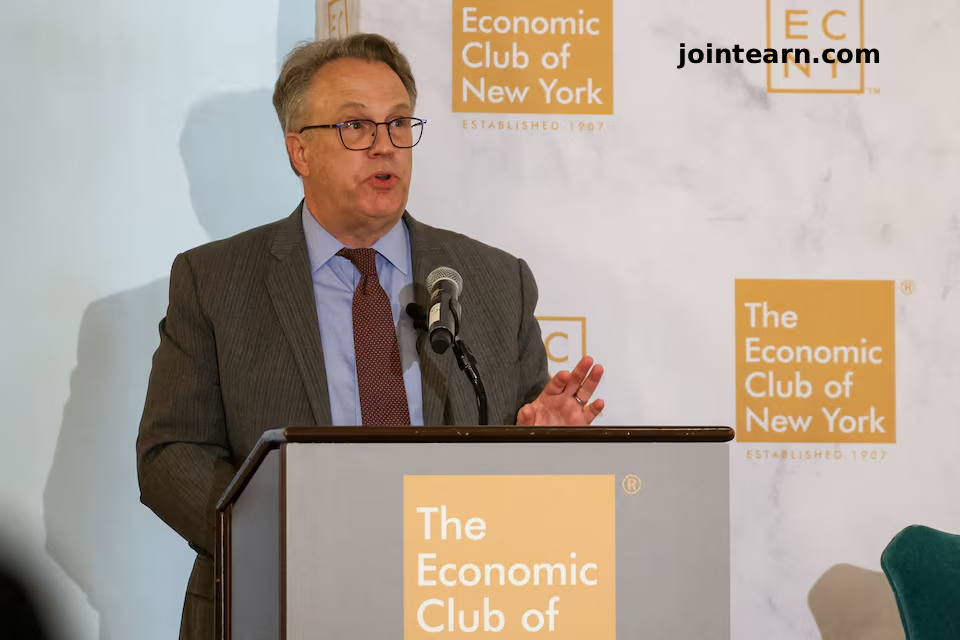
The debate over the Federal Reserve’s next interest rate move has intensified after New York Fed President John Williams suggested that the central bank could consider lowering rates in the near term. Speaking at a conference hosted by the Central Bank of Chile on Friday, Williams, who is a permanent voter on the Federal Open Market Committee (FOMC), said that reducing rates could be done without jeopardizing the Fed’s long-term inflation goals while also supporting the U.S. job market.
His remarks immediately influenced market expectations, with investors now assigning nearly a 60% probability to a quarter-point cut at the Fed’s December 9-10 meeting, reversing prior assumptions that the Fed would pause due to lingering inflation concerns.
Williams Highlights Room for Rate Cuts
Williams described current monetary policy as “modestly restrictive” and indicated that there is space for a “further adjustment in the near term” to bring the stance closer to neutral. He noted that although inflation remains above the Fed’s 2% target, price pressures are expected to ease as the effects of tariffs pass through the economy.
He also observed signs of a softening labor market, highlighting that the September unemployment rate of 4.4% reflects conditions closer to pre-pandemic norms rather than an overheated economy. According to Williams, careful calibration of interest rates is necessary to achieve inflation targets without endangering maximum employment.
Fed Officials Split on December Rate Cut
Despite Williams’ optimism, several Fed policymakers remain cautious. Boston Fed President Susan Collins, a voting member of the FOMC, emphasized that the current policy stance—benchmark rates in the 3.75% to 4% range—is appropriate to maintain downward pressure on inflation. Collins expressed hesitancy about further cuts, noting that the economy has shown resilience and that monetary policy is currently “very appropriate.”
Similarly, Dallas Fed President Lorie Logan advocated for leaving rates on hold to better assess the cumulative impact of past rate moves on the economy. Logan, who will hold a voting seat next year, argued that without clear evidence justifying additional easing, maintaining the current rate allows the Fed to evaluate policy effectiveness.
Market Implications and Political Dynamics
Markets reacted quickly to Williams’ comments, with U.S. Treasury yields falling amid expectations of lower benchmark rates. The uncertainty surrounding the December rate decision is compounded by delays in the release of core economic data, which were affected by a recent government shutdown.
The FOMC continues to navigate a delicate balance between dovish voices, such as Williams and Fed Governor Stephen Miran, who favor lower rates to protect employment, and hawkish officials, including several regional bank presidents, who stress caution given persistent inflation. This divergence raises the prospect of divided votes on upcoming rate moves.
Stephen Miran, a vocal proponent of larger rate cuts, noted that he would support a 25-basis-point cut if his vote proved decisive, emphasizing the need to act to avoid economic harm. His stance reflects the ongoing tension between maintaining inflation control and supporting economic growth.
Outlook Ahead of December Fed Meeting
With the December 2025 FOMC meeting approaching, financial markets are closely watching for signals that could sway the committee’s decision. Analysts expect that the Fed may face a split decision, as officials weigh the risk of persistent inflation against emerging weaknesses in the labor market.
Investors and economists alike recognize that any policy change could have wide-reaching implications for U.S. economic growth, employment, and global financial markets, making this one of the most closely watched central bank meetings of the year.


Leave a Reply