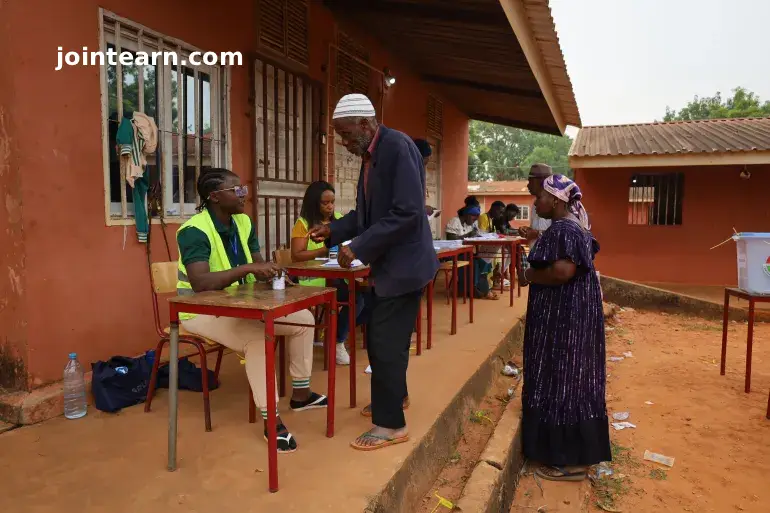
Guinea-Bissau, one of West Africa’s most politically volatile nations, is heading to the polls in a highly contentious presidential election. President Umaro Sissoco Embalo is seeking a rare second term, facing opposition from a relatively unknown candidate, Fernando Dias da Costa, who is backed by former Prime Minister Domingos Simoes Pereira.
The election comes against a backdrop of repeated military coups and political unrest, reflecting the country’s longstanding struggle to maintain civilian rule. Voting stations across the capital, Bissau, and other regions opened on Sunday, November 23, 2025, with hundreds of thousands of registered voters expected to cast their ballots.
Guinea-Bissau’s Troubled Political Landscape
Since gaining independence from Portugal over 50 years ago, Guinea-Bissau has experienced chronic political instability. Military coups, attempted coups, and political turmoil have repeatedly disrupted the democratic process.
President Embalo, a 53-year-old former army general and prime minister (2016–2018), first assumed office in February 2020. His tenure has been marked by tension with opposition parties, including the African Party for the Independence of Guinea and Cape Verde (PAIGC), which has been banned from participating in the current election.
The opposition argues that Embalo’s term should have concluded earlier this year, a claim supported in part by a Supreme Court ruling that allowed his term to continue until September. However, the election was delayed until November 2025, intensifying political friction.
The Candidates: Embalo vs. Fernando Dias da Costa
The presidential race features 12 candidates, but the spotlight is on two main figures:
- Umaro Sissoco Embalo: Seeking reelection, Embalo has pledged to modernize the country’s infrastructure, including upgrading the main airport, and improve overall governance. His record as a former army general and prime minister is central to his campaign, appealing to voters who prioritize security and stability.
- Fernando Dias da Costa: A relatively unknown 47-year-old politician, Dias da Costa is supported by former Prime Minister Domingos Simoes Pereira, runner-up in the 2019 presidential election. Despite his backing, his campaign faces challenges due to restrictions imposed on the top opposition party.
To win outright, a candidate must secure more than 50% of the vote. Otherwise, a runoff election will be required. Approximately half of Guinea-Bissau’s 2.2 million residents are registered to vote, highlighting the importance of voter turnout in shaping the country’s future.
Challenges Facing Guinea-Bissau
Guinea-Bissau remains one of the world’s poorest nations, with nearly half of its population living below the poverty line, according to the World Bank. In addition to economic hardship, the country grapples with political instability, weak governance, and sporadic military interventions.
Since Embalo took office, at least two coup attempts have occurred, including a recent October plot in which several military officers were arrested. The nation’s history of coups underscores the ongoing fragility of its democratic institutions.
The Stakes of the 2025 Election
This election represents a crucial juncture for Guinea-Bissau. It is not only a test of Embalo’s leadership but also a measure of the country’s ability to maintain civilian governance in the face of military influence. International observers and local citizens alike are closely watching the outcome, as it will shape the nation’s political trajectory for years to come.
As voting continues, key issues such as political stability, economic development, and infrastructure modernization dominate the conversation. The result of the election will determine whether Guinea-Bissau can move toward greater stability or remain trapped in cycles of unrest and uncertainty.


Leave a Reply