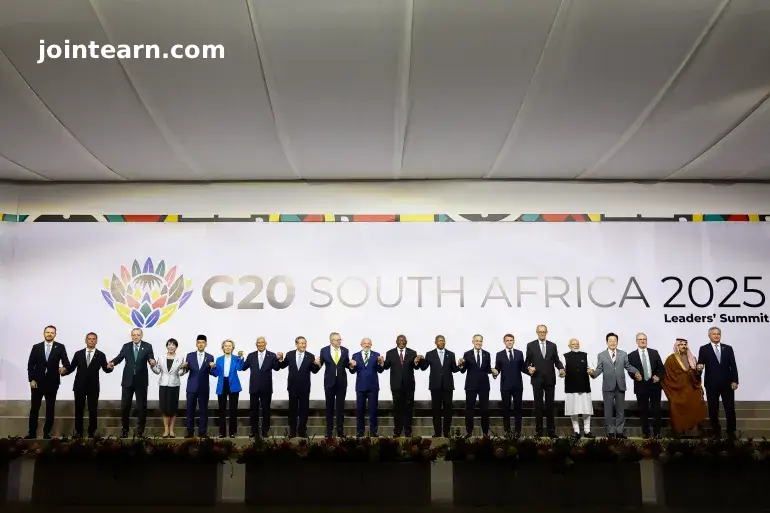
South African President Cyril Ramaphosa declared the Group of 20 (G20) summit in Johannesburg a success, emphasizing that the shared goals of member nations outweigh their differences. The summit concluded with a strong declaration on multilateral cooperation, even as tensions lingered with the United States, which boycotted the event.
G20 Summit Declaration: A Commitment to Multilateralism
Speaking at the closing ceremony, President Ramaphosa highlighted the summit’s central achievement: a declaration reflecting a renewed commitment to global cooperation. The declaration addressed pressing international challenges, including climate change, economic inequality, and global development, demonstrating that the collective interests of G20 members extend beyond political disagreements.
“Today’s declaration shows that our shared goals outweigh our differences,” Ramaphosa said, underlining the importance of multilateral action to improve lives worldwide.
Brazilian President Luiz Inácio Lula da Silva echoed Ramaphosa’s sentiments, noting that both the G20 summit and the recent COP30 climate summit in Brazil reaffirmed the vitality of multilateralism. He stressed that the real test now lies in implementing the decisions agreed upon in Johannesburg.
US-South Africa Diplomatic Dispute
The summit concluded amid a diplomatic spat with the United States. President Donald Trump’s administration boycotted the summit, citing claims—widely disputed—that South Africa’s government persecutes its white minority. The White House ultimately sent officials only for the formal G20 presidency handover, which Ramaphosa criticized as insufficient for a summit of world leaders.
“The United States is a member of the G20, and if they want to be represented, they can still send anyone at the right level,” South African Foreign Minister Ronald Lamola said. He emphasized that the leaders’ summit requires participation at the head-of-state level or an appropriately designated envoy.
Starting in 2026, the US will assume the G20 presidency and host the summit at President Trump’s Doral golf club in Florida, further highlighting ongoing tensions over protocol and summit management.
Focus on Developing Countries and Global Challenges
South Africa’s G20 agenda emphasized issues that disproportionately affect developing nations, including:
- Climate-related disaster recovery and financial aid for vulnerable countries
- Debt relief and economic stability for emerging economies
- Support for green energy transitions
Most G20 members—including China, Russia, France, Germany, the UK, Japan, and Canada—backed the Johannesburg declaration. However, countries like Argentina, aligned with Trump, opposed the early issuance of the declaration, which deviated from the usual practice of releasing communiqués at the end of the summit.
Turkey and Gaza: Security Cooperation Talks
Turkish President Recep Tayyip Erdoğan announced that Turkey continues to evaluate potential participation in an international stabilization force in Gaza. Turkey played a significant role in ceasefire negotiations in Egypt and remains active in regional security discussions. Erdoğan reiterated his criticism of Israel’s actions in Gaza, labeling them as “genocide” and holding Prime Minister Benjamin Netanyahu responsible.
Historic First G20 Summit in Africa
The Johannesburg summit marked the first G20 summit ever hosted on the African continent, signaling a shift toward a broader global focus. South Africa’s leadership highlighted issues of climate change, wealth inequality, and development challenges, reflecting the priorities of the developing world. By issuing a leaders’ declaration on the opening day, South Africa set a precedent for proactive, early-action diplomacy in G20 forums.


Leave a Reply