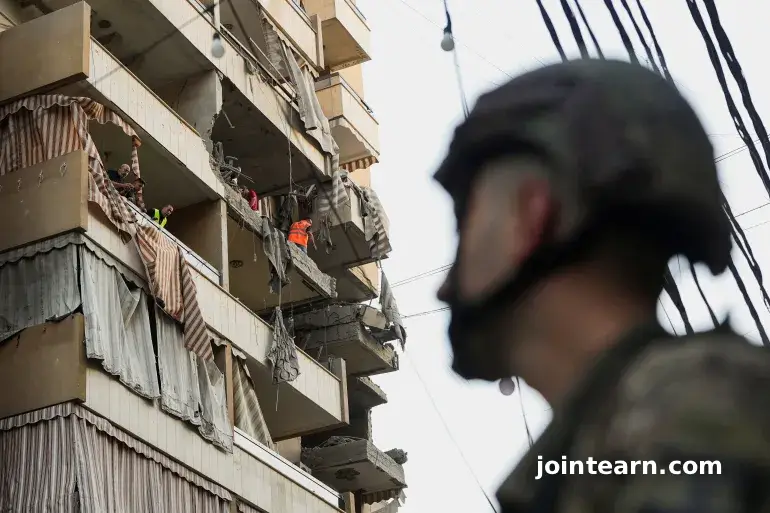
Hezbollah has confirmed that its senior military commander, Haytham Ali Tabatabai, was killed in an Israeli airstrike on Lebanon’s capital, Beirut. The strike, which targeted an apartment block in the southern suburb of Dahiyeh, claimed at least five lives and wounded 28 others, further intensifying tensions in the region.
Hezbollah Confirms Death of “Great Commander”
In a statement, Hezbollah described Tabatabai as a “great commander” and condemned the strike as a “treacherous Israeli attack” on the Haret Hreik neighborhood. Tabatabai, born in 1968 to a Lebanese mother and Iranian father, had risen through the ranks of Hezbollah’s armed wing since joining in the 1980s.
He is the most senior Hezbollah leader killed by Israel since the November 2024 ceasefire that temporarily ended over a year of hostilities between the two sides.
Senior Hezbollah official Mahmoud Qmati warned that the attack “opens the door to an escalation of assaults all over Lebanon,” signaling the potential for renewed conflict.
Israel Confirms Targeting Tabatabai
The Israeli military stated it had “eliminated” Tabatabai, confirming he was the main target of the strike. Israeli Prime Minister Benjamin Netanyahu’s office reiterated that the attack was intentional, marking the third known attempt to eliminate the commander since last year’s war.
The strike also caused significant damage to surrounding buildings and vehicles in the Haret Hreik area, a Hezbollah stronghold, as reported by Lebanon’s National News Agency (NNA).
Regional Tensions and Hezbollah’s Dilemma
Al Jazeera correspondent Zeina Khodr, reporting from Beirut, noted that Hezbollah faces a difficult position. The organization risks losing deterrence if it fails to respond, yet retaliation could provoke massive Israeli bombardment, threatening civilian areas and its support base.
Security analyst Ali Rizk commented: “Hezbollah is unlikely to give Netanyahu an excuse for a full-scale war, which could be politically advantageous for Israel and extremely costly for Lebanon.”
Lebanese President Joseph Aoun called on the international community to intervene firmly to halt Israeli attacks, emphasizing Lebanon’s sovereignty and citizens’ safety.
Repeated Israeli Strikes on Lebanon
Sunday’s strike follows a series of near-daily Israeli airstrikes on southern Lebanon. Recent attacks include a strike on a Palestinian refugee camp in Ein el-Hilweh near Sidon that killed at least 13 people.
Israel and the United States continue to pressure Lebanon to disarm Hezbollah, while the Lebanese government has attempted to implement plans to remove the group’s military capabilities, which Hezbollah refuses to comply with. Israel claims Hezbollah is rebuilding its arsenal in southern Lebanon, a charge the Lebanese government denies.
This escalation comes just days before Pope Leo XIV is scheduled to visit Lebanon, raising concerns about further instability during his visit.
Implications for Regional Security
The assassination of Haytham Ali Tabatabai marks a significant escalation in the ongoing Israeli-Hezbollah conflict. Observers warn that it could destabilize Lebanon further, threaten regional security, and provoke retaliatory measures that may impact civilians across southern Lebanon and Beirut.
Hezbollah MPs, including Ali Ammar, condemned Israel’s repeated strikes, stating that the attacks violate Lebanon’s dignity, sovereignty, and citizen safety. The international community faces mounting pressure to address the cycle of violence before it escalates into a broader conflict.


Leave a Reply