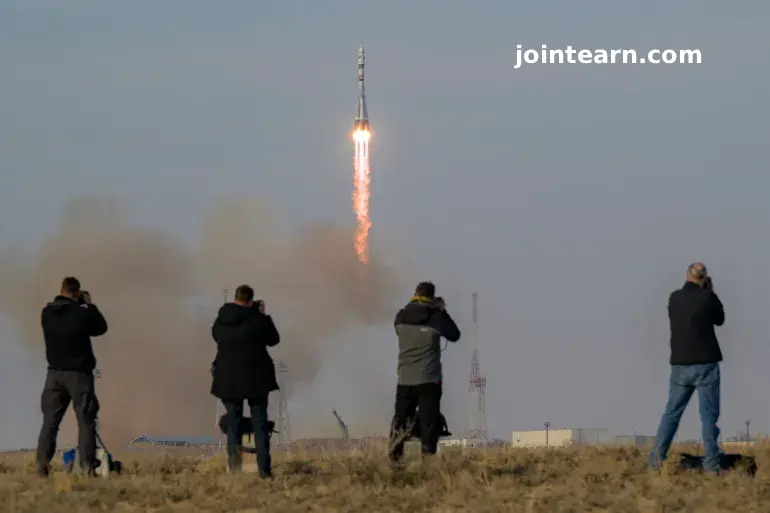
Russia’s state space agency Roscosmos has confirmed that parts of the Baikonur Cosmodrome, the country’s only launch site capable of sending humans into space, were damaged during a joint launch with the United States. The incident occurred after a Soyuz MS-28 spacecraft, carrying two Russian cosmonauts and one NASA astronaut, blasted off toward the International Space Station (ISS) on Thursday.
The launch proceeded normally, lifting off from Kazakhstan’s Baikonur site at 12:28pm Moscow time (09:27 GMT). On board were Roscosmos cosmonauts Sergey Mikaev and Sergey Kud-Sverchkov, along with NASA astronaut Chris Williams, forming part of Expedition 74. The ISS later reported that the spacecraft docked successfully and that all three crew members arrived in “good health.”
Launch Site Damage Confirmed After Inspection
Shortly after liftoff, engineers assessed the condition of Launchpad 31, where the rocket had departed. Roscosmos issued a statement acknowledging that “damage to a number of elements of the launchpad” had been discovered.
According to the agency:
“An assessment of the state of the launch complex is being conducted now. All the necessary reserve elements are available to restore it, and the damage will be eliminated very soon.”
The official tone suggests that authorities believe the damage is manageable. However, independent Russian space analysts and bloggers have indicated the situation may be more serious than Roscosmos has publicly admitted.
Analysts Say Damage Could Halt Russia’s Crewed Launches
Soon after the launch, Russian rocket analyst Georgy Trishkin reported that the service cabin appeared to have collapsed, with parts of the structure falling onto the launchpad. He suggested that repairs could take longer than officials expect.
Prominent Russian space journalist Vitaly Egorov also pointed to suspicious debris seen during the official launch broadcast:
“In the gas exhaust tray under the launchpad, there was some massive metal structure that should not have been there.”
Egorov warned that if the damage is extensive and Baikonur becomes inoperable, Russia may temporarily lose the capability to launch humans into space — something that has not happened since the beginning of the Soviet human spaceflight program in 1961.
Significance of Baikonur Cosmodrome
The Baikonur Cosmodrome, located in southern Kazakhstan, is leased by Russia and serves as the primary site for Soyuz crewed missions. Although Russia has been developing other launch facilities, Baikonur remains the only one fully certified for human flights.
Any disruption to Baikonur’s operations could have significant implications not only for Russia but also for the ISS, where Russia remains a core partner despite deteriorating relations with the West over Moscow’s war in Ukraine.
Soyuz MS-28 Crew Will Spend 242 Days in Space
The three-member Expedition 74 crew is scheduled to remain aboard the ISS for 242 days, until July 2026. Their mission includes approximately 40 scientific experiments and two planned spacewalks.
The Soyuz launch represents a rare area of ongoing US-Russia cooperation, even as most other scientific and technological collaborations have been severed due to sanctions.
However, Western nations — including the United States — have ended many other partnerships with Roscosmos, citing Russia’s aggression in Ukraine and long-standing concerns about mismanagement and corruption within Russia’s space sector.
A Space Program Facing Growing Challenges
Once a global leader in space technology, Russia’s space program has struggled in recent years due to budget constraints, aging infrastructure, and repeated reliability issues. The damage to Baikonur adds another layer of challenge at a time when Roscosmos is under intense scrutiny.
With repair assessments ongoing, it remains unclear how soon the launchpad can return to full operation — and whether Russia may face a temporary suspension of its crewed missions.


Leave a Reply