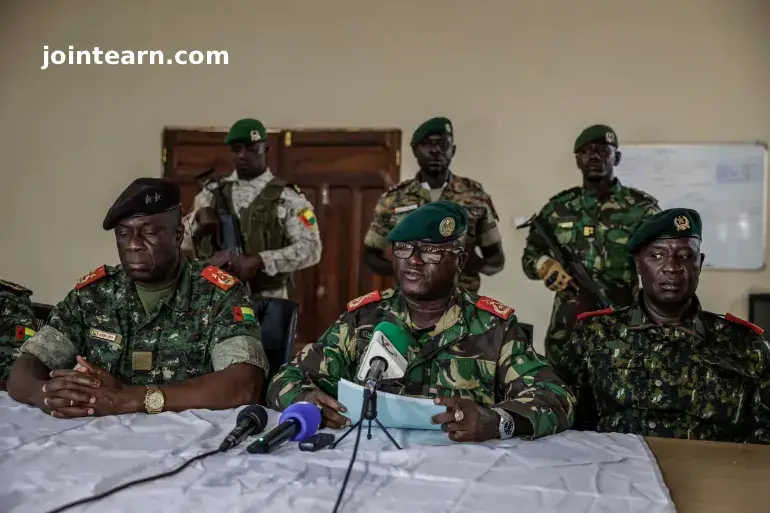
Guinea-Bissau’s political landscape has been thrown into turmoil as military officers announced they had seized control of the country, arresting President Umaro Sissoco Embalo and opposition leader Domingos Simoes Pereira. The takeover comes just a day before the results of a closely contested presidential election were expected to be announced.
Military Declares “Total Control”
Calling themselves the High Military Command for the Restoration of Order, the officers addressed the nation on television on Wednesday, declaring the suspension of the electoral process until further notice.
Additional measures included:
- Closure of all land, air, and sea borders
- Overnight curfew in the capital, Bissau
Sustained gunfire was reported near key government buildings, including the election commission headquarters, the presidential palace, and the Ministry of the Interior.
Brigadier General Denis N’Canha, head of the presidential guard, led the coup. Ironically, N’Canha had been tasked with protecting President Embalo before orchestrating his arrest.
Disputed Presidential Election
Sunday’s presidential vote pitted President Embalo against his primary challenger, Fernando Dias. Both candidates had prematurely declared victory, creating a politically tense environment:
- Embalo claimed a second mandate in a statement to AFP
- Dias declared victory in a social media video, claiming the election was won in the first round
Civil society groups and election observers had already raised concerns over the legitimacy of the vote, noting that the opposition PAIGC party was barred from running in the presidential election. Analysts say the military may have intervened to prevent a stalemate.
Guinea-Bissau has a long history of coups, with the last presidential vote in 2019 resulting in a four-month post-election crisis when Embalo and Pereira both claimed victory.
Arrests and Communications Blackout
President Embalo and opposition leader Pereira are currently under military detention. Reports indicate that authorities are attempting to cut off Internet access, intensifying concerns about information control and civil liberties.
Soldiers have been deployed near key government sites, restricting movement and maintaining a heavy security presence in the capital.
International Reactions
The military takeover has drawn condemnation and concern from international observers:
- ECOWAS (Economic Community of West African States) and the African Union called for the immediate release of detained officials and urged the restoration of constitutional order.
- The United Nations Secretary-General Antonio Guterres appealed for restraint and respect for the rule of law.
- The Portuguese government emphasized that Guinea-Bissau’s state institutions must be allowed to function to finalise the electoral process.
ECOWAS and AU missions, including former leaders Filipe Nyusi of Mozambique and Goodluck Jonathan of Nigeria, stressed the importance of allowing the electoral process to conclude transparently.
Guinea-Bissau’s History of Political Instability
Guinea-Bissau has experienced repeated military interventions since its independence from Portugal in 1974. The nation has struggled with contested elections, political violence, and military influence over civilian governance, contributing to long-term instability.
Observers warn that the current coup threatens both political legitimacy and the country’s fragile democratic institutions. The suspension of the electoral process risks prolonging uncertainty and undermining confidence in West Africa’s broader democratic framework.
Conclusion
The unfolding situation in Guinea-Bissau marks another chapter in the country’s volatile political history. With President Embalo and opposition leader Pereira detained, international calls for constitutional restoration are intensifying. How the military manages the suspended election process will be critical to regional stability and Guinea-Bissau’s path toward democracy.


Leave a Reply