Global Economy Shows Resilience Amid Trade Shocks and AI Investment
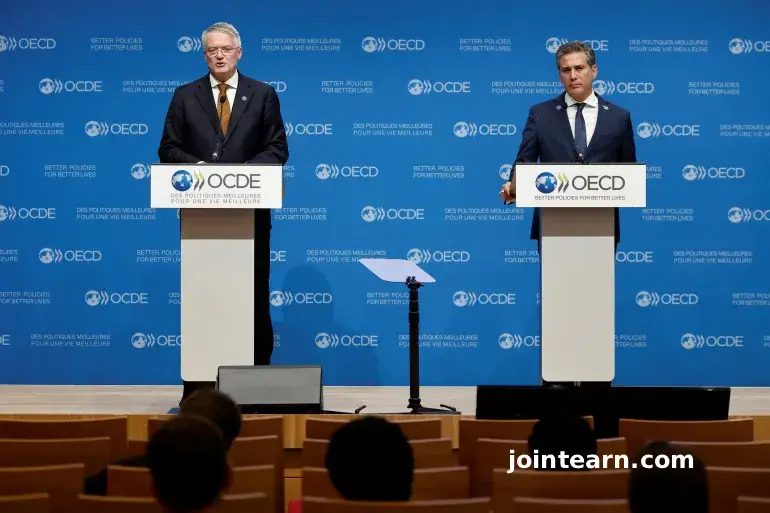
The Organisation for Economic Co-operation and Development (OECD) has warned that while the global economy grew modestly by 3.2 percent in 2025, rising US tariffs and heightened expectations from artificial intelligence (AI) investment could test its resilience in the coming years.
In its latest Economic Outlook, the OECD noted that global growth has been stronger than initially expected due to robust AI-related investments, fiscal support measures, and anticipated US Federal Reserve rate cuts. However, the Paris-based organisation cautioned that renewed trade tensions or unmet market expectations around AI could trigger economic instability or a stock market correction.
OECD Global Growth Forecasts
The OECD forecast that global growth would slow slightly to 2.9 percent in 2026, before rebounding to 3.1 percent in 2027, keeping its projections consistent with September’s estimates.
Mathias Cormann, OECD Secretary-General, highlighted that the impact of US President Donald Trump’s tariff hikes had been relatively mild so far, but their full economic costs are likely to increase as companies run down stockpiled inventories.
“The full effects of those higher tariffs since the start of the year will become clearer as firms run down the inventories that they built up,” Cormann said.
Regional Economic Outlook
United States
- Forecast to grow 2 percent in 2025, revised up from 1.8 percent.
- Expected to slow to 1.7 percent in 2026, up from 1.5 percent previously.
- Growth is being supported by AI investment, fiscal support, and Fed rate cuts, offsetting the drag from tariffs, reduced immigration, and federal job cuts.
- The OECD warned that US fiscal policy is on an unsustainable path, with rising deficits and debt requiring a “significant adjustment” in the coming years.
China
- Growth expected at 5 percent in 2025, slightly up from 4.9 percent in September.
- Forecasted to slow to 4.4 percent in 2026 as fiscal support diminishes and new US tariffs affect trade.
Eurozone
- Growth revised up to 1.3 percent in 2025 from 1.2 percent, driven by strong labour markets and increased public spending in Germany.
- Expected to moderate to 1.2 percent in 2026, slightly higher than the previous forecast of 1 percent, amid budget tightening in France and Italy.
Japan
- Projected growth of 1.3 percent in 2025, up from 1.1 percent, supported by corporate earnings and investment.
- Slowed growth of 0.9 percent expected in 2026.
Trade, Inflation, and Monetary Policy
- Global trade growth expected to decline from 4.2 percent in 2025 to 2.3 percent in 2026, as the effects of tariffs weigh on investment and consumption.
- Inflation projected to gradually return to central bank targets by mid-2027.
- In the US, inflation expected to peak in mid-2026 due to tariff pass-through, then ease.
- China and emerging markets may see modest inflation rises as excess production capacity declines.
- Most major central banks are expected to maintain or reduce borrowing costs, with the US Federal Reserve projected to cut rates slightly by end-2026, barring unforeseen inflation shocks from tariffs.
OECD Cautions About AI and Market Expectations
The OECD highlighted that while AI investment is currently supporting growth, overly high investor expectations could create financial vulnerabilities. A correction in tech and AI-related stocks may have ripple effects on global financial markets, particularly if companies fail to deliver projected productivity gains.
Conclusion
The OECD’s report signals a cautiously optimistic outlook for the global economy, but underscores the risks posed by:
- Ongoing trade tensions, especially US tariffs.
- Rising fiscal deficits and debt in the US.
- Potential market corrections in AI and tech sectors.
Policymakers and investors are advised to monitor trade policy, inflation trends, and AI-driven productivity gains closely as the global economy navigates a period of moderate growth and potential volatility.


Leave a Reply