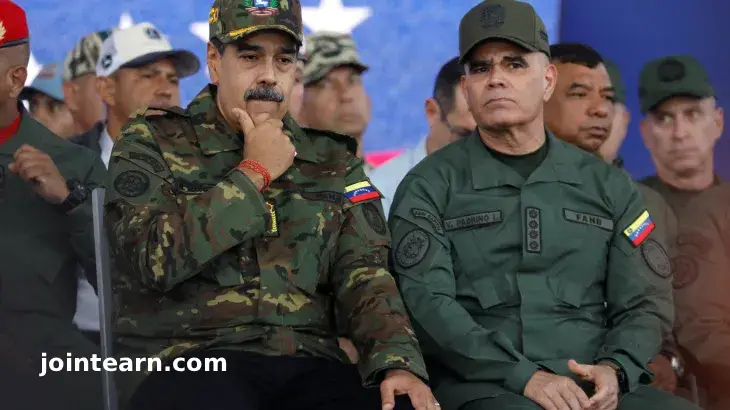
Growing military movements in the Caribbean and increasingly hostile rhetoric from Washington have sparked global concern: Could the United States be preparing for direct military action against Venezuela?
Analysts warn that even a limited strike could unleash instability across the region rather than bring about a smooth political transition.
Rising Tensions: Why Fears of a US Strike Are Growing
Over the past few months, the United States has ramped up its military presence around Venezuela. Naval forces, including advanced aircraft carriers, have been positioned near Venezuelan waters. At the same time, US forces have targeted more than 20 Venezuelan vessels accused of drug trafficking—a claim many experts say lacks evidence.
Washington argues that Venezuelan-linked drug networks endanger US national security. However, analysts point out that Venezuela is not the primary source of cocaine entering the United States, raising questions about the true motives of these operations.
Meanwhile, President Nicolas Maduro has accused the US government of using the drug narrative as cover for an attempted regime change. He insists Venezuela will resist any foreign assault.
How Might the US Attack Venezuela?
Most experts agree that if the United States acted militarily, it would rely heavily on air and naval power rather than sending ground troops. The current US deployments suggest readiness for missile strikes launched from warships, submarines, and aircraft positioned in the region.
Analysts believe the first wave of action would likely target strategic infrastructure from a distance, aiming to avoid Venezuelan air defenses.
Despite dramatic speculation, a full-scale ground invasion is widely viewed as unlikely. Such an operation would face political backlash at home, legal constraints, and memories of Iraq and Afghanistan.
Military specialists emphasize that the situation is not a simple binary between “no conflict” and “another Iraq.” Instead, the more realistic scenario is a series of limited, escalating operations that could still cause major unintended consequences.
What Would a US Strike Mean for Venezuela?
A US attack, even if limited, could set off a chain reaction far beyond Washington’s expectations. Experts warn that military action could:
- Empower armed groups, militias, or criminal networks
- Fragment control over different regions
- Undermine stability rather than weaken Maduro
- Leave the Venezuelan opposition politically vulnerable
Paradoxically, a strike could even strengthen Maduro’s grip on power. Historically, foreign aggression often creates a “rally-around-the-flag” effect, allowing governments to portray dissent as treason. Analysts argue this would weaken an already fragmented Venezuelan opposition that lacks armed backing.
Examples from Iraq and Libya show that externally driven attempts at regime change rarely produce stable democracies—and Venezuela could be no different.
What Is the US Trying to Achieve?
According to military analysts, US strategy appears focused on diminishing loyalty within Venezuela’s armed forces. Intelligence operations reportedly aim to encourage military units to remain neutral if conflict occurs, similar to tactics used before the 1991 Gulf War.
However, experts say Venezuela’s government has purged disloyal officers for years. That means the security forces are now more tightly aligned with Maduro and more likely to resist external pressure.
How Might Venezuela’s Military Respond?
The Venezuelan response would depend heavily on what the US signals before any strike. If Washington offers guarantees or deals to military leaders, some units could choose to stand down. But if the plan involves marginalizing or purging the armed forces after an intervention, resistance could intensify.
Analysts caution that excluding the military could spark isolated clashes or localized conflict—without necessarily leading to a nationwide civil war.
How Would Ordinary Venezuelans React?
For millions of Venezuelans already living through economic collapse, hyperinflation, and shortages of basic goods, a foreign strike could deepen a humanitarian crisis.
Most Venezuelans distrust both the government and foreign intervention, making public reaction difficult to predict. However, experts believe many would see a US attack not as liberation, but as another threat to access food, medicine, electricity, and stability.
How Would China and Russia Respond?
Venezuela’s closest partners would almost certainly condemn a US attack:
- China would offer strong diplomatic support but is unlikely to intervene militarily.
- Russia has deeper military ties, including weapons sales and training. Moscow could provide advisory support but is also unlikely to confront the US directly.
Both countries would continue backing Maduro politically, but their influence during an active conflict would be limited.
Could the US Target Other Countries Next?
Washington’s framing of Venezuela as a “narco-terrorist threat” has raised regional concerns. Some analysts fear this approach could become a new model for US intervention across Latin America.
By labeling domestic crises as drug-related threats, the US can justify military action under the banners of counterterrorism and law enforcement. If applied broadly, this strategy could undermine international law and destabilize countries facing internal political turmoil.
Experts warn that such a militarized approach would shift attention away from social and economic solutions to drug trafficking and migration—problems rooted in long-term structural issues, not just security threats.


Leave a Reply