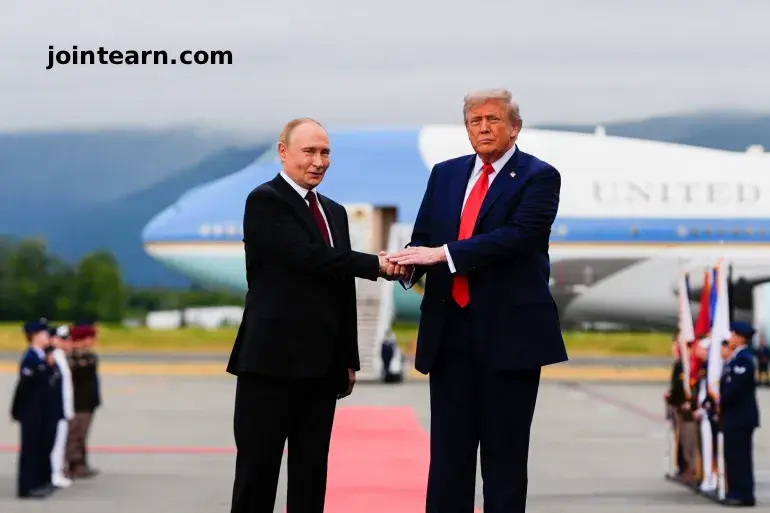
The Kremlin has welcomed the new national security strategy unveiled by US President Donald Trump, saying it aligns closely with Russia’s vision of global affairs. The updated strategy, released last week, signals a significant shift in Washington’s foreign policy approach, particularly regarding Europe, NATO, Russia, and the Indo-Pacific.
Kremlin Praises Alignment With Russia’s Vision
Kremlin spokesperson Dmitry Peskov stated that the revised US strategy “corresponds in many ways to our vision.” He specifically highlighted the language concerning NATO, noting that the document addresses ending “the perception … of the NATO military alliance as a perpetually expanding alliance.”
Moscow has long opposed NATO enlargement, citing security concerns along its western borders. Peskov, however, also cautioned that the stance of the US “deep state” — a term frequently used by Trump to describe officials who allegedly oppose his agenda — may not fully align with the president’s new approach.
Shifting US Focus on Ukraine and Europe
Since Russia’s annexation of Crimea in 2014 and the full-scale invasion of Ukraine in 2022, US security strategies have consistently described Moscow as a destabilizing force threatening the post-Cold War order. Trump’s new approach marks a notable change, emphasizing strategic stability with Russia and signaling a potential willingness to reconsider the US stance on territorial negotiations in Ukraine.
Public tensions between Trump and Ukrainian President Volodymyr Zelenskyy have shaped the context for this strategy. While Trump has previously referred to Russian President Vladimir Putin as a “friend,” the new document frames ending the war in Ukraine as a “core” US interest, leaving room for diplomatic solutions that may involve negotiated concessions.
Zelenskyy is expected to travel to London for a critical four-way meeting with UK Prime Minister Keir Starmer, French President Emmanuel Macron, and German Chancellor Friedrich Merz, underscoring the high stakes of Western diplomacy in the coming weeks.
Indo-Pacific Policy Gains Center Stage
The updated US security strategy also shifts the focus to the Indo-Pacific region, describing it as a “key economic and geopolitical battleground.” The document pledges to expand US military capabilities to deter potential conflicts, particularly between China and Taiwan.
Russia, meanwhile, has strengthened its economic and political ties with China following Western sanctions over the Ukraine war. Experts note that Trump’s strategy reflects his historical perspective: “As a student of history, which I am, and I’ve watched it all, the first thing you learn is you don’t want Russia and China to get together,” he told Fox News in March 2025.
Redefining the US-Led Global Order
Analysts interpret the document as Trump’s attempt to overhaul the US-led post–World War II order, reshaping global alliances under an “America First” lens. The strategy emphasizes defending the so-called “Western identity” of Europe and preventing what it terms “civilizational erasure,” language that resonates with far-right narratives in both the United States and Europe.
This strategic pivot may influence NATO dynamics, European security policies, and the broader balance of power between Washington, Moscow, and Beijing.
Implications for Global Security
Trump’s revised national security strategy could have far-reaching consequences:
- US-Russia relations: Potential for renewed diplomatic engagement and stability, though skepticism remains due to internal US opposition.
- Ukraine conflict: Opportunities for negotiated settlements may emerge, but tensions between US, European, and Ukrainian policymakers could persist.
- Indo-Pacific stability: Expanded military presence may heighten deterrence against China but risks escalating regional tensions.
- NATO and Europe: Reduced perception of perpetual NATO expansion could shift alliance priorities and defense spending.
For global observers, the new strategy signals a dramatic recalibration of US foreign policy that could reshape international alliances, military postures, and the geopolitical landscape over the next decade.


Leave a Reply