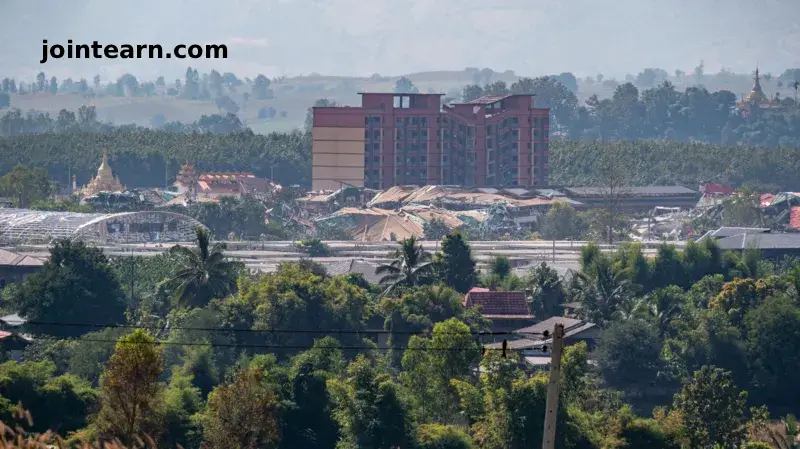
The Myanmar military has launched a high-profile campaign to eradicate scam compounds along the country’s border with Thailand, demolishing buildings in locations such as KK Park with explosives. The army claims it is cracking down on online fraud operations run by Chinese criminal syndicates, but experts and locals remain skeptical about the junta’s true intentions.
Explosions on the Moei River: The Reality on the Ground
On a recent afternoon along the Moei River, which separates Thailand from Myanmar, three loud explosions shattered the calm. Ethnic Karen families bathing in the river scrambled to safety as plumes of smoke rose from nearby trees.
These operations are part of the military’s broader effort to remove illegal online scam operations, which have flourished in Karen State over the past two years. The compounds reportedly housed thousands of foreign workers, many of whom were involved in romance scams, cryptocurrency fraud, and other online cons.
Military Claims Versus Skepticism
Myanmar junta spokesman Gen Zaw Min Tun stated:
“We are working to completely eradicate online scam activities from their roots.”
While the military has showcased dramatic demolitions, observers note that the destruction in KK Park has not fully dismantled the infrastructure. Many buildings remain intact, and similar compounds continue to operate elsewhere in Myanmar, including Shwe Kokko, Minletpan, and Payathonzu.
The Role of the Scam Compounds
Scam compounds have become multi-billion-dollar operations, affecting victims worldwide. In addition to online fraud targeting elderly people, crypto investors, and those deceived by romance scams, these compounds are linked to human trafficking, money laundering, and serious human rights abuses.
Historically, the Myanmar military tolerated these operations, with local warlords allied to the junta profiting alongside Chinese syndicates. Only recently, under international pressure—particularly from China, concerned about its citizens being trafficked—has the junta appeared to take action.
International Attention and Law Enforcement
The operations in KK Park have attracted international scrutiny, with authorities observing the confiscation of mobile phones, computers, and Starlink satellite dishes. Yet, the military has focused mainly on demolishing buildings rather than preserving evidence, contrasting with efforts by the Karen National Union (KNU), which exposed scam activities without destroying documents or infrastructure.
Thousands of scam workers fled to Thailand or relocated to more remote areas within Myanmar. Despite the military’s efforts, some compounds remain active, often under the protection of local militias like the DKBA.
Political Context: Elections and Legitimacy
The military’s campaign against scam compounds is partly linked to its plan to hold elections later this month. The junta seeks to consolidate control, regain public legitimacy, and project an image of reform and law enforcement capability to international allies such as China.
However, much of the country remains under insurgent control, and the civil war sparked by the 2021 coup continues to cause chaos and humanitarian crises. Many opposition groups either cannot or will not participate in the planned elections, raising doubts about the junta’s political strategy.
Future of Scam Operations in Myanmar
While compounds like KK Park and Shwe Kokko have been partially targeted, new scam centers have appeared near border crossings such as Wawlay (Wa Le) and Payathonzu. Many still operate under militia protection and continue using satellite technology to facilitate scams.
Observers warn that while the military may appear to be tackling the problem, the online scam business remains resilient, adapting to new locations and challenges. Until more comprehensive reforms are implemented, these criminal networks are likely to continue thriving.


Leave a Reply