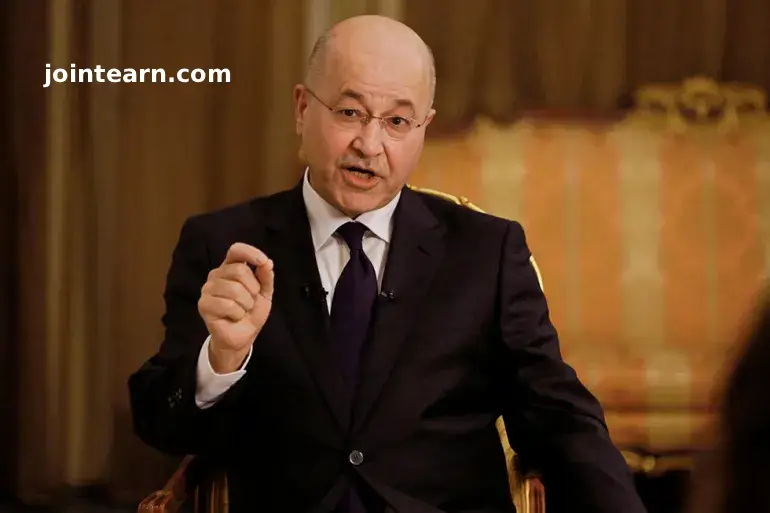
Former Iraqi President Barham Salih is set to become the next United Nations High Commissioner for Refugees (UNHCR) after UN Secretary-General Antonio Guterres formally recommended him for the position. Salih, 65, would succeed Italy’s Filippo Grandi, whose second term ends on December 31, 2025. If confirmed, Salih will be the first non-Western head of UNHCR in nearly 50 years.
Appointment Process
A signed letter from Guterres, addressed to Atsuyuki Oike, Japan’s top diplomat in Geneva and chair of UNHCR’s executive committee, confirmed Salih’s nomination, pending formal approval. UN spokesperson Alessandra Vellucci emphasized that the appointment requires consultation with the UNHCR committee and a final decision by the UN General Assembly in New York.
“The process is ongoing. Once completed, there will be an official announcement by the United Nations,” Vellucci said.
Salih’s Background and Experience
Originally from Iraq’s Kurdish region, Salih fled persecution under Saddam Hussein’s regime and pursued engineering studies in the United Kingdom. He served as Iraq’s president from 2018 to 2022 and has consistently emphasized humanitarian concerns in his public work.
During his campaign for UNHCR, Salih highlighted his personal experience as a refugee, stating:
“I believe deeply in the UNHCR mission because I have lived it. Humanitarian aid is meant to be temporary, and refugees must be placed at the centre of all efforts.”
Challenges Ahead
Salih steps into the role at a challenging time. UNHCR’s 2026 budget has been cut nearly 20% to $8.5 billion, with an expected 5,000 job reductions, even as global displacement continues to rise amid crises in Gaza, Sudan, and Ukraine.
Key donor countries, including the United States under President Donald Trump, have reduced contributions, while some funds have been redirected to defense spending. Salih has proposed innovative strategies to broaden funding, such as tapping into Islamic finance, partnering with the private sector, and establishing a “Global CEO Humanitarian Council” to support UNHCR operations.
He will also face growing Western restrictions on asylum, anti-immigration sentiment, and frustrations from countries in the Global South bearing the brunt of refugee hosting.
Global Significance
About a dozen candidates competed for the UNHCR role, including European politicians, corporate executives, and media figures. Salih’s selection marks a significant shift in leadership, reflecting a broader push for diverse representation at the United Nations. The last non-Western head of UNHCR was Prince Sadruddin Aga Khan of Iran, who served from 1966 to 1977.
Outlook
If confirmed, Salih aims to strengthen UNHCR’s capacity to respond to the mounting refugee crisis, improve financial sustainability, and ensure that displaced populations receive aid efficiently. His personal experience as a refugee is expected to guide a more empathetic, human-centered approach to global humanitarian challenges.


Leave a Reply