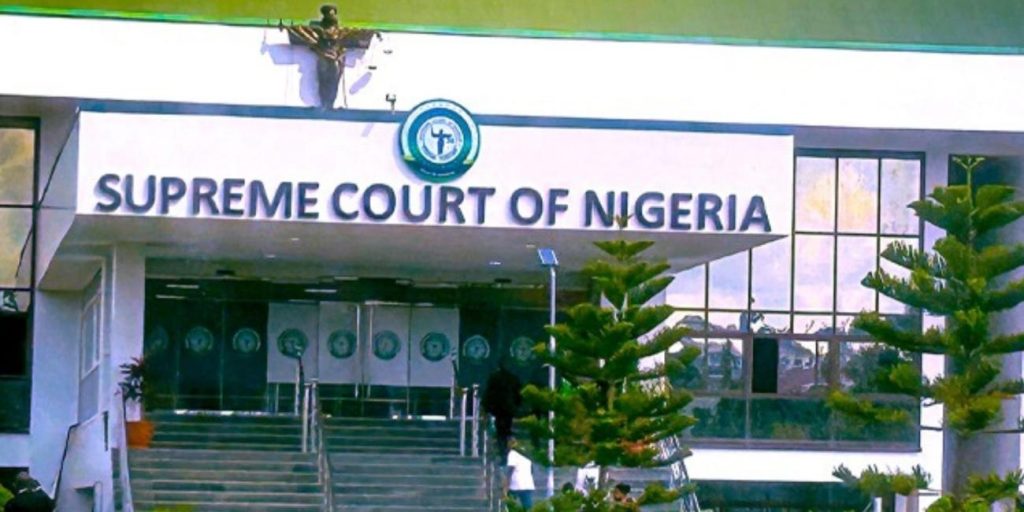
A controversial legal drama that began more than a decade ago has taken a dramatic turn, following a fresh ruling by Nigeria’s Supreme Court that effectively altered its own earlier judgment in the long-running dispute between Sagecom Concepts Limited and Fidelity Bank Plc.
The dispute originated in 2011 when Sagecom Concepts Limited instituted an action at the High Court of Lagos State in Suit No. LD/1734/2011 against G. Cappa Plc and Fidelity Bank Plc. Sagecom sought possession of a prime property located in Ikoyi, Lagos, alongside substantial claims for special damages arising from unpaid rents on multiple residential units within the property.
Background of the Case
Sagecom’s claims covered Flats 1 to 10 and Penthouses 1 and 2, spanning rental periods between November 2005 and June 2011. According to the claimant, the annual rental values ranged from US$30,000 to US$67,500 per unit. These sums were to be converted to naira using the Central Bank of Nigeria’s official exchange rate prevailing on the date of actual payment.
The company further structured its claims such that Fidelity Bank alone was liable for rental obligations prior to June 21, 2011, while both Fidelity Bank and G. Cappa Plc were jointly and severally liable from that date onward. Sagecom also demanded interest on the rental sums at a daily compounded rate of 19.5 percent per annum until full liquidation of the debt.
Lower Courts’ Decisions
The High Court of Lagos State ruled in favour of Sagecom, granting the reliefs sought, including the interest and exchange rate computation. Fidelity Bank challenged the judgment at the Court of Appeal, Lagos Division, but its appeal was dismissed in 2021, with the appellate court affirming the High Court’s decision.
Still dissatisfied, Fidelity Bank escalated the matter to the Supreme Court in Appeal No. SC/CV/1602/2021. On April 11, 2025, the apex court dismissed the appeal and upheld the judgments of the lower courts, seemingly bringing the protracted litigation to a close.
At the time, Fidelity Bank was represented by senior advocates including former Attorney General of the Federation, Kanu Agabi, SAN, and Onyechi Ikpeazu, SAN, while Sagecom’s legal team featured Muiz Banire, SAN, and Adeyinka Olumide-Fusika, SAN.
Fidelity Bank Returns to Supreme Court
Following the April 2025 ruling, SaharaReporters learnt that Fidelity Bank engaged Chief Wole Olanipekun, SAN, and filed a post-judgment application at the Supreme Court seeking what it described as “clarifications” to the judgment.
Olanipekun’s involvement drew attention due to past controversies, including a 2021 Supreme Court sanction over attempts to alter a judgment in the Bayelsa governorship election case. Despite this history, Fidelity Bank proceeded with the application, which critics viewed as an attempt to reopen a concluded matter.
Supreme Court Alters the Judgment
In a surprising development on Friday, December 12, 2025, the Supreme Court granted the application and modified critical components of its earlier ruling. The court changed the interest awarded from a daily compounded rate of 19.5 percent per annum to a flat annual rate of 19.5 percent.
Additionally, the court altered the applicable exchange rate for converting the dollar-denominated rents to naira. Rather than using the exchange rate prevailing at the date of actual payment—estimated at about ₦1,600 per dollar in April 2025—the court adopted the 2018 exchange rate of approximately ₦305 per dollar.
Legal Community Reacts
The decision triggered shock and disbelief within Nigeria’s legal community. Senior lawyers contacted described the development as unprecedented, with one insisting on seeing the ruling before commenting, describing such a scenario as “a legal impossibility.”
Reference was made to Order 20(4) of the Supreme Court Rules 2024, which restricts the court’s power to review its judgments except for clerical errors or accidental slips, and explicitly prohibits substantive variations once a judgment correctly reflects the court’s decision.
Fidelity Bank Defends Its Actions
Responding to inquiries, Fidelity Bank’s Divisional Head of Brand and Communications, Meksley Nwagboh, confirmed that the bank authorised the post-judgment application. He maintained that the move was aimed solely at clarifying ambiguities relating to interest computation, applicable exchange rates, and the currency of payment.
According to him, the application did not seek to reopen or vary the judgment but to ensure accurate and faithful execution in line with the Supreme Court’s intention. He added that the court acted within its powers and that the clarification brings finality to the dispute.
Efforts to obtain comments from Wole Olanipekun & Co. were unsuccessful as of press time.


Leave a Reply