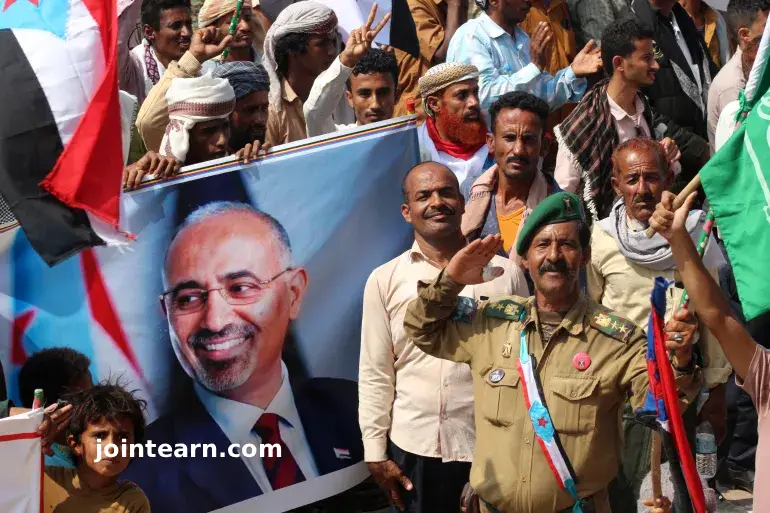
STC Expansion: Redrawing Yemen’s Map of Power
The Southern Transitional Council (STC), a separatist group backed by the United Arab Emirates, is intensifying its influence in Yemen’s eastern governorates, particularly Hadramout and al-Mahra. This expansion highlights that the Yemeni conflict—ongoing for over a decade—is no longer a simple battle between the internationally recognized government and the Houthis. Instead, Yemen now features a complex mosaic of de facto authorities competing over security, resources, and governance.
The STC’s recent military advances signal its ambition to consolidate power in Yemen’s south and east, areas historically part of South Yemen before its 1990 unification with the north. By challenging government forces in these resource-rich regions, the STC is effectively reshaping the anti-Houthi coalition, creating new tensions both domestically and regionally.
Economic Consequences of Political Fragmentation
Yemen’s fragile economy is already under immense strain due to the prolonged war. The International Monetary Fund (IMF) has reportedly suspended its activities in the country, a development interpreted as a signal of worsening economic and security conditions. President Rashad al-Alimi, head of Yemen’s Presidential Leadership Council, warned that instability in Hadramout and al-Mahra could jeopardize salary distribution, fuel access, public services, and international donor confidence.
Al-Alimi stressed that the withdrawal of external forces from these governorates is essential to restore trust with the international community. Without these steps, Yemen risks deeper economic collapse and further erosion of government authority.
Fragmentation of the Anti-Houthi Camp
The STC’s push eastwards exacerbates the political fragmentation within the anti-Houthi camp. Previously united under the nominal leadership of the Yemeni government, factions now operate under multiple centers of power, undermining the notion of a unified command.
Key trends emerging in Hadramout and al-Mahra include:
- STC territorial expansion with regional backing.
- Local and tribal forces asserting autonomy, independent of the STC.
- Government limitations in confronting rival factions, weakening central authority.
This fragmentation occurs on three levels:
- Political: Competing centers of decision-making hinder unified governance.
- Geographical: New lines of control emerge between the Houthis, STC, and local forces.
- Representative: Confusion over legitimate leadership for southern Yemen and eastern governorates undermines the concept of a single sovereign state.
Strategic Importance of Hadramout and al-Mahra
Both governorates are geopolitically critical, featuring key border crossings with Saudi Arabia and Oman, long coastlines for trade and smuggling, and potential routes for irregular migration. Any instability here has regional repercussions, affecting security, trade, and the influence of external powers in Yemen.
How the Houthis Benefit from Fragmentation
While the STC and local forces clash, the Houthis indirectly benefit. Every internal conflict among anti-Houthi factions strengthens Houthi negotiating leverage and prolongs the war economy, allowing them to maintain control over resources and governance in areas under their dominion.
The fragmentation within their rivals’ camp also reinforces the Houthis’ narrative of opposing foreign agendas, portraying themselves as independent actors capable of managing their territories effectively.
Domestic and Regional Risks
Yemen’s evolving situation raises several overlapping risks:
- Domestically: Potential creation of de facto borders, expansion of security vacuums, and declining prospects for a unifying social contract.
- Regionally: Increased lawlessness along Saudi and Omani borders, higher smuggling risks, and greater costs for border security.
- Internationally: External powers may negotiate directly with local authorities instead of the Yemeni government, further weakening the political center and prolonging the crisis.
This scenario makes the emergence of a stable, unified Yemeni state increasingly unlikely, turning the country into a patchwork of semi-autonomous zones dependent on external sponsorship.
A Path Forward: Reducing Tensions and Restoring Governance
Partial deals and troop redeployments are insufficient. Yemen needs a comprehensive strategy based on three pillars:
- Redefining the national project: Establish a federal framework that guarantees fair partnership across all regions while strengthening the central government’s role in ensuring rights and services.
- Security reform: Build professional local forces under national oversight, particularly in Hadramout and al-Mahra, with structured withdrawal of outside actors.
- Economic stabilization: Implement transparent resource management, equitable revenue distribution, and link international support to clear reform plans, safeguarding sovereign facilities under central authority.
Without these measures, Yemen risks continued peripheral disintegration, with cohesive armed groups expanding their influence while contested margins remain unstable. The economy and governance structures are the first casualties, leaving millions of Yemenis in increasingly precarious conditions.
Conclusion: Yemen’s future hinges on its ability to manage the STC’s eastward expansion, local tribal dynamics, and regional interventions. The country faces a critical crossroads: pursue a federal, inclusive framework to restore stability or succumb to a fragmented mosaic of competing authorities with profound economic, political, and humanitarian consequences.


Leave a Reply