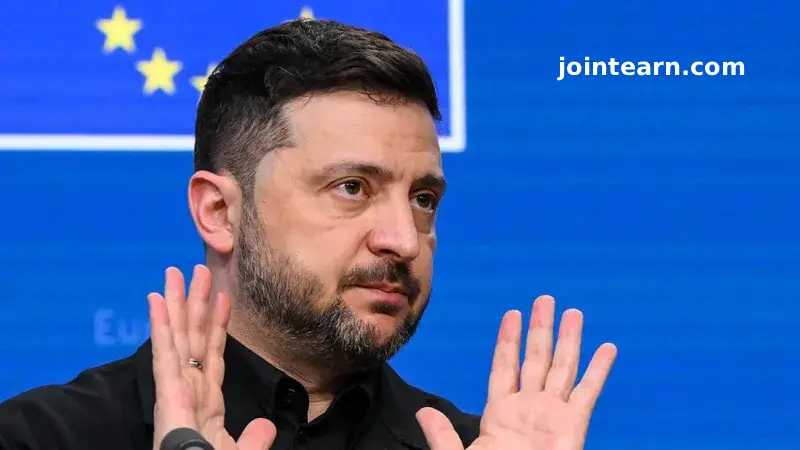
As Ukraine faces a looming financial crisis, President Volodymyr Zelensky has issued a stark warning to European Union leaders, urging them to reach an agreement by the end of the year to release frozen Russian assets to fund Ukraine’s military and economic needs.
Speaking at a crucial EU summit in Brussels, Zelensky stressed that without a major financial injection by spring 2026, Ukraine “will have to reduce production of drones,” threatening the country’s ability to defend itself against Russian aggression.
Frozen Russian Assets and EU Divisions
Most of Russia’s €210 billion in EU-based assets are held by Belgium-based Euroclear. Until now, Belgium and several other member states have opposed using the funds as a “reparations loan” to Ukraine. This hesitancy comes amid warnings from Russia, which has filed a lawsuit in a Moscow court attempting to reclaim the assets.
Polish Prime Minister Donald Tusk has argued that the EU must rise to the occasion, emphasizing the strategic necessity of supporting Ukraine. Meanwhile, Belgian Prime Minister Bart De Wever has acknowledged the legal and financial risks, describing the situation as “jumping into the abyss together with the rest of the Europeans and hoping the parachute holds.”
European Commission chief Ursula von der Leyen reiterated the urgency, vowing, “We will not leave the summit without a solution,” while a European official described the bloc as “cautiously optimistic” that an agreement could be reached.
Proposed EU Loan to Ukraine
The European Commission has proposed loaning Kyiv €90 billion over two years, approximately two-thirds of the €137 billion Ukraine needs to cover its 2026–2027 budget shortfall. The plan would draw from Russia’s frozen assets, which until now have only generated interest for Ukraine without providing direct funding.
Supporters of the move argue that releasing the funds would strengthen Ukraine’s position in ongoing peace negotiations and send a clear signal to Moscow that continuing the war is costly and unsustainable. A Finnish official noted, “This gives Ukraine leverage to say ‘we’re not desperate, and we have the funds to continue fighting.’”
Legal and Political Hurdles
Despite EU confidence in the legal basis for using frozen Russian assets, unanimity among member states is far from guaranteed. Belgium remains the pivotal player, and countries like Hungary, Malta, Bulgaria, and the Czech Republic have expressed reservations.
Hungarian Prime Minister Viktor Orban has openly opposed further EU money for Ukraine, while Slovakian Prime Minister Robert Fico objects if the funds are used to procure weapons rather than for reconstruction. Italy’s Giorgia Meloni has indicated she will support the plan “if the legal basis is solid.”
Fitch ratings have placed Euroclear on a negative watch due to potential legal risks, and the Euroclear CEO has warned against the initiative. EU officials are exploring financial guarantees to mitigate these risks and ensure Belgium’s concerns are addressed.
Diplomatic Context and US Involvement
The summit comes at a pivotal moment in the war, as US-Russia peace talks are scheduled in Miami this weekend. Kremlin envoy Kirill Dmitriev is expected to meet with envoys from the Trump administration, including Steve Witkoff and Jared Kushner.
Ukraine is also sending officials to the United States for discussions on security guarantees, designed to protect Kyiv from future Russian aggression. Meanwhile, Russian President Vladimir Putin continues to criticize Europe, dismissing the continent as in “total degradation” and disparaging Ukraine’s European allies.
Why the Decision Matters
For Ukraine, the EU’s decision on whether to release frozen Russian assets is not just financial—it is existential. With a projected deficit of €45–50 billion next year, the country faces a critical choice between continuing military operations or diverting funds for reconstruction.
The agreement would also increase the cost of war for Russia, signaling that the EU is prepared to support Ukraine robustly, even amid internal divisions. If successful, the plan could secure a multi-billion-euro lifeline for Ukraine while providing a framework for holding Russia accountable for its aggression.
European Council President António Costa has emphasized that no EU vote will override Belgium’s position. Officials are committed to addressing legal and financial risks, ensuring that any use of frozen Russian assets is backed by a strong legal framework.


Leave a Reply