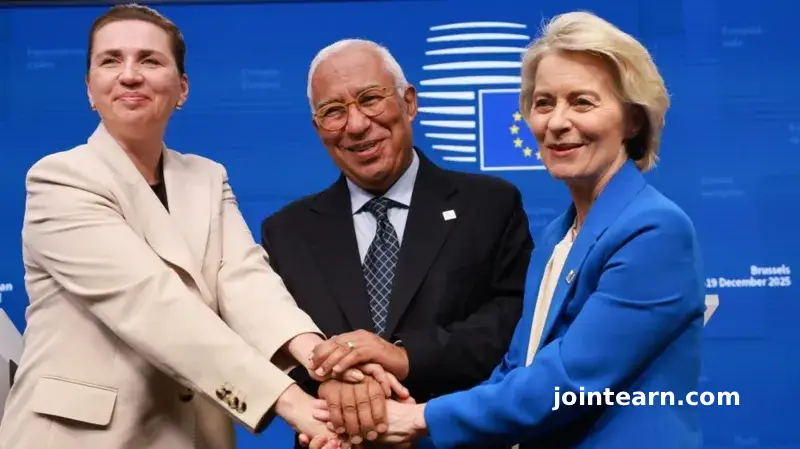
European Union leaders have reached a historic agreement to provide Ukraine with a €90 billion (€105 billion / £79 billion) loan to support its military and economic needs over the next two years. The decision comes after intense negotiations at a summit in Brussels, where EU leaders were unable to agree on using frozen Russian assets to finance the aid package.
EU Leaders Reach Consensus Amid Complex Talks
The deal was announced by European Council President Antonio Costa, who emphasized that the agreement would meet Ukraine’s urgent financial requirements and maintain EU unity. “We committed, we delivered,” Costa wrote on X, highlighting that the loan would be backed by the EU’s common budget rather than Russian reserves.
Ukrainian President Volodymyr Zelensky had previously called for the EU to unlock €200 billion in frozen Russian assets to fund Ukraine’s defense and reconstruction efforts. However, Belgium, which holds the majority of these assets, insisted on guarantees regarding shared liability, a demand that other EU member states could not accept.
Zelensky expressed his gratitude to the European leaders, describing the deal as “significant support that truly strengthens our resilience”. He stressed the importance of keeping Russian assets frozen and thanked the EU for maintaining unity in a critical moment.
Why the EU Avoided Russian Assets
Belgian Prime Minister Bart De Wever explained that EU leaders wanted to prevent division and chaos within the bloc. By agreeing to a loan drawn from the EU’s budget rather than frozen Russian funds, the EU maintained a cohesive approach while providing Ukraine with the financial lifeline it urgently needed.
Germany’s Chancellor Friedrich Merz, who had strongly advocated for using Russian assets, noted that the decision sends a clear message to Russia about European solidarity with Ukraine. Meanwhile, Polish Prime Minister Donald Tusk emphasized the moral and strategic necessity of supporting Kyiv, despite Russian objections.
Ukraine Faces Imminent Financial Challenges
Ukraine is facing a severe cash crunch, with estimates suggesting it needs an additional €135 billion over the next two years to maintain essential operations. Without immediate financial support, Zelensky warned that Ukraine would be forced to reduce drone production and cut critical defense expenditures as early as April.
The EU’s €90 billion loan provides a much-needed bridge, giving Ukraine time to stabilize its economy and continue military operations against Russian aggression.
Diplomatic Developments and International Engagement
The loan comes amid active diplomacy on the war in Ukraine. French President Emmanuel Macron suggested that Europe could benefit from re-engaging with Russian President Vladimir Putin, proposing that discussions continue in the coming weeks to establish a “proper framework” for dialogue.
On the international front, U.S. officials confirmed that discussions between Russian and American delegations would take place in Miami this weekend, with the aim of advancing peace talks. Ukrainian and U.S. delegations are also scheduled to meet to discuss additional security guarantees that would protect Ukraine from future invasions.
Conclusion: A Lifeline for Ukraine
The EU’s decision to provide a €90 billion loan marks a major financial and political commitment to Ukraine at a critical time. While the debate over frozen Russian assets remains unresolved, the loan ensures that Ukraine can continue defending its sovereignty and maintaining economic stability. This agreement not only reinforces European unity but also strengthens Kyiv’s position in ongoing diplomatic negotiations.


Leave a Reply