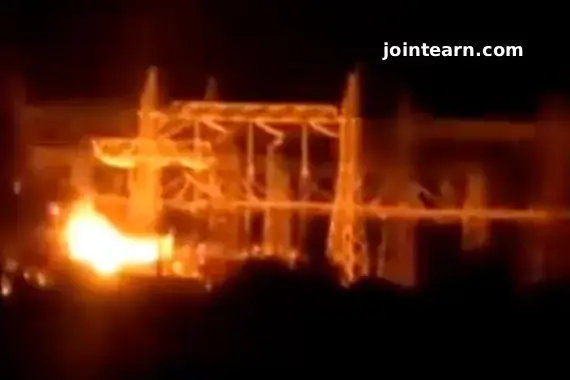
Major cities across Sudan, including the capital Khartoum and the key port city of Port Sudan, were plunged into darkness after drone strikes targeted a critical power plant in Atbara, River Nile state, on Thursday. Flames and smoke erupted from the facility, controlled by the Sudanese Armed Forces (SAF), amid continued attacks by the paramilitary Rapid Support Forces (RSF) in the ongoing civil war that has devastated the country.
Civilian Casualties and Infrastructure Damage
Two civil defense workers were killed while attempting to extinguish the initial fire, and additional rescue personnel were injured during a second drone strike, according to power plant officials. The attacks mark the latest escalation in a drone warfare campaign that has crippled infrastructure and claimed civilian lives.
Al Jazeera correspondent Mohamed Vall in Port Sudan explained:
“RSF drones are traveling thousands of kilometers across Sudan, targeting key facilities to weaken the government and show the population that the military cannot provide protection.”
The strikes follow a series of deadly attacks, including the bombing of a kindergarten and hospital in Kalogi, South Kordofan, killing 89 people, including 43 children and eight women. Six Bangladeshi peacekeepers were also killed when drones struck their base in Kadugli on December 13, prompting UN Secretary-General Antonio Guterres to warn that targeting peacekeepers “may constitute war crimes under international law.”
Rising Use of Drones in Sudan’s Civil War
Drone attacks have been extensive, conducted by both the SAF and RSF. According to the Africa Center for Strategic Studies, Sudan accounted for 264 of 484 drone strikes across 13 African countries in 2024. By March 2025, the SAF claimed to have shot down over 100 drones in just ten days, highlighting the intensity of the aerial warfare.
Humanitarian Crisis and Sexual Violence
Sudan has been in turmoil since April 2023, when a power struggle between the SAF and RSF escalated into open conflict. Estimates suggest over 100,000 deaths and more than 14 million people displaced, with at least 30 million in need of humanitarian aid.
The UN and other agencies have warned of alarming sexual violence, with women disproportionately affected. UN Human Rights spokesperson Seif Magango described conditions in cities like el-Fasher as horrific, with women facing gang rape while fleeing bombings.
Medical facilities have also been heavily targeted. WHO chief Tedros Adhanom Ghebreyesus reported over 1,600 deaths in 65 attacks on healthcare centers in 2025 alone, further worsening the humanitarian emergency.
Evidence Destruction and RSF Atrocities
A recent report from Yale School of Public Health’s Humanitarian Research Lab revealed that RSF forces systematically destroyed evidence of mass killings in el-Fasher through burial, burning, and removal of human remains after capturing the city in October.
Conclusion
Sudan’s civil war has reached a critical point, with drone warfare crippling infrastructure, civilians at risk, and humanitarian access severely restricted. International observers warn that without urgent intervention, the conflict could worsen, leaving millions more in peril as the SAF and RSF continue their deadly struggle for control.


Leave a Reply