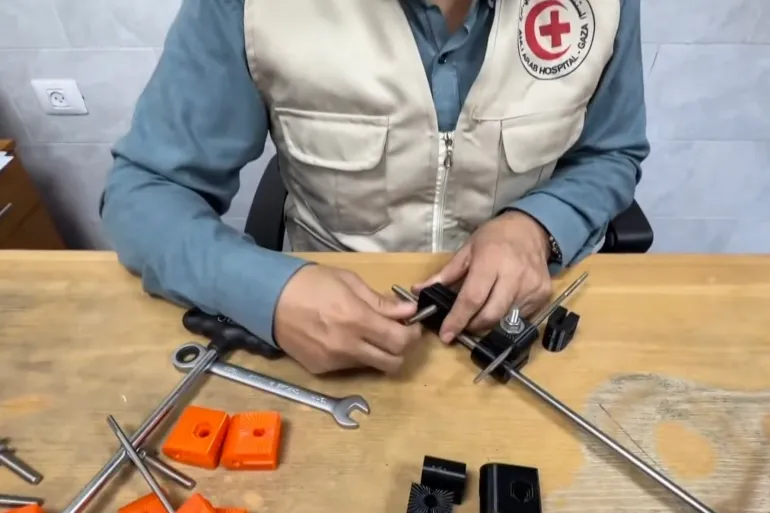
In Gaza, doctors are finding innovative ways to save lives and prevent amputations as the enclave’s medical infrastructure collapses under continuous Israeli military attacks. Using solar-powered 3D printers, medical teams are creating low-cost external fixators to treat complex fractures caused by the conflict.
Life-Saving Innovation in a War Zone
Dr. Fadel Naim, consultant orthopedic surgeon and acting director general of al-Ahli Arab Hospital in Gaza City, explained that the fixators are assembled from recycled materials, metal rods, and bolts. These devices stabilize shattered limbs, offering a chance to recover mobility where conventional treatment would be unaffordable or unavailable.
“The fractures we treat, especially in this war, are extremely complex. The external fixator is the most suitable treatment,” Dr. Naim said, demonstrating the assembly process.
The initiative, developed in collaboration with medical solidarity organization Glia, allows the creation of devices that would normally cost over $500 each. Using open-source designs and solar energy, doctors can produce these lifesaving devices without relying on unstable electricity from the grid.
Patients Walk Again
One of the first patients to benefit, Zakaria, displaced from Jabalia refugee camp to Deir el-Balah, survived a severe leg injury from Israeli shelling.
“I was injured in August and brought to the hospital with no care. Two weeks later, they used a Palestinian-made device to fix my leg. Now I can walk without pain,” he said.
Dr. Naim confirmed Zakaria’s full recovery of movement, emphasizing the impact of locally produced medical devices in a city struggling with electricity blackouts and overwhelmed hospitals.
Gaza Healthcare in Crisis
The Gaza Strip has suffered extensive damage during the war. As of December 9, 63% of hospitals remain nonfunctional, according to UN agencies. More than 282,000 housing units have been destroyed, leaving around 1.5 million Palestinians displaced. Over 70,000 people have been killed since the escalation began on October 7, 2023.
Amid this humanitarian crisis, the solar-powered 3D printing project has become a lifeline, with 12 more patients awaiting treatment. Glia highlighted the global relevance of the project, stating it offers a model for other conflict zones, disaster-affected regions, and climate-vulnerable communities worldwide.
A Symbol of Resistance and Ingenuity
Hind Khoudary of Al Jazeera reported:
“In a place where everything is being destroyed, Palestinian doctors are still creating, still resisting, still saving lives – one printed piece at a time.”
This initiative underscores the resilience and ingenuity of Gaza’s medical professionals, demonstrating how 3D printing technology can mitigate the effects of war, electricity shortages, and humanitarian blockades.


Leave a Reply