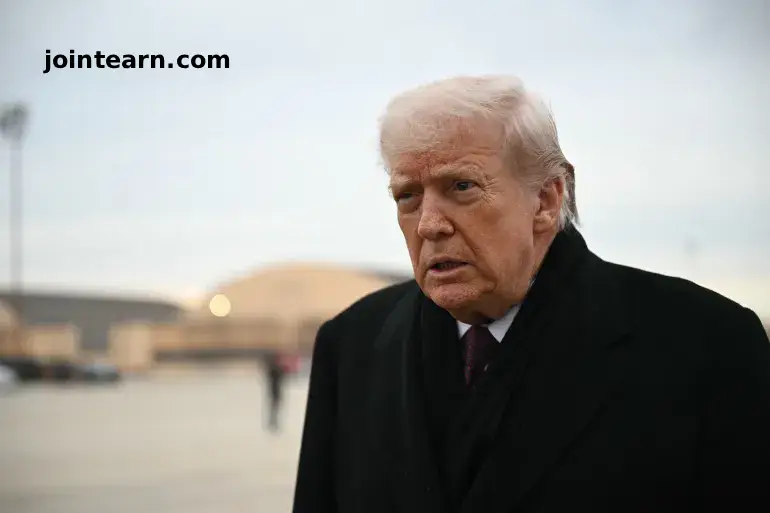
The United States military has carried out large-scale air and artillery strikes against ISIL (ISIS) targets in Syria, following the deaths of two US National Guard members and a civilian interpreter in Palmyra last week. President Donald Trump described the operation as a “massive strike” and a declaration of vengeance for the attack that claimed the lives of three Americans.
Trump Confirms Strikes and Praises Precision
Speaking in Rocky Mount, North Carolina, President Trump stated that the operation targeted “the terrorists that killed our three great patriots last week” and was “very successful” with all sites hit flawlessly. He emphasized that the strike demonstrates the US approach of restoring peace through strength worldwide.
Trump also highlighted that the Syrian government, formed after the fall of Bashar al-Assad’s regime in late 2024, fully supported the operation. Syrian authorities reiterated their commitment to fighting ISIL and welcomed the involvement of US and coalition forces in eliminating the terrorist threat.
Operation Hawkeye Strike: Targets and Tactics
US Secretary of Defense Pete Hegseth confirmed that the operation, dubbed Operation Hawkeye Strike, targeted ISIL fighters, infrastructure, and weapons sites. Hegseth called the operation a “declaration of vengeance” and assured that the US would continue to hunt and eliminate ISIL fighters.
The US Central Command (CENTCOM) reported deploying fighter jets, attack helicopters, and artillery, dropping over 100 precision munitions on known ISIL positions across Homs, Deir Az Zor, and Raqqa provinces. The Jordanian Armed Forces also supported the mission with fighter aircraft.
According to local sources, residents in Palmyra and Raqqa heard loud explosions and the roar of fighter jets during the night, signaling the operation’s intensity.
Casualties and Results
Rami Abdel Rahman, head of the Syrian Observatory for Human Rights, confirmed that at least five ISIL members were killed in eastern Syria, including the leader of a cell responsible for drone operations. One US official stated that 70 targets linked to ISIL infrastructure and weapons were destroyed during the strikes.
Although no US ground forces participated directly, the operation is seen as a significant blow to ISIL cells operating in Syria’s vast Badia desert.
Background: Palmyra Attack and US Retaliation
The strikes come a week after three Americans – two National Guard members and a civilian interpreter – were killed in Palmyra by an ISIL attacker who targeted a joint US-Syrian convoy. Three additional US soldiers were wounded.
Approximately 1,000 US troops remain stationed in Syria as part of ongoing operations targeting ISIL remnants. The US-led coalition has previously carried out multiple air strikes and ground operations in Syria, often in collaboration with Syrian security forces.
Syria’s Role and Regional Implications
Syria’s President Ahmed al-Sharaa has publicly supported efforts to eradicate ISIL, aiming to demonstrate that Syria is no longer a safe haven for terrorists. Al-Sharaa’s cooperation with the US also appears to be part of a broader effort to improve Syria’s international image after the fall of Assad’s regime.
The strikes place additional pressure on the US, Jordan, Syrian forces, and Kurdish-led Syrian Democratic Forces to coordinate efforts in eliminating ISIL threats, while simultaneously highlighting Syria’s ongoing struggle to maintain security and rebuild after years of civil war.
ISIL in Syria: A Continuing Threat
ISIL captured Palmyra in 2015, using the city to stage mass killings and destroy cultural heritage. Although ISIL was militarily defeated in Syria by 2018, the group continues to carry out sporadic attacks, posing a security threat to both civilians and coalition forces.
The recent US strikes aim to dismantle remaining ISIL cells, prevent them from regaining territory, and reinforce the US commitment to combating global terrorism.


Leave a Reply