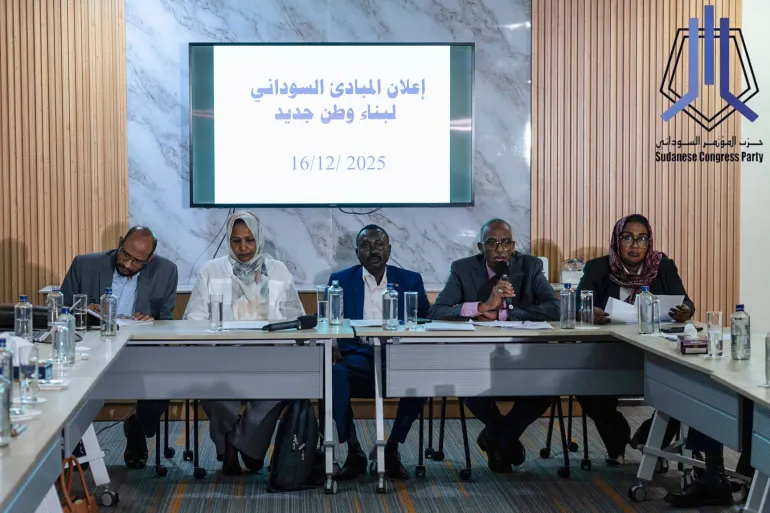
On December 16, 2025, a coalition of Sudanese political parties, armed movements, civil society organizations, and prominent political figures signed a nine-point political roadmap in Nairobi, Kenya, presenting it as a civilian-led initiative aimed at ending Sudan’s protracted conflict and restoring a democratic transition.
Framed as an anti-war, pro-peace platform, the Nairobi roadmap seeks to establish civilians as a “third pole” in Sudan, positioned against the two dominant military actors: the Sudanese Armed Forces (SAF) and the paramilitary Rapid Support Forces (RSF).
Objectives of the Nairobi Declaration
The authors of the roadmap argue that it represents a bid to reclaim civilian political agency after months of marginalization by armed actors and international mediators. While the declaration signals intent for civilian leadership, critics note that it lacks concrete proposals for military reform, raising questions about its practical impact.
The roadmap echoes key points from the Quad statement released in September 2025 by Egypt, Saudi Arabia, the United Arab Emirates (UAE), and the United States, which called for:
- A three-month truce as a precursor to a permanent ceasefire
- Expanded humanitarian access to aid civilians
- Creation of a civilian-led political process
- Exclusion of remnants of former President Omar al-Bashir’s regime
- Reform of Sudan’s security forces under civilian oversight
Key Signatories and Civilian Representation
The Nairobi declaration includes diverse stakeholders:
- National Umma Party
- Sudanese Congress Party
- Civil society organizations such as the Darfur Lawyers Association and Coordination of Internally Displaced Persons and Refugees
- Sudan Liberation Movement (SLM-AW), led by Abdelwahid al-Nur
Former Prime Minister Abdalla Hamdok, who led Sudan’s transitional civilian government from 2019 until the October 2021 military coup, also endorsed the declaration. Al-Nur, a longstanding Darfur-based armed leader, lent his support, though his participation sparked debate about whether the initiative truly empowers civilians or serves as an elite counterbalance to military-aligned forces.
Critiques: Elite Politics vs. Grassroots Inclusion
Sudanese researcher Hamid Khalafallah noted that while the Nairobi roadmap projects civilian leadership, it falls short of representing Sudan’s broader civic movement.
- Resistance committees, grassroots groups central to the 2019 anti-Bashir protests, were referenced but did not formally endorse the declaration.
- The drafting process reportedly bypassed extensive consultation with local communities, raising concerns that civilians remain political instruments rather than decision-makers.
- Critics argue that the coalition mirrors earlier elite-driven formations that have historically struggled to engage the majority of Sudanese citizens affected by conflict.
Fragmented Civilian Landscape
Before the Nairobi declaration, Sudan’s civilian scene was already divided into three main coalitions:
- Tasis: Political parties and armed movements founded in February 2025, later forming an RSF-aligned parallel government.
- Democratic Bloc: Parties and armed groups aligned with the SAF.
- Sumoud: Led by Hamdok, accused by the SAF of supporting the RSF.
This fragmentation has complicated efforts to establish a unified civilian process capable of challenging military dominance.
European and International Perspectives
European officials have expressed skepticism toward the Nairobi roadmap. A senior European Union diplomat told Al Jazeera that Brussels does not see Nairobi as the foundation for a unified civilian process.
“We would like to see only one civilian process, that’s why we are helping the African Union (AU). Everything else is a distraction,” the EU official said.
The EU emphasizes the need for a single credible civilian framework, inclusive and broadly accepted by Sudanese society, to ensure a viable third pole between the RSF and SAF.
Warring Parties and Ongoing Challenges
Despite the roadmap, Sudan’s armed factions remain central to any cessation of hostilities. Recent agreements mediated by South Sudan include SAF and RSF withdrawal from the Heglig oil facility, highlighting the ongoing strategic importance of military actors in Sudan’s political and economic landscape.
US-Africa policy expert Cameron Hudson observed that the Nairobi initiative seems designed to align with international expectations, particularly the Quad’s objectives, rather than cultivating domestic consensus. He warned that linking ceasefire efforts to political reforms prematurely risks undermining the transition process.
The Road Ahead: Civilian-Led Peace or Elite Strategy?
While the Nairobi roadmap signals an attempt at civilian empowerment, analysts caution that it may replicate elite-driven politics under the guise of grassroots inclusion. The central question remains whether Sudanese civilians will be genuine architects of peace or if military and elite interests will continue to dominate.
As Sudan navigates these complex dynamics, international actors—ranging from the Quad to the EU and AU—face the ongoing challenge of balancing humanitarian priorities, ceasefire enforcement, and democratic transition in a deeply fractured political landscape.


Leave a Reply