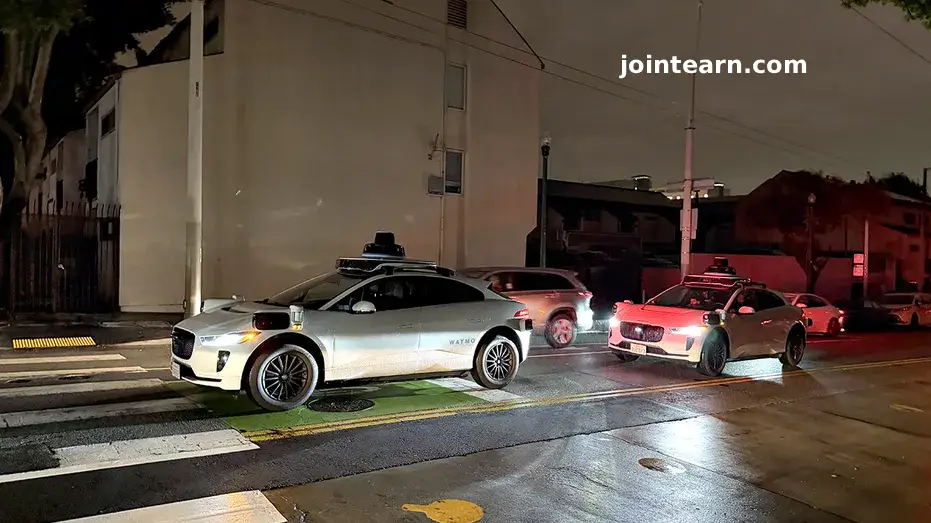
A widespread power outage in San Francisco over the weekend caused Waymo’s self-driving taxis to stop operating, leaving several vehicles stranded in the middle of city streets and intersections. The outage, triggered by a fire at a PG&E substation, affected more than 100,000 residents and caused significant disruption to traffic and public transportation.
Waymo Robotaxis Stop in the Streets
Videos shared on social media captured Waymo robotaxis idling with hazard lights flashing while drivers navigated around the stopped vehicles. Waymo, owned by Alphabet, the parent company of Google, temporarily paused all operations in the Bay Area during the outage.
A Waymo spokesperson told the BBC:
“While the Waymo Driver is designed to treat non-functional signals as four-way stops, the sheer scale of the outage led to instances where vehicles remained stationary longer than usual to confirm the state of the affected intersections. That contributed to traffic friction during the height of the congestion.”
Despite the disruption, most ongoing trips were completed before vehicles were returned to depots or safely pulled over, the spokesperson added.
Traffic and City Response
The outage affected traffic signals across San Francisco, prompting Mayor Daniel Lurie to deploy police officers, fire crews, and city personnel to manage traffic flow. Some commuter train lines and stations also experienced temporary shutdowns.
Utility provider PG&E described the damage as “significant and extensive” and confirmed that power had been restored to all but 17,000 customers by Sunday afternoon, with full restoration expected by Monday.
Waymo’s Growing Presence
Waymo continues to expand its autonomous ride-hailing services across the San Francisco Bay Area, as well as in Los Angeles, Phoenix, Austin, Atlanta, Miami, and other parts of Texas. The company plans to launch services in London and Washington, DC, next year.
In 2025 alone, Waymo reported over 14 million rides, tripling the number of trips provided in 2024. The company’s autonomous technology continues to evolve, though events like the San Francisco blackout highlight the challenges self-driving vehicles face during large-scale infrastructure failures.
What This Means for Autonomous Vehicles
The incident underscores the importance of autonomous vehicle safety protocols and the ability of self-driving systems to navigate complex, real-world situations. Waymo’s vehicles are programmed to handle non-functional traffic signals as four-way stops, but large-scale power outages can still create traffic congestion and operational delays.
City officials and tech companies are increasingly focused on ensuring autonomous fleets can safely respond to emergency scenarios and infrastructure disruptions, a consideration that will be vital as autonomous vehicles become more widespread in urban environments.


Leave a Reply