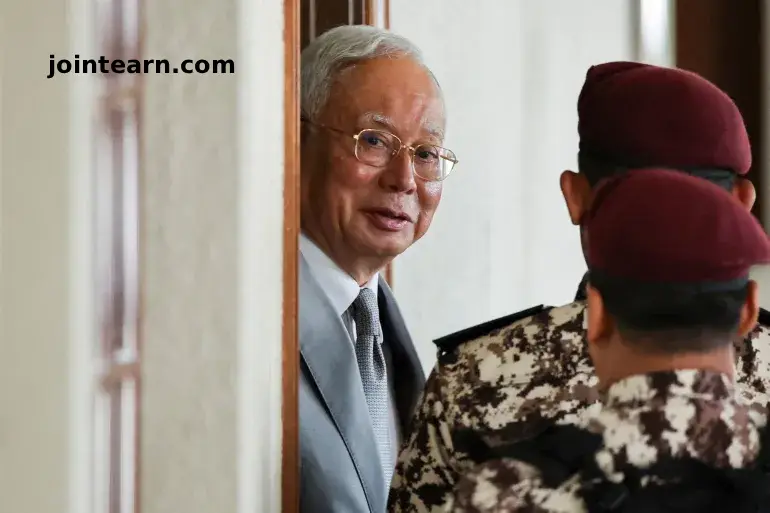
In a landmark ruling, Malaysia’s former Prime Minister Najib Razak has been found guilty of money laundering and abuse of power in his second major trial linked to the multibillion-dollar 1MDB scandal. The verdict, delivered by the Kuala Lumpur High Court, marks a significant moment in Malaysia’s ongoing battle against corruption at the highest levels of government.
Najib, 72, faced a total of 25 charges, including 21 counts of money laundering and four counts of abuse of power. These charges were related to the unlawful transfer of 2.2 billion Malaysian ringgit (approximately $543 million) from the 1Malaysia Development Berhad (1MDB) sovereign wealth fund into his personal accounts.
Court Verdict and Judge’s Statement
Judge Collin Lawrence Sequerah stated in his ruling that Najib’s claims that the charges were politically motivated were refuted by clear evidence demonstrating that he had misused his official powers. “The evidence against the accused is incontrovertible and points directly to his abuse of authority in 1MDB, coupled with the extensive powers conferred upon him,” the judge noted.
Each count carries a potential prison sentence ranging from 15 to 20 years, though final sentencing has not yet been announced.
Background on the 1MDB Scandal
The 1MDB scandal first came to light in 2015 and quickly became a defining moment in Malaysian politics. The scandal centered on the misappropriation of billions of dollars from the state-run sovereign wealth fund, implicating Najib Razak, who served as both Prime Minister and Finance Minister, and also chaired the 1MDB advisory board.
Najib had previously been convicted in 2020 for misappropriating $9.9 million in 1MDB funds, resulting in a 12-year prison sentence, later reduced to six years. This latest conviction, however, involves far larger sums and is widely considered the most significant to date in terms of political accountability and legal precedent.
The Lengthy Trial Process
The trial, which has spanned over seven years, was one of the most complex in Malaysian legal history. Lawyers called 76 witnesses, including Najib himself, to testify on various aspects of the case. The proceedings included extensive documentation of financial transactions and communications linking Najib to the fugitive financier Jho Low, who allegedly acted as a proxy in facilitating the transfers of 1MDB funds.
Bridget Welsh, honorary research associate at the University of Nottingham Asia Research Institute Malaysia, described the trial as “multi-layered and highly complex,” reflecting the sophisticated nature of the financial crimes involved.
Najib Razak’s Defense and Apology
During the trial, Najib maintained that he had been misled by Jho Low, a financier wanted by Interpol since 2016. He also attempted to claim that some funds were donations from the Saudi royal family, a defense that the judge rejected. Despite his recent apology for mishandling the 1MDB scandal, the court found him guilty on all counts.
Political Implications
The verdict has wide-reaching implications for Malaysian politics. The 1MDB scandal played a key role in unseating the United Malays National Organisation (UMNO) in 2018 after decades in power. Despite his convictions, Najib remains popular among segments of the Malaysian population, and the trial has been described as a “red line” issue for UMNO, which is part of Prime Minister Anwar Ibrahim’s unity government coalition.
Political analyst James Chai warned that the conviction could create tensions within the coalition, potentially destabilizing the current government. “While the judgment was fair and thorough, it may be perceived as harsh by Najib supporters amid shifting political sentiments,” Chai noted.
A Test for Malaysia’s Judiciary
Legal experts have emphasized that the outcome of this trial represents a crucial test of Malaysia’s judiciary and the broader political will to enforce accountability. Bridget Welsh of the Asia Research Institute stated, “This case is a litmus test for the integrity of Malaysia’s legal system, especially when the convicted individual has deep ties to a major political party within the ruling coalition.”
With sentencing and potential appeals still pending, the nation will closely watch how Malaysia continues to confront high-level corruption and strengthen its judicial system. The 1MDB case remains one of the most significant corruption scandals in Southeast Asia, setting a precedent for future accountability efforts.


Leave a Reply