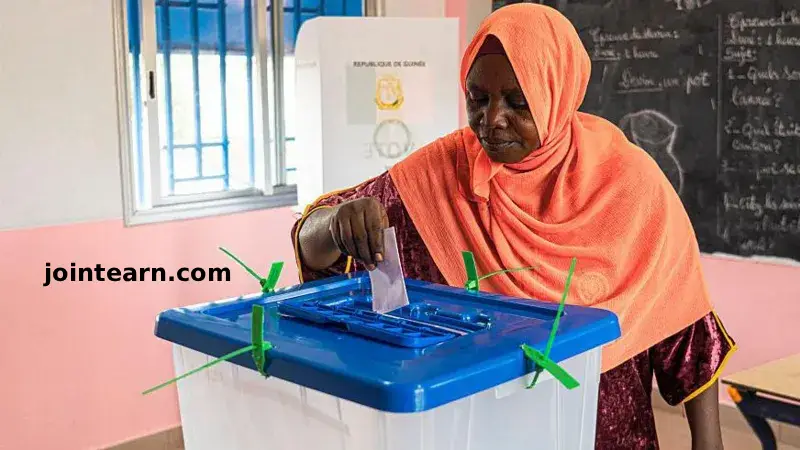
Voters in Guinea and the Central African Republic (CAR) are heading to the polls this Sunday to elect their presidents for seven-year terms. While both contests could theoretically proceed to run-off ballots, observers predict that the incumbents are strong favorites, likely securing victory in the first round with over 50% of the vote.
However, the similarities largely end there, with the political contexts and candidates’ backgrounds sharply contrasting between the two countries.
CAR: A Mathematician Seeking a Third Term
The CAR, a vast and landlocked nation, remains one of Africa’s poorest countries, enduring decades of instability fueled by armed groups, political rivalries, and local grievances. From 2013 to 2016, African, French, and UN peacekeepers prevented a slide into deeper inter-communal violence, though the central government in Bangui has historically struggled to assert control over distant northern and eastern regions.
Despite fragilities, multi-party politics has largely persisted, with tolerance for opposition and protest. This year, two major rebel groups have returned to the peace process, beginning disarmament and demobilization efforts. The CAR also boasts a special court for human-rights crimes, staffed by national and international judges.
President Faustin-Archange Touadéra, a mathematician and former university vice-chancellor, entered politics as prime minister under François Bozizé. He was later elected president as a post-conflict consensus figure and is now seeking a third term after changing the constitution to remove term limits.
Touadéra has become more political and partisan, yet the election still allows his main rival, Anicet-Georges Dologuélé, to contest, marking a notable exception compared with other African countries experiencing limited electoral competition.
Guinea: A General Transitioning to Civilian Rule
In Guinea, Gen Mamadi Doumbouya, leader of the September 2021 coup that deposed President Alpha Condé, is preparing to convert his junta leadership into constitutional civilian authority. Although facing eight challengers, Doumbouya dominates the campaign, with opposition leaders such as Cellou Dalein Diallo barred from participating, limiting political choice.
Doumbouya’s approach contrasts with neighboring military regimes in Mali, Burkina Faso, and Niger, which withdrew from the Economic Community of West African States (Ecowas). By maintaining good relations with France and Western governments, Doumbouya has secured international goodwill despite human rights concerns.
Notably, he advanced the long-delayed trial over the 2009 stadium massacre, demonstrating a commitment to accountability. Guinea’s return to an elected government is welcomed by regional and European leaders as a step toward stability and reintegration into the Ecowas framework.
Regional and International Context
Both CAR and Guinea have faced political fragility, insurgencies, and coups. The CAR relies heavily on the UN peacekeeping force Minusca to restore administration and services, while the country maintains security ties with Russia alongside partnerships with France, the EU, and the UN.
Guinea’s election comes at a time of regional instability, with jihadist groups disrupting life in southern Mali and Burkina Faso. Doumbouya’s controlled transition is seen as a gradual move toward constitutional stability, despite concerns over civil rights violations and electoral constraints.
Conclusion
The elections in Guinea and the CAR reflect diverging paths to political continuity: a general consolidating power through a constitutional process in Guinea, and a mathematician-turned-politician navigating post-conflict governance in the CAR.
Both countries’ leadership choices carry significant implications for regional stability, democracy, and international engagement, with voters facing elections that are at once symbolic of progress and constrained by the realities of fragile state institutions.


Leave a Reply