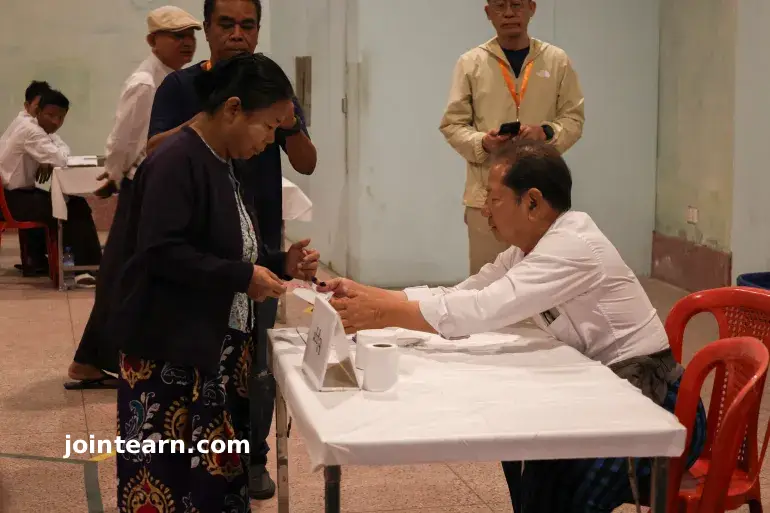
Myanmar’s main pro-military party, the Union Solidarity and Development Party (USDP), has claimed a sweeping lead in the first phase of elections organised by the country’s military rulers. Critics argue that the tightly controlled vote is designed to consolidate the military’s grip on power, raising concerns over democracy and human rights.
First Phase of Voting
The first round of voting took place on Sunday, covering roughly a third of Myanmar’s 330 townships. Two additional rounds are scheduled for January 11 and January 25, 2026. Voting has already been cancelled in 65 townships due to security concerns.
A senior USDP official told AFP that the party had won 82 of 102 lower house seats in townships where counting was complete, translating to more than 80% of the contested seats. The party also claimed victory in all eight townships in the capital, Naypyidaw. Official results from Myanmar’s Union Election Commission are yet to be published.
International Condemnation
The elections have been widely criticized by the international community. The United Nations human rights chief condemned the vote, highlighting a crackdown on dissent and restrictions on opposition candidates. Campaigners noted that candidate lists were dominated by figures aligned with the military.
Only a limited portion of the country could participate due to ongoing fighting between the military and opposition forces following the 2021 coup that ousted Nobel Peace Prize laureate Aung San Suu Kyi. Large parts of Myanmar remain inaccessible because of the civil conflict, which has killed an estimated 90,000 people, displaced 3.5 million, and left 22 million in need of humanitarian assistance.
Background: USDP and Military Influence
The USDP is widely considered a civilian proxy for the military. In the 2020 elections, it suffered a crushing defeat to Suu Kyi’s National League for Democracy (NLD). Since the 2021 military coup, the NLD and 39 other political parties have been banned, and Suu Kyi has been detained.
Military leader Min Aung Hlaing has ruled Myanmar by decree since the coup and has promised to return power to a civilian-led government, although skeptics doubt the credibility of this commitment. The election comes amid a nationwide civil war, with pro-democracy activists forming armed resistance alongside long-standing ethnic minority militias.
Humanitarian and Political Crisis
The ongoing conflict has caused severe humanitarian crises:
- 90,000 fatalities
- 3.5 million internally displaced persons
- 22 million people in need of aid
- Over 22,000 political prisoners, according to the Assistance Association for Political Prisoners
The military government insists that the elections are legitimate and a step toward restoring civilian rule. However, campaigners and international observers warn that the vote is unlikely to reflect genuine democratic representation.


Leave a Reply