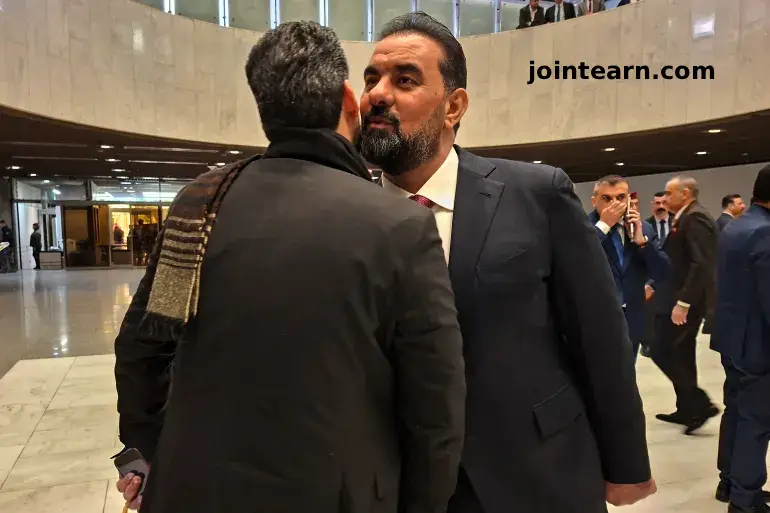
Iraq’s newly elected Council of Representatives held its first session on Monday, marking a crucial step in forming the country’s next government. Haybat al-Halbousi, from the Taqaddum (Progress) Party, was elected as speaker of parliament, receiving 208 votes, decisively beating two rivals who received 66 and 9 votes, respectively.
Al-Halbousi’s Victory and Political Background
Al-Halbousi’s Taqaddum Party draws its support primarily from Sunni-majority regions in western and northern Iraq. His election as speaker is in line with Iraq’s muhasasa system, a power-sharing arrangement established after 2003, which dictates that the speaker is typically a Sunni, the president a Kurd, and the prime minister a Shia.
The first sitting of parliament was highly anticipated, as Iraqis seek clarity following the November 11 elections, which produced a fragmented parliament and a complex path to government formation.
Iraq’s Muhasasa System and Government Formation
Under muhasasa:
- Speaker of Parliament – a Sunni candidate (elected first)
- President of Iraq – a Kurdish candidate, elected after the speaker
- Prime Minister – nominated by the president from the largest Shia bloc, the Shia Coordination Framework (SCF)
Although the Federal Supreme Court (FSC) ratified the election results faster than usual, the political landscape remains complicated. Historically, forming a government can take months; in 2021, it took over 300 days.
Prime Ministerial Controversy
Incumbent Prime Minister Mohammed Shia al-Sudani, previously nominated by the SCF, ran an independent list in the elections under the Reconstruction and Development Coalition (RDC), winning 46 of 329 parliamentary seats. However, an FSC ruling reinstated him under SCF control.
The SCF now faces critical decisions: whether to continue supporting al-Sudani or select an alternative candidate as prime minister. Complicating matters, the growing parliamentary influence of pro-Iran Shia factions, many under US sanctions, now totals 80–90 of the SCF’s 180 lawmakers. This represents a significant rise from 17 seats in 2021, raising concerns about Iraq’s foreign relations and internal political balance.
Challenges Ahead
Al-Halbousi’s election as speaker is just the first step in a complex, multi-step government formation process. Iraqis and international observers will closely monitor:
- SCF decisions on the prime ministership
- The role of pro-Iran Shia factions in parliament
- Maintaining Iraq’s delicate balance between domestic politics and foreign influence
While the muhasasa system ensures representation for Iraq’s major ethnic and sectarian groups, it also complicates consensus-building, particularly in a parliament now characterized by growing external influence and factional rivalries.


Leave a Reply