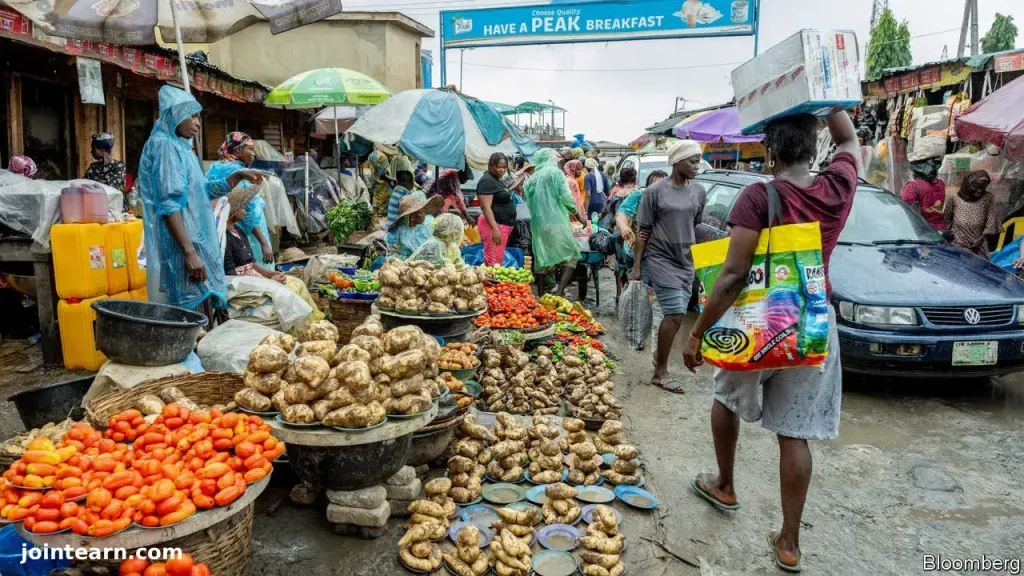
“There are only two families in the world, my grandmother used to say: the Haves and the Have-nots.” – Miguel de Cervantes, 1547–1616
2025 in Review: Budget of Restoration
The Budget of Restoration, presented by President Tinubu at the start of 2025, set the stage for an economy running on one strong engine—monetary policy—while fiscal policy sputters. The most visible outcome is a widening gap between the rich and poor. While the Haves grew wealthier, the Have-nots and disappearing Middle Class saw little benefit from economic recovery.
Farmers, a crucial but vulnerable segment, ended the year poorer than before, with many unwilling to farm in 2026. Social unrest is brewing: the Nigerian Labour Congress (NLC) called for a protest on December 18, 2025, signaling a potential national strike in early 2026.
Despite a modest GDP growth of 4%—higher than the 3.6% forecast—most Nigerians saw no improvement in living standards.
Oil Revenue Shortfalls and Budget Failures
Oil production, Nigeria’s primary revenue source, fell drastically short of targets:
| Quarter | Budget (₦trn) | Actual (₦trn) | Variance | % |
|---|---|---|---|---|
| Q1 | 12.76 | 4.45 | -8.31 | -64.35 |
| Q2 | 12.76 | 4.77 | -7.99 | -62.62 |
By December, 20 million barrels remained unsold, and Nigeria imported crude from the US for the first time since 1959. Overall, the Federal Government recorded a ₦30 trillion revenue shortfall, with the 2025 Budget of ₦40.8 trillion yielding only ₦10.7 trillion.
Consequently, 70% of 2025 capital projects were deferred to 2026, leaving highways, hospitals, and other infrastructure in dire condition.
2026 Budget: A Repeat of Old Mistakes
The MTEF 2026–2028 and 2026 Budget are based on the same flawed fiscal assumptions as 2025:
- Projected revenue: ₦34.33 trillion
- Crude oil production: 1.8 million barrels/day
- Fiscal deficit: ₦20.12 trillion
- Additional loans: ₦17.89 trillion
- Exchange rate: ₦1,512/US$1
With oil markets affected by Russia-Ukraine peace, global oversupply, and repayment obligations, these targets appear overly optimistic. Historical trends suggest actual revenues will likely fall short again.
Debt and Fiscal Pressures
Nigeria’s debt burden is escalating. Already at ₦152.39 trillion, total debt could surpass ₦220 trillion by year-end. Debt servicing alone consumes a growing share of the budget, leaving little for education, health, security, or infrastructure. Even if projected revenues materialize—a highly unlikely scenario—the government would still need to borrow to meet salaries and debt obligations.
Monetary Policy: A Silver Lining
The Central Bank of Nigeria (CBN), under Governor Yemi Cardoso, has stabilized the exchange rate at ₦1,400–1,450/US$, curbed inflation, and encouraged foreign investment. Trade with ECOWAS countries rose 43%, and foreign direct investment surged 140%. These measures provide a limited buffer, but monetary policy alone cannot offset fiscal mismanagement.
External Risks
International factors also threaten economic recovery. US travel restrictions and trade tariffs imposed in 2025 cost Nigeria nearly ₦1 trillion in export revenue. Geopolitical tensions, such as security operations in Sokoto, continue to disrupt commerce.
Conclusion: Twin-Engine Plane, One on Fire
The Budget of Restoration was largely a failure. Monetary policy has worked well, but fiscal mismanagement remains a serious threat. Unless more competent managers are deployed, 2026 risks becoming another year of widening inequality, deferred infrastructure projects, and mounting debt.
For most Nigerians, the economic recovery remains a distant promise, while the heavy burden of fiscal failure lands squarely on their shoulders.


Leave a Reply