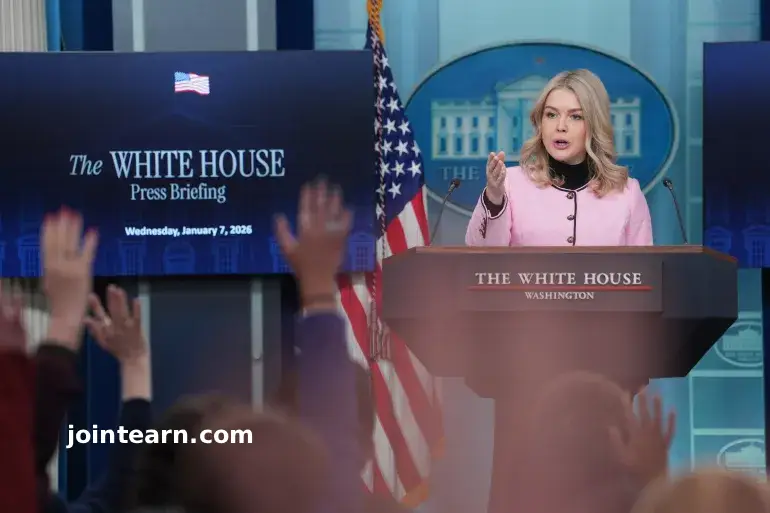
The Trump administration has confirmed its intent to dictate policy to Venezuela’s interim government following the high-profile abduction of President Nicolás Maduro and his wife, Cilia Flores, over the weekend. US officials, including Vice President JD Vance and White House Press Secretary Karoline Leavitt, emphasized that Washington will control Venezuela’s key economic and energy resources to influence governance.
US Military Operation and Maduro Abduction
In a daring pre-dawn operation on Saturday, US forces abducted Venezuelan President Nicolás Maduro and his wife, transporting them to New York City to face charges of overseeing the shipment of “tons of cocaine into the United States.” The White House described the operation as a law enforcement mission, but the international community widely condemned it as a violation of Venezuelan sovereignty.
President Trump, speaking from his Mar-a-Lago residence in Palm Beach, Florida, asserted that the US would effectively “run the country” until a safe and orderly transition could occur. “We’re going to run the country until such time as we can do a safe, proper and judicious transition,” Trump said, framing the move as part of his broader “peace through strength” foreign policy.
Control Over Venezuela’s Resources
Vice President JD Vance clarified in an interview with Fox News that the US intends to exercise strict oversight over Venezuela’s oil and financial resources. “The way that we control Venezuela is we control the purse strings, we control the energy resources, and we tell the regime, ‘You’re allowed to sell the oil, so long as you serve America’s national interest,’” Vance explained.
Trump himself confirmed on social media that 30 to 50 million barrels of Venezuelan oil would be surrendered to the United States for international sale. He stated that revenue from the oil would be controlled by him as US president to “benefit the people of Venezuela and the United States.”
Interim Government and Delcy Rodriguez
Following Maduro’s removal, Delcy Rodriguez, Maduro’s former vice president, was sworn in as interim leader of Venezuela. The Trump administration has publicly framed Rodriguez’s government as cooperative and subject to US influence. Leavitt emphasized, “We obviously have maximum leverage over the interim authorities in Venezuela right now.”
Rodriguez, however, has rejected claims that Venezuela is being controlled by foreign powers. “The government of Venezuela is in charge in our country, and no one else. There is no foreign agent governing Venezuela,” she stated in a televised address, seeking to assert independence despite US oversight.
Human Rights Concerns
Since the operation, Venezuelan authorities have enforced emergency measures to maintain order, including arrests of individuals celebrating Maduro’s abduction. Human rights organizations, including Foro Penal and Caleidoscopio Humano, reported arrests of journalists and civilians, highlighting ongoing concerns over freedom of expression and civil liberties.
International bodies, including the United Nations, have condemned the US actions as an “international crime of aggression,” warning that the operation violates fundamental principles of sovereignty and risks destabilizing the region.
Legacy of Chavismo and Oil Nationalization
Rodriguez continues policies rooted in the Chavismo movement founded by the late President Hugo Chávez. Under Chávez, Venezuela nationalized significant oil reserves and asserted state control over petroleum resources, a move now framed by the Trump administration as a challenge to US interests.
While Rodriguez has maintained a conciliatory approach toward Washington, she continues to engage with Venezuela’s traditional allies, including Russia, China, Cuba, and Iran—a stance reportedly under scrutiny by the US.
Conclusion
The Trump administration’s actions in Venezuela represent a dramatic assertion of US influence over a foreign nation, combining military force, economic leverage, and control over energy resources. While officials portray the approach as necessary for regional stability and anti-drug enforcement, critics warn of violations of international law, human rights abuses, and destabilization across Latin America.
The situation remains fluid, with the interim government of Venezuela asserting its authority even as the United States consolidates control over the country’s economic and strategic assets. The coming months will be critical in determining whether the US can maintain influence without triggering broader geopolitical repercussions.


Leave a Reply