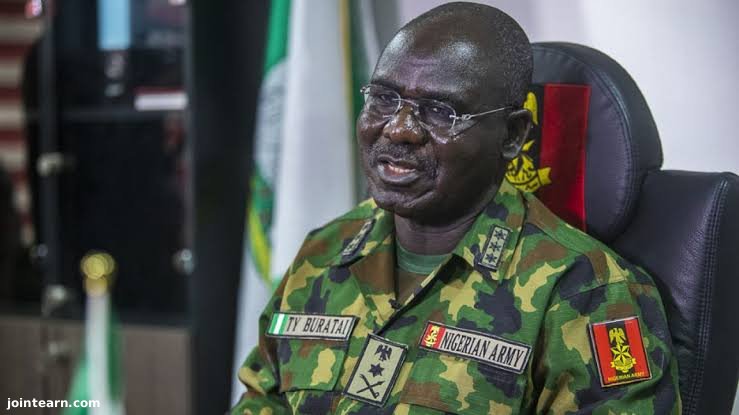
Former Chief of Army Staff, Lieutenant General Tukur Buratai (rtd), has called for a strengthened and well-equipped Nigeria Police Force capable of taking full responsibility for internal security, reducing the country’s reliance on the military for routine policing duties.
Buratai made the remarks during the National Symposium/Lecture Series commemorating the 2026 Armed Forces Celebration and Remembrance Day (AFCRD) in Abuja, where he delivered a lecture titled “Securing Nigeria’s Future: The Armed Forces and National Development.”
He recommended professionalising the police under a multi-year funding plan to achieve a force of approximately 1.5 million officers, ensuring they can independently manage domestic security responsibilities.
The former COAS also advocated comprehensive reforms in Nigeria’s security and governance architecture, repositioning the armed forces to focus on high-intensity combat and external defence while serving as a catalyst for national development.
Among his policy proposals, Buratai recommended the establishment of a National Defence Innovation Fund (NDIF) to support research and development in dual-use technologies—such as cyber defence, unmanned aerial systems, satellite communications, and renewable energy solutions for forward operating bases—through public-private partnerships. He emphasized that defence spending should also drive innovation in the civilian technology sector.
On human capital, Buratai proposed a revised National Service and Veterans’ Framework, transforming the NYSC into a mandatory national service program with military and civic tracks to promote skills acquisition, national cohesion, and post-service employment opportunities. He also called for a Veterans’ Rights and Transition Act to guarantee pensions, healthcare access, skills conversion, and legal protections for retired personnel.
Buratai further recommended institutionalising permanent civil-military cooperation (CIMIC) directorates within the Ministry of Defence and service headquarters to ensure structured collaboration with civilian ministries in post-conflict development while preventing mission creep by the military.
On regional security, he stressed the importance of multilateral cooperation through initiatives such as the Multinational Joint Task Force and the Gulf of Guinea maritime security framework, noting that collective action is vital in addressing transnational threats and fostering regional stability.
He concluded that a balanced approach to defence reform, internal security restructuring, and regional cooperation would enable Nigeria to optimise resources, strengthen national unity, and secure a prosperous future.
Earlier, Minister of Defence General Christopher Musa (rtd) reaffirmed the Federal Government’s commitment to building a professional and resilient armed forces, highlighting ongoing efforts in troop welfare, enhanced training, doctrinal refinement, and expansion of indigenous defence production to ensure sustainable long-term security capabilities. Musa also noted that policy and legislative reforms are revitalising local defence industries, encouraging private sector participation, creating jobs, and reducing dependence on foreign suppliers.


Leave a Reply