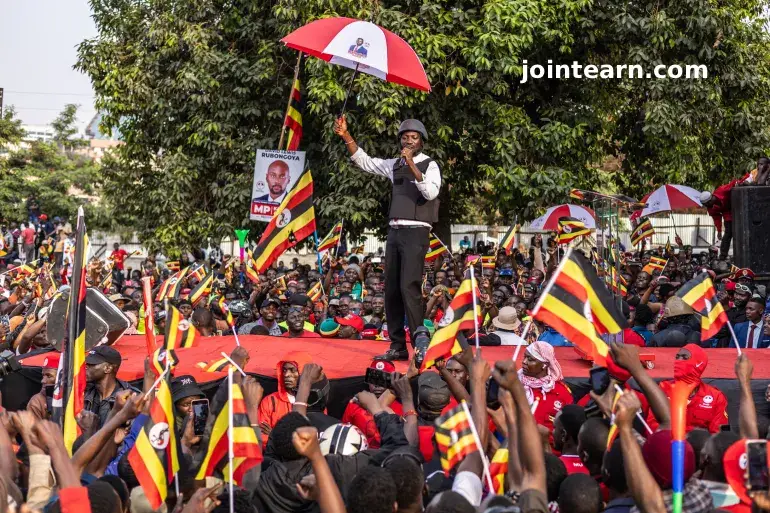
Kampala, Uganda – As Uganda prepares for its 2026 presidential election, the spotlight is firmly on Bobi Wine, the singer-turned-politician whose real name is Robert Kyagulanyi Ssentamu. Wine, the main opposition candidate seeking to unseat long-serving President Yoweri Museveni, has been navigating a campaign marked by escalating state repression, intimidation, and widespread concern over the fairness of the electoral process.
From Hopeful Campaigner to Symbol of Resistance
When Bobi Wine launched his presidential campaign in October 2025, he appeared in tailored suits and greeted supporters with his signature smile, projecting an image of hope and optimism. By December, however, the scene had shifted dramatically. Wine now makes public appearances in a bulletproof vest and helmet, a stark symbol of the security threats and state-sponsored violence that have accompanied his campaign.
Since being cleared to run in September, Wine’s campaign convoy has faced tear gas, roadblocks, and arrests of supporters. Many rallies were disrupted, and roads leading to campaign events were frequently sealed off, creating a climate of fear. Although the violence has not reached the deadly levels seen during the 2021 election—when over 50 people died and hundreds of his supporters were detained—analysts describe the current repression as more calculated and controlled.
Bobi Wine, 43, is contesting for a second time, having finished as the runner-up in the 2021 elections, which he claimed were marred by fraud. Museveni, now 81, has been in power since 1986 following a rebel war and is seeking his seventh term in office. Alongside Wine, five other candidates are contesting in an election with 21.6 million registered voters.
Escalating Violence and Political Intimidation
A major source of concern has been the involvement of Museveni’s son, Muhoozi Kainerugaba, the army chief, who has publicly threatened Bobi Wine, including remarks about beheading him. Kainerugaba has claimed responsibility for the abduction and torture of Wine’s bodyguard, Edward Ssebuufu, who remains in detention.
Security forces and plainclothes operatives have attacked Wine and his team at campaign stops. In December, during a rally in Gulu, northern Uganda, Wine was physically assaulted, and campaign equipment was vandalized, resulting in one death. In November, police arrested 43 supporters during a campaign event in Mbarara, western Uganda.
Political analysts say the difference between the current election and previous ones lies in the strategic approach of state repression. “In 2021, violence was less calculated. Now, it is planned and systematic,” says Michael Mutyaba, a political analyst and doctoral researcher at SOAS University of London. Random arrests, like that of a Catholic priest on money laundering charges, illustrate this calculated approach.
Electoral Manipulation and Candidate Suppression
Beyond violence, Wine has faced political manipulation targeting candidates sponsored by his party, the National Unity Platform (NUP). Several parliamentary candidates withdrew, publicly denounced Wine, and joined the governing party—a move Wine claims involved bribery. Additionally, the Electoral Commission has disqualified opposition-backed candidates, citing alleged nomination violations, which critics argue is a tactic to prevent competition.
Months before the campaign season, Museveni also engaged in “vote-buying” initiatives, distributing cash and gifts to informal sector workers in central Uganda, including motorcycle taxi operators, street vendors, and salon owners. Analysts describe this as electoral corruption designed to sway voters in key opposition strongholds.
Preparing for Election Day: “Protect the Vote”
As the election approaches on Thursday, Bobi Wine has warned supporters of potential state attempts to arrest him or abduct election organizers. He has advised them to disable phone location services, avoid predictable routes, and remain vigilant around unfamiliar vehicles—particularly Toyota Hiace vans commonly linked to state abductions.
Wine has urged voters to “protect the vote” by remaining near polling stations after casting ballots, even though Ugandan law requires voters to stay at least 20 metres away. The Electoral Commission has framed this as a safety issue, warning that crowds could provoke unrest.
Public Desire for Peace Amid Tension
Despite the tense political climate, ordinary Ugandans express a desire for peaceful elections. Wanyama Isaac, a construction worker and Wine supporter in Kampala, said: “Violence helps no one. Both sides must remain calm.” Mashabe Alex, a Museveni supporter and boda boda rider, echoed this sentiment, emphasizing that political unrest harms businesses and livelihoods.
What Happens Next?
Bobi Wine’s post-election strategy remains undisclosed. Analysts predict that, regardless of the vote, Museveni may attempt to contain opposition activity through house arrests or other measures, as seen in previous elections. Political observers suggest the NUP’s focus may not be solely on unseating Museveni but also on consolidating parliamentary positions and sustaining people-power momentum for future political influence.
Uganda’s 2026 election underscores the challenges faced by opposition candidates under long-term incumbency, with state resources, intimidation, and electoral manipulation creating a difficult environment for fair competition. The outcome will likely shape Uganda’s political landscape for years to come.


Leave a Reply