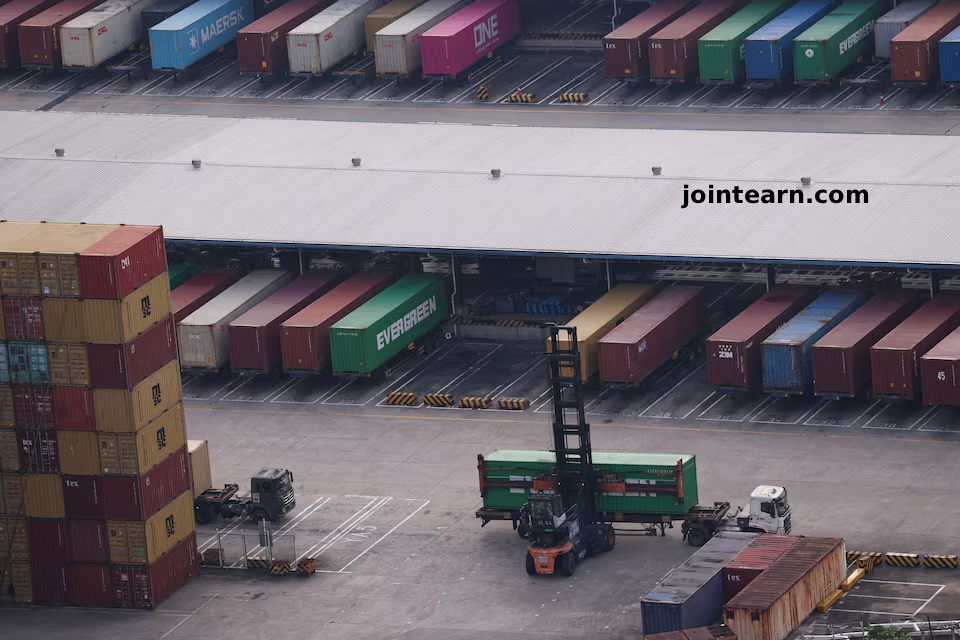
China closed 2025 with a record trade surplus of $1.189 trillion, driven by strong exports to non-U.S. markets as policymakers pushed firms to diversify globally. The robust trade performance highlights China’s ability to weather sustained pressure from U.S. tariffs under the Trump administration while scaling its presence in Southeast Asia, Africa, Latin America, and Europe.
Record Trade Surplus Amid Global Diversification
The surplus, which exceeded $100 billion in seven months of 2025, underscores China’s success in shifting focus from the U.S. market, where exports fell 20% in dollar terms, to emerging and alternative markets:
- Africa: Exports jumped 25.8%
- ASEAN nations: Exports rose 13.4%
- European Union: Exports grew 8.4%
Vice Minister Wang Jun of China’s Customs Administration stated that the country’s ability to withstand economic risks has been significantly enhanced thanks to this diversification strategy.
Exports to the U.S. declined due to tariffs, while imports from the U.S. dropped 14.6%. However, China offset these losses with booming sales elsewhere, maintaining its position as a global manufacturing powerhouse.
Monthly Export and Import Growth
- December 2025 exports: Up 6.6% year-on-year, surpassing forecasts of 3.0%
- December 2025 imports: Up 5.7%, above the 0.9% expected increase
Economists note that strong export growth has cushioned weak domestic demand, with Chinese manufacturers leveraging productivity gains, technological sophistication, and excess production capacity to maintain competitiveness, according to Fred Neumann, HSBC’s chief Asia economist.
Rare-Earth and Technology Exports
China’s rare-earth exports surged to the highest levels since 2014, even as Beijing restricted shipments of certain medium- and heavy-element materials from April. Analysts viewed this as a strategic move to signal leverage over the U.S. amid ongoing negotiations on soybean purchases, potential Boeing deals, and the fate of TikTok’s U.S. operations.
Additionally, China purchased record volumes of soybeans from South America, avoiding U.S. crops for much of the year due to trade tensions.
Yuan Stability and Market Reaction
Following the strong trade data, the Chinese yuan held steady, and equities reacted positively:
- Shanghai Composite (.SSEC) rose more than 1% in morning trading
- CSI 300 blue-chip index (.CSI300) also increased over 1%
These gains reflect investor confidence in China’s ability to mitigate domestic economic weaknesses through export-led growth and maintain stability despite external pressures.
Ongoing U.S.-China Trade Tensions
While China has successfully navigated U.S. tariffs, the Trump administration remains a potential challenge. Analysts note that:
- Threats of additional 25% tariffs on countries trading with Iran could reopen tensions with Beijing
- The U.S. Supreme Court may soon rule on the legality of President Trump’s earlier tariffs
China has also started to moderate industrial largesse, such as scrapping export tax rebates for the solar sector, to address EU concerns and reduce friction with trade partners.
Strategic Outlook for 2026
Economists predict that China will continue gaining global market share in 2026 by:
- Establishing overseas production hubs for lower-tariff access to the U.S. and EU
- Leveraging strong demand for lower-grade chips, electronics, and industrial goods
- Sustaining export growth even amidst trade tensions
Zhiwei Zhang, chief economist at Pinpoint Asset Management, noted:
“Strong export growth helps to mitigate weak domestic demand. Combined with the booming stock market and stable U.S.-China relations, the government is likely to maintain its macro policy stance at least through Q1.”
Conclusion
China’s record $1.2 trillion trade surplus in 2025 highlights the resilience and global competitiveness of its economy. Despite U.S. tariffs and geopolitical frictions, the country has successfully diversified exports, strengthened global trade ties, and maintained economic stability. As 2026 unfolds, markets will continue to monitor China’s export strategies, U.S.-China trade negotiations, and domestic demand conditions.


Leave a Reply