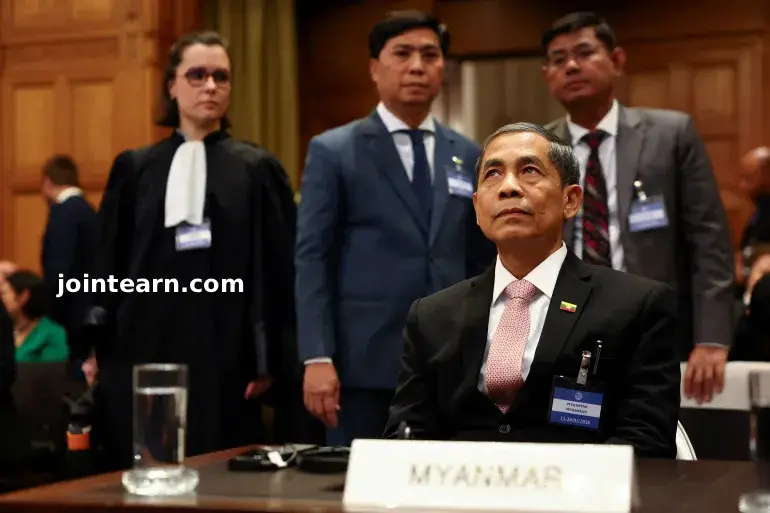
Myanmar’s military government has strongly rejected allegations that it committed genocide against the Rohingya minority, calling the case “flawed and unfounded” as the International Court of Justice (ICJ) begins hearings in The Hague, Netherlands.
The case, brought by The Gambia in 2019, accuses Myanmar of orchestrating a military offensive in 2017 that forced hundreds of thousands of Rohingya Muslims from their homes, many fleeing to neighboring Bangladesh. Survivors have recounted mass killings, sexual violence, and widespread destruction of villages.
Myanmar’s Statement on the ICJ Proceedings
In a statement published on Wednesday, Myanmar’s Ministry of Foreign Affairs dismissed the allegations as based on “biased reports” and “unreliable evidence,” insisting that these claims cannot replace the truth.
“The allegations made by The Gambia are flawed and unfounded in fact and law,” the statement said, emphasizing that Myanmar is cooperating with the ICJ “in good faith” as a sign of respect for international law.
Notably, the statement avoided direct mention of the Rohingya, instead referring to the group as “persons from Rakhine state.” Myanmar does not recognize the Rohingya as a legal ethnic minority and denies them citizenship, despite many having lived in the country for generations.
Background: The Rohingya Crisis
The 2017 military crackdown in Myanmar’s Rakhine State displaced approximately 750,000 Rohingya, who fled to overcrowded refugee camps in Cox’s Bazar, Bangladesh. Today, about 1.17 million Rohingya remain in the camps, facing dire conditions, limited access to education, healthcare shortages, and ongoing humanitarian challenges.
The United Nations described the offensive as a “textbook example of ethnic cleansing,” and a UN fact-finding mission concluded that the military’s actions included genocidal acts. Myanmar, however, insists the military campaign was a legitimate counterterrorism operation in response to attacks by Rohingya armed groups.
On the opening day of the trial, Gambian Justice Minister Dawda Jallow told the court that the Rohingya “have been targeted for destruction,” underscoring the international gravity of the case. Myanmar’s legal team is scheduled to respond formally on Friday.
International Implications
This trial marks the first full genocide case the ICJ has taken on in over a decade, and its outcome may set a precedent for other global cases, including South Africa’s petition against Israel over alleged genocidal actions in Gaza.
While the ICJ cannot directly enforce rulings, a decision in favor of The Gambia could increase political and diplomatic pressure on Myanmar, impacting its international relations and potentially influencing the treatment of Rohingya refugees.
Myanmar’s Current Political Landscape
Myanmar is currently conducting phased national elections, which have been criticized by the United Nations, Western governments, and human rights organizations for being neither free nor fair. Observers suggest that the ICJ case, combined with ongoing scrutiny of electoral processes, may compound international pressure on the country’s military rulers.
Looking Ahead
A final ruling in the Rohingya genocide case could take months or even years. Analysts say that regardless of the ICJ’s decision, the proceedings highlight the ongoing global concern over human rights abuses in Myanmar, the plight of the Rohingya, and the broader implications for international justice and accountability.
“While enforcement is limited, the ICJ case shines a critical spotlight on one of the most severe humanitarian crises of the 21st century,” experts say.


Leave a Reply