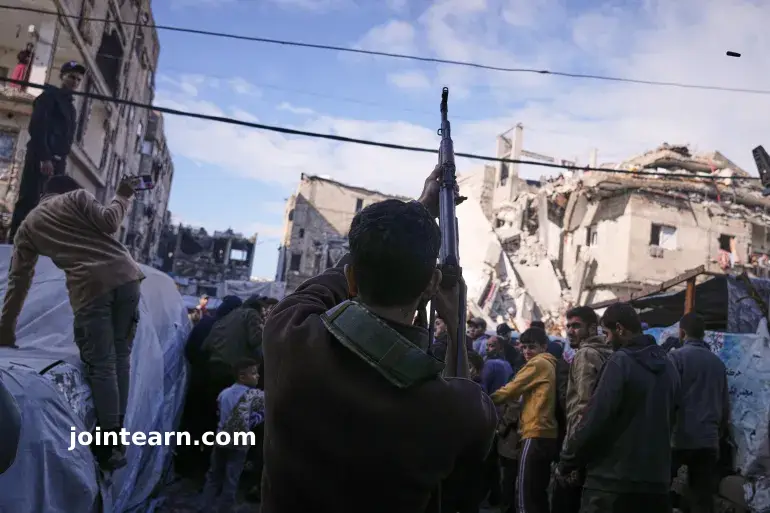
Gaza/US – President Donald Trump has issued a stern ultimatum to Hamas, demanding the group fully disarm as the second phase of the US-brokered ceasefire deal with Israel begins. The move comes amid ongoing tensions over Israel’s incomplete withdrawal from Gaza and the slow delivery of humanitarian aid to the enclave.
Trump Issues “Easy Way or Hard Way” Warning
Late on Thursday, Trump took to Truth Social to stress that Hamas must comply with the ceasefire terms or face consequences:
“Hamas must IMMEDIATELY honor its commitments, including the return of the final body to Israel, and proceed without delay to full Demilitarization. As I have said before, they can do this the easy way, or the hard way.”
The US has repeatedly stated that Hamas is expected to fulfill obligations from phase one of the ceasefire, including the return of the body of the last deceased Israeli captive, Ran Gvili.
Phase two is explicitly focused on Hamas disarmament, including the dismantling of its network of tunnels and weapons, with support from regional actors such as Egypt, Turkey, and Qatar.
Phase Two Ceasefire Framework
Under the second phase of the ceasefire, announced by US special envoy Steve Witkoff, Gaza is set to be governed by a 15-member Palestinian technocratic committee, operating under a supervisory Board of Peace chaired by Trump.
Trump reiterated his backing of a new Palestinian Technocratic Government in Gaza, claiming that the leaders involved are committed to a “PEACEFUL future.”
“These Palestinian leaders are unwaveringly committed to a PEACEFUL future!” he wrote.
However, key elements of the deal remain unresolved. Most notably, Israel has yet to implement its withdrawal obligations and continues to control borders and access points into Gaza.
Humanitarian Crisis Persists
Despite claims from the US administration that the ceasefire has enabled “record levels” of aid into Gaza, humanitarian agencies report insufficient assistance, with shortages of food, clean water, medicine, and fuel continuing to affect the population.
Israel has reportedly suspended permits for over three dozen aid organizations, restricting the flow of critical supplies. The International Court of Justice (ICJ) has emphasized that Israel is obliged to ensure the basic needs of Gaza’s residents are met.
UN officials warn that the relief delivered under phase one is far below the level needed to prevent a humanitarian disaster and localized famine in the enclave.
Obstacles to Hamas Demilitarization
Hamas has refused to disarm while Israel maintains military control over parts of Gaza. Analysts note that dismantling Hamas’s arsenal and tunnel networks will be complex, given the group’s entrenched presence and regional support.
Trump’s plan relies heavily on cooperation from Egypt, Turkey, and Qatar, but practical steps and timelines for enforcement remain unclear.
For Palestinians, the central concern continues to be Israel’s full military withdrawal from Gaza – a commitment included in the ceasefire framework but lacking a detailed timetable.
Regional and International Implications
The new US push for Hamas disarmament signals a heightened diplomatic and military pressure campaign on the Palestinian group.
- The ceasefire framework also emphasizes technocratic governance and international oversight in Gaza.
- Failure by Israel to meet its obligations could undermine the fragile ceasefire.
- Continued humanitarian shortages risk escalating tension and unrest in the region.


Leave a Reply