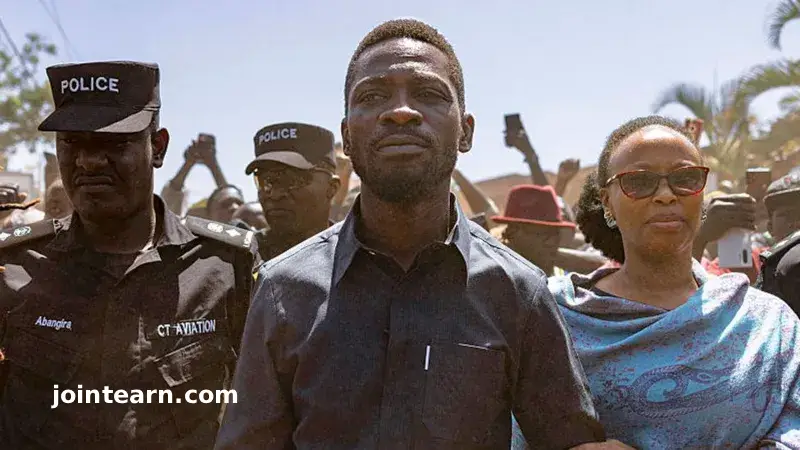
Ugandan authorities have denied allegations that presidential candidate Bobi Wine was abducted from his home in the capital, Kampala, as the country’s vote counting continues under a widespread internet blackout. The denial comes amid rising tensions following Thursday’s election, which saw President Yoweri Museveni seeking a seventh term in office.
Conflicting Reports About Bobi Wine’s Whereabouts
The opposition National Unity Platform (NUP) party reported that a helicopter landed at Wine’s residence on Friday evening and forcibly transported him to an unknown location. Initially, Wine’s son, Solomon Kampala, claimed both his parents had been seized. Later, he posted that his father had “escaped,” while his mother remained under house arrest, creating confusion over Wine’s actual location.
Police spokesman Kituuma Rusoke addressed the reports at a press briefing on Saturday morning, stating that Wine was still at his home in Kampala. He dismissed the abduction claims as “untrue” and “unfounded,” attributing the conflicting information to family members spreading inaccurate updates.
Wine’s movements have reportedly been restricted due to his home being a security-sensitive area. Rusoke told the Daily Monitor:
“We have controlled access to areas which are security hotspots. We cannot allow people to use some places to gather and cause chaos. All our actions are intended to prevent anybody from creating violence or destabilising our security.”
Election Results and Opposition Concerns
Early electoral returns show President Museveni leading with 72% of the vote, while Bobi Wine trails at 24%, based on 94% of polling stations reporting. Wine and the NUP have rejected the preliminary results, calling them fraudulent, though no evidence has been provided to support these claims.
During the campaign, Wine urged supporters to ignore what he described as “fake results” and alleged that authorities were “stealing the vote.” Security forces have faced accusations of suppressing opposition activity, with reports of assaults, detentions, and restricted movement for Wine’s supporters.
Violence and Internet Blackout
The election period has been marred by violence and logistical issues. Voting was delayed in some areas by up to four hours due to slow delivery of ballot boxes and malfunctioning biometric voter verification machines.
Amid these disruptions, Uganda has experienced a nationwide internet blackout, imposed on Tuesday by the Communications Commission to prevent the spread of misinformation, election fraud, and incitement of violence. The UN human rights office condemned the blackout as “deeply worrying”, highlighting concerns over transparency and civil liberties.
Reports of at least seven opposition supporters being killed in Butambala, roughly 55 km southwest of Kampala, emerged on Friday. The U.S. embassy issued an alert to its citizens, citing instances of tear gas and live rounds fired by security forces to disperse gatherings.
Bobi Wine: Pop Star Turned Opposition Leader
Bobi Wine, 43, is a former musician who has positioned himself as a voice for Uganda’s youth, a population largely under 30. His campaign platform emphasizes anti-corruption measures, government reforms, and increased opportunities for young Ugandans.
Museveni, 81, has ruled Uganda since 1986 after rising as a rebel leader and argues that he is the sole guarantor of national stability and progress. While six other candidates contested the election, the race was largely framed as a two-horse contest between Museveni and Wine.
International Concerns and Human Rights
Police have downplayed claims of harassment and intimidation of opposition supporters, asserting that any unrest was instigated by the opposition. Meanwhile, the internet blackout has hindered independent verification of events, leading to confusion and widespread speculation about the conduct of both government forces and opposition leaders.
The contested election, combined with allegations of abductions, house arrests, and violent crackdowns, has drawn international attention. Observers are closely monitoring the situation for signs of post-election unrest, potential human rights violations, and the final certification of results by Uganda’s electoral authorities.
Next Steps
Electoral chief Simon Byabakama stated that vote counting had not been affected by the internet blackout and promised that final results would be announced by Saturday, 17:00 local time (14:00 GMT).
Meanwhile, the political atmosphere in Uganda remains tense. Opposition supporters continue to question the credibility of the electoral process, while the government emphasizes security concerns and maintaining order in the capital.


Leave a Reply