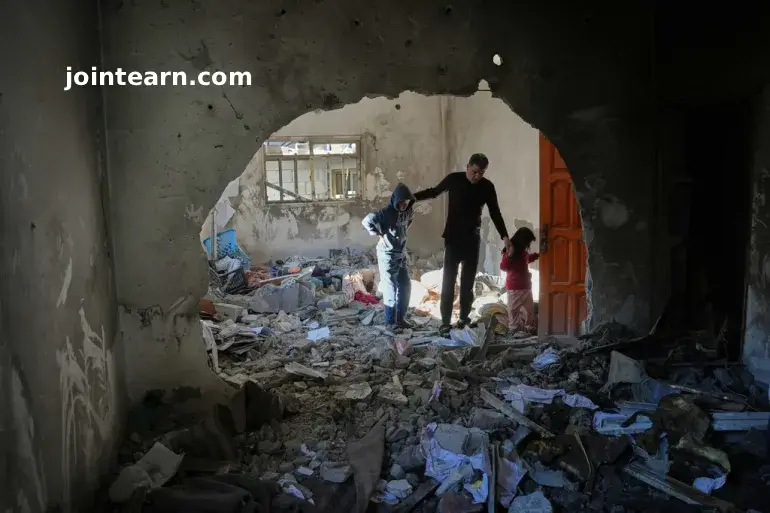
Israeli attacks have killed at least three Palestinians in Gaza amid a fragile ceasefire, just as a Palestinian technocratic committee convened in Cairo to oversee the second phase of former U.S. President Donald Trump’s Gaza peace plan. Civilians in the besieged territory continue to face severe shortages of food, shelter, and safety, raising doubts over the plan’s immediate impact on the ground.
Palestinian Casualties Amid Ceasefire
On Friday, Israeli military operations resulted in the deaths of:
- A 10-year-old girl in Beit Lahiya, killed by a drone strike.
- A 16-year-old boy, Mohammad Raed al-Barawi, shot in the head by Israeli forces in northern Gaza.
- A 62-year-old woman, Sabah Ahmed Ali Abu Jamea, killed during demolition operations near Khan Younis.
In total, at least 15 Palestinians were killed in Gaza in the 24 hours preceding Friday afternoon, including six in airstrikes on the homes of the al-Hawli and al-Jarou families in Deir el-Balah. Among the casualties was a 16-year-old. Israel reported the killing of Muhammad al-Hawli, a commander in the Hamas-affiliated Qassam Brigades, describing the strikes as targeting “several terrorists across the Gaza Strip.”
Since the ceasefire came into effect on October 10, 2025, Gaza authorities report 463 Palestinian deaths, while Israel reports three soldiers killed over the same period.
Technocratic Committee Convenes in Cairo
As violence continued, the newly formed National Committee for the Administration of Gaza (NCAG) met for the first time in Cairo to prepare for the second phase of Trump’s multi-stage peace initiative.
Ali Shaath, an engineer and former deputy minister in the Palestinian Authority (PA), leads the committee. He expressed cautious optimism, telling Egypt’s state news agency Al-Qahera News:
“The Palestinian people were looking forward to this committee, its establishment, and its work to rescue them.”
The committee is designed to run day-to-day governance in Gaza under the oversight of the Trump-led Board of Peace, chaired by Bulgarian diplomat Nickolay Mladenov, the High Representative for Gaza.
Shaath has projected that reconstruction and recovery could take around three years, although UN agencies suggest it may take seven years to clear the rubble completely, assuming uninterrupted supplies of fuel and heavy machinery—conditions far from guaranteed amid continued Israeli occupation of over 50% of the strip.
Unclear Prospects for Phase Two
Despite the committee’s launch, key elements of Trump’s plan remain uncertain, including:
- The timing and extent of Israeli withdrawal from Gaza.
- The disarmament of Hamas, a central requirement that the group has so far refused to meet.
Nevertheless, Hamas signaled conditional support, calling the formation of the technocratic committee “a step in the right direction” and indicating readiness to transfer administrative responsibilities. Analysts note that this appears to temporarily ease tensions between Hamas and the PA.
Sultan Barakat, professor of public policy at Hamad Bin Khalifa University, told Al Jazeera that Hamas’s approval “papered over” longstanding disputes with the PA, allowing the committee to operate.
Palestinian Civilians Remain Skeptical
For ordinary Palestinians, political developments offer little immediate relief. Al Jazeera correspondent Tareq Abu Azzoum reported from Gaza City that residents, many of whom live in flimsy shelters during harsh winter conditions, feel disconnected from the plan:
“For most people here, the promises about phase two of the ceasefire agreement feel distant and abstract, while food, shelter, water, and safety remain urgent concerns.”
The ongoing strikes, destruction of homes, and delayed reconstruction highlight the huge gap between political initiatives and tangible humanitarian outcomes for Gaza’s population.
Context: Trump’s Multi-Phase Gaza Peace Plan
Phase two of the plan emphasizes:
- Technocratic governance through the NCAG.
- Reconstruction and recovery of war-torn infrastructure.
- Oversight by the international Board of Peace, which includes figures such as Tony Blair, Jared Kushner, and other high-profile diplomats and officials.
The plan continues to face criticism for being remote from the daily realities of Palestinians, as Israeli military operations persist despite the ceasefire and international oversight.
Key Takeaways
- At least three Palestinians were killed in Gaza amid Israeli military operations during the launch of Trump’s plan’s second phase.
- The NCAG met in Cairo to coordinate governance under international supervision.
- Reconstruction is projected to take 3–7 years, depending on uninterrupted aid and equipment access.
- Hamas continues to resist disarmament, although it appears willing to temporarily cooperate administratively.
- Palestinians remain skeptical, focusing on immediate humanitarian needs over political agreements.


Leave a Reply