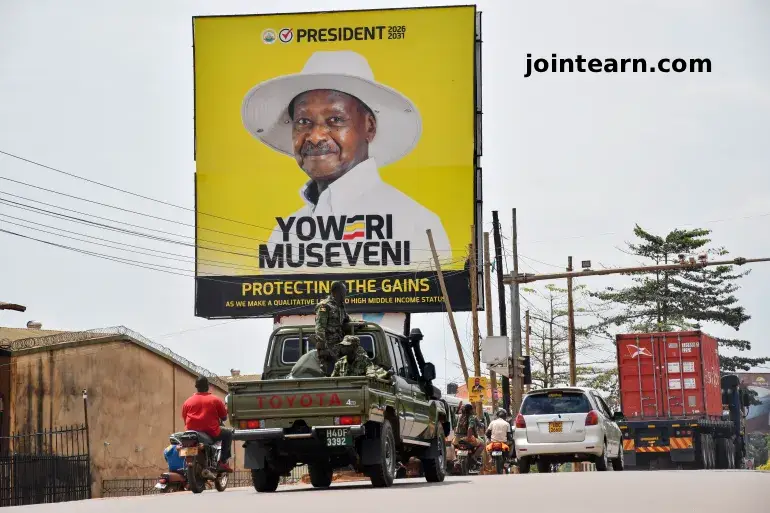
Uganda’s long-serving president Yoweri Museveni has been declared the winner of the country’s presidential election, securing a seventh term in office, according to the Electoral Commission. The announcement extends Museveni’s rule to more than four decades, cementing his status as one of Africa’s longest-serving leaders.
The Electoral Commission said on Saturday that Museveni, 81, won 71.65 percent of the vote, defeating his main challenger, opposition leader Bobi Wine, who garnered 24.72 percent.
Museveni Extends 40-Year Rule After Contentious Election
Museveni’s re-election was widely anticipated, but the campaign and voting period were marked by controversy, heavy security deployment, and allegations of repression.
The president has been in power since 1986, when he seized control after a guerrilla war. Over the decades, he has consolidated authority through constitutional changes, including the removal of presidential term limits and age limits, enabling him to run again despite being over 80.
Ahead of the vote, Museveni had predicted a landslide victory of around 80 percent, a figure close to the final tally announced by electoral authorities.
Bobi Wine Rejects Results, Alleges Irregularities
Bobi Wine, 43, a popular singer-turned-politician whose real name is Robert Kyagulanyi, rejected the outcome of the election, calling it fraudulent.
On Election Day, Wine alleged “massive ballot stuffing” and irregularities across the country. He later claimed that security forces raided his home, forcing him to flee.
“Currently, I am not at home, although my wife and other family members remain under house arrest,” Wine said in a social media post. “I know that these criminals are looking for me everywhere, and I am trying my best to keep safe.”
The military and police have denied abducting Wine, though opposition figures insist security forces have targeted party leaders and supporters since voting concluded.
Internet Blackout and Security Crackdown Raise Concerns
Thursday’s election took place amid a nationwide internet blackout, a move that drew sharp criticism from civil society groups, opposition leaders, and international observers.
The shutdown limited communication, restricted access to information, and complicated independent monitoring of the vote count. Critics said the blackout contributed to fear and uncertainty, particularly in urban areas such as the capital, Kampala.
Security forces were deployed heavily across the country both before and after the election, with police checkpoints and patrols increasing as results were announced.
International Observers Cite Intimidation and Arrests
Election observer missions said they found no conclusive evidence of large-scale ballot stuffing, but raised serious concerns about the broader political environment.
Former Nigerian President Goodluck Jonathan, leading observers from the African Union and regional bodies, said the election was affected by:
- Reports of intimidation
- Arrests and abductions of opposition members
- Restrictions on civil society activity
“These actions instilled fear and eroded public trust in the electoral process,” Jonathan said.
He added that the internet blackout “disrupted effective observation” and increased suspicion surrounding the results, even though Election Day itself was largely calm in many areas.
Deadly Clashes Reported After Voting
Despite official assurances of order, violence was reported in parts of the country following the vote.
Opposition groups said at least 10 people were killed by police during an operation at the home of an opposition lawmaker in Butambala, southwest of Kampala. Local authorities disputed the figure, saying seven people died, and accused opposition supporters armed with machetes of attacking a police station and a vote-counting centre.
Throughout the campaign, Bobi Wine’s rallies were repeatedly disrupted by security forces using tear gas and live ammunition. At least one person was killed during campaign-related unrest, and hundreds of opposition supporters were arrested, according to rights groups.
Museveni’s Dominance Over State Institutions
Analysts note that Museveni’s victory was widely seen as inevitable due to his control over state institutions, the military, and police.
His ruling National Resistance Movement (NRM) also appeared on track to secure a large parliamentary majority, according to provisional legislative results, further strengthening the president’s grip on power.
Critics argue that Uganda’s political space has steadily narrowed, while supporters say Museveni has delivered stability in a region long plagued by conflict.
What Comes Next for Uganda?
Museveni’s new term comes amid:
- A young and rapidly growing population
- High unemployment and economic pressures
- Rising demands for political reform
Opposition leaders say they will continue to challenge the results through legal and political channels, while the government has warned against protests it says could threaten national security.
As Uganda enters another five-year term under Museveni, questions remain over democratic governance, civil liberties, and the country’s political future.


Leave a Reply